


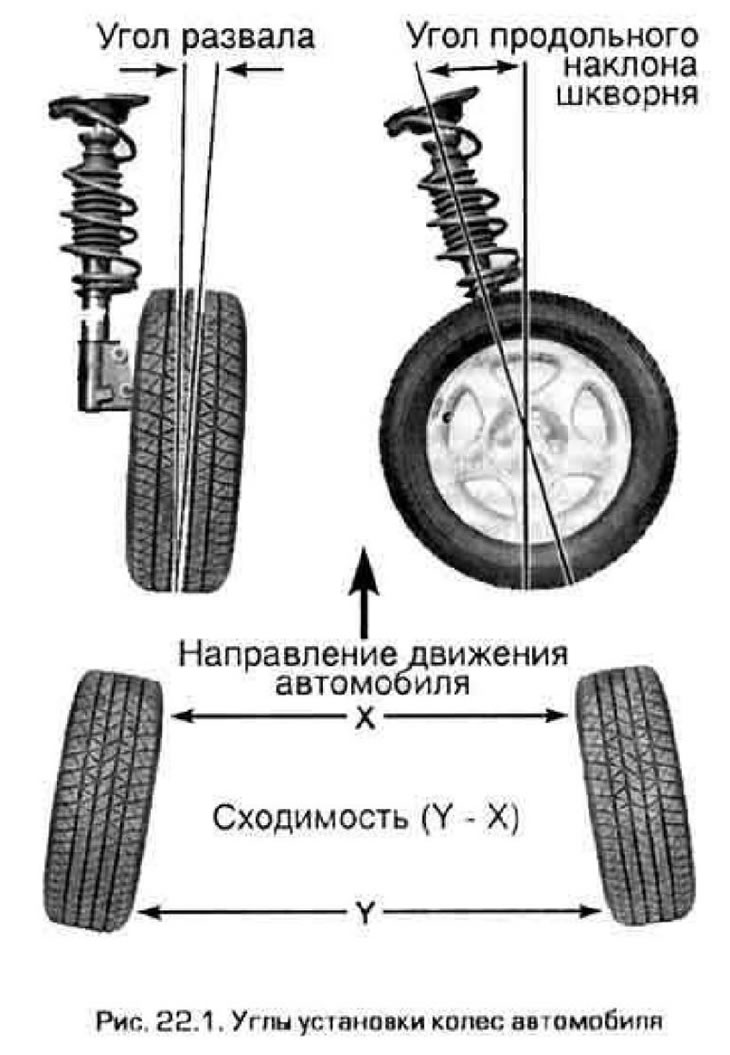
Wheel alignment is a very important process that requires special equipment. However, we provide information here that contains the basic principles of adjustment to help you better understand this process.
Toe-in is the difference in distances between the inner surfaces of the wheels, measured at the front and rear at the axle level. The purpose of this adjustment is to ensure that the front wheels are parallel when the vehicle is moving. On a vehicle with zero toe, the distances between the front and rear wheel surfaces will be equal. Typically the convergence value is a few millimeters. The toe-in of the front wheels is adjusted by rotating the steering rod ends. The toe-in of the rear wheels is adjusted by the cam device of the rear wishbones. Incorrect toe-in adjustment results in increased tire edge wear and unstable vehicle handling when driving in a straight line.
Camber is the angle at which the plane of the wheel deviates from the vertical (if you look at the wheel from the front). Positive camber is when the top edges of the wheels are further apart than the bottom edges. The camber angle is measured in degrees. This angle affects tread wear and compensates for changes in the vehicle's position on the road when turning or driving over uneven surfaces.
Kingpin inclination is the angle between the steering axis of the steering wheels and the vertical when looking at the car from the side. "Positive caster" means that the top of the steering axis is offset rearward.