
MazBook.ru
English Русский
Български
Беларускі
Український
Српски
Hrvatski
Română
Polski
Slovenský
Magyar
• Bookmark • Sitemap • Contacts •   
Cars Opel Cars Ford Cars Volkswagen Cars Audi Cars Kia Cars Renault Cars Peugeot


Familia Capella Mazda3 Mazda6 CX-? Others Articles
Mazda 121 (3) (1996-2003) Mazda BT-50 (1) (2006-2011)

Checking the end of compression stroke pressure (Mazda BT-50 (1))

  • Home
  • Mazda
  • BT-50 J97M (2006-2011)
  • General information
  • Maintenance
  • Checking the end of compression stroke pressure
0
Warning: The engine or engine oil may be hot and cause burns. Use caution when removing or installing any parts.


If the engine develops insufficient power, has increased fuel consumption, unstable idle speed, perform the following check operations:

1. Make sure the battery is fully charged. If necessary, charge the battery.

2. Warm up the engine to normal operating temperature,

3. Turn off the engine and wait 10 minutes for it to cool down.

4. Remove the engine trim panel.
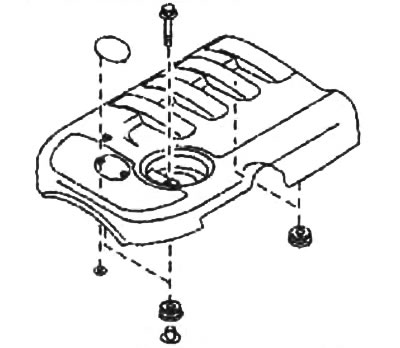
4. Remove the engine trim panel.


5. Remove the fuel accumulator (see chapter "Fuel injection system"),

6. Remove the glow plugs (see chapter "Engine electrical equipment").

7. Install the compression tester nipple into the glow plug hole.
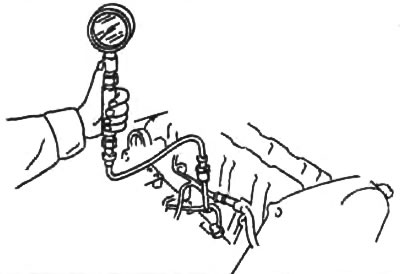
7. Install the compression tester nipple into the glow plug hole.


8. Turn the crankshaft using the starter and record the maximum value of the pressure at the end of the compression stroke.


Attention:
  • Stay clear of spark plug/glow plug holes while cranking engine with starter.
  • If during the measurement of the pressure at the end of the compression stroke in the cylinder (as a result of cracks appearing) if coolant, oil, fuel, etc. gets in, these substances will heat up and fly out of the spark plug hole under pressure, which is dangerous.


9. Perform the described check for each cylinder. Turn the crankshaft the same number of revolutions.

Compression stroke end pressure (at 200 rpm):
  • nominal - 2942 kPa
  • minimum - 2648 kPa

If the maximum pressure in one of the cylinders is low, pour a small amount of clean engine oil into the cylinder and check the pressure again.
  • If the pressure has increased, this may indicate wear of the piston, piston rings, and cylinder, and the need for repair of the cylinder-piston group.
  • If the pressure does not rise, this indicates that the valves are faulty and require repair.
  • If the pressure in two adjacent cylinders remains low, this indicates a blown cylinder head gasket or a warped cylinder head.

10. Remove the compression gauge.

11. Installation of parts is carried out in the reverse order of removal.
This article is available at: russian, bulgarian, belarusian, ukrainian, serbian, croatian, romanian, polish, slovak, hungarian
This text was checked by: Vladimir Bazhenov
Share with friends on social networks:

Previous
Mazda BT-50 (1) » Maintenance
Next

Checking the battery status
Checking and replacing the air filter
Fuel system
Cooling liquid
Engine oil and filter
Attachment drive belts
Fuel injection advance angle
Checking the idle speed
Checking thermal clearances in the valve drive
Checking the level and replacing oil in the manual transmission
More articles on repairing other Mazda models
Checking the fuel supply pressure Mazda Familia 5 (1985-1989)
Dual pressure regulating valve — checking operation, removal and… Mazda Capella 3 (1982-1992, petrol)
Checking the air pressure in the tires Mazda3 BK (2003-2009)
Checking the air pressure in the tires Mazda6 GG (2002-2008)
Checking the compression in the cylinders Mazda CX-5KE (2012-2017)
Link in different formats to this article
Comments and feedback from visitors
No comments yet


How much will 42 + 13 ?


Mazda BT-50 (1) (2006-2011) 
  • General information
  • Introduction to guide
  • User manual
  • Maintenance
  • Power unit
  • Engine repair (diesel)
  • Cooling and lubrication system
  • Fuel injection system
  • Intake and exhaust system
  • Engine electrical equipment
  • Transmission
  • Clutch
  • Mechanical gearbox
  • All-wheel drive system
  • Transfer case and gearboxes
  • Chassis
  • Front suspension
  • Rear suspension
  • Steering
  • Brake system
  • Body
  • Exterior (external elements)
  • Interior (internal elements)
  • Heating and air conditioning
  • Security system SRS
  • Electrical equipment
  • Equipment and devices
  • Electrical circuits
Mazda 121 (3) (1996-2003) 
  • General information
  • User manual
  • Maintenance
  • Power unit
  • Petrol engine 1.3 l
  • Petrol engine 1.25/1.4 l
  • Diesel engine
  • Lubrication system
  • Cooling system
  • Ignition system
  • Supply system
  • Fuel injection (gasoline)
  • Fuel injection (diesel)
  • Exhaust system
  • Transmission
  • Clutch
  • Car gearbox
  • Chassis
  • Front suspension
  • Rear suspension
  • Steering
  • Brake system
  • Wheels and tires
  • Body
  • Exterior (external elements)
  • Interior (internal elements)
  • Doors, windows and locks
  • Heating system
  • Electrical equipment
  • Troubleshooting
  • Equipment and devices
  • Lighting system
  • Power devices
  • Electrical circuits
MazBook.ru © 2018–2026 · Mobile version · Articles and news · Sitemap: EN BG BY UA RS HR RO PL SK HU · Feedback · Site search · Add to bookmarks Familia 5 (BF) · Familia 6 (BG) · Capella 3 (GC) · Capella 3 and 4 (GC) · Capella 4 (GD) · Capella 5 (GE) · Capella 6 (GF) · Mazda3 BK · Mazda6 GG · CX-5KE · Mazda 121 (3) · Mazda BT-50 (1) ·
By continuing to use the site, you agree to the use of cookies 🔐