


Contents: Engine Air Intake Temperature Sensor…⇓ Coolant temperature sensor ⇓ Atmospheric pressure sensor ⇓ Temperature sensor ⇓ Throttle angle sensor ⇓ Oxygen concentration sensor ⇓ Intake manifold pressure sensor…⇓ Power steering switch ⇓ Brake light switch ⇓ Clutch release sensor ⇓ Neutral position sensor for manual…⇓ Deceleration sensor for models with…⇓ 5th gear shift sensor ⇓ Main relay ⇓ Control unit ⇓
Engine Air Intake Temperature Sensor for 1986 and 1987 models
Remove the air filter cover. Using an ohmmeter connected to the "E2" and "TNA" contacts of the air flow meter connector, measure the resistance of the engine air temperature sensor at different temperature values and compare with the data given in the table. 15.10 (see Figure 15.24).
Table 15.10. Dependence of the resistance of the engine intake air temperature sensor on the temperature
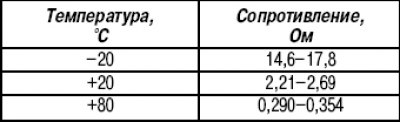
To heat the sensor, use a hair dryer; to cool it, use dry ice, placing it tightly around the sensor. If the resistance is different from the specified value, replace the air flow meter.
Coolant temperature sensor
Measure the voltage at the sensor connector contacts. To do this, remove the rubber boot from the connector, turn the ignition switch to the "ON" position, and use a voltmeter to measure the voltage, which should be approximately 0.05 V. If the voltage differs, measure the resistance of the sensor and check the wires.
To check the resistance, remove the sensor from the engine. Place the sensor in a glass container filled with water and, heating the water to boiling, measure the resistance at different temperatures. To measure resistance at low temperatures, tightly surround the sensor with dry ice. The resistance of the coolant temperature sensor depending on the temperature is given in the table. 15.11.
Table 15.11. Coolant temperature sensor resistance versus temperature
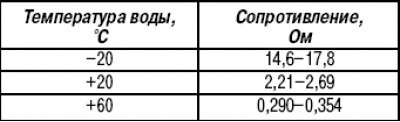
If the resistance differs from the values given in the table. 15.11, replace the sensor.
Before removing the sensor, cool the engine and drain the coolant to a level below the sensor. Disconnect the connector and unscrew the sensor from the engine. Before installation, wrap the sensor threads with Teflon tape.
Atmospheric pressure sensor
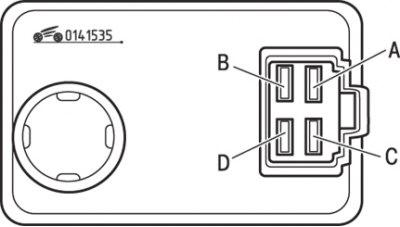
Figure 15.35. Location of atmospheric pressure sensor contacts
Remove the cap from the sensor and connect the vacuum pump. Turn the ignition switch to the "ON" position. Measure the voltage at each terminal with and without vacuum (figure 15.35). Voltage at the sensor contacts depending on the vacuum see. in table 15.12.
Table 15.12. Voltage at the contacts of the atmospheric pressure sensor depending on the vacuum
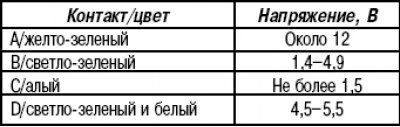
If the voltage at terminals "A", "C" or "D" differs from that shown in the table, check the wires. If the voltage at contacts "A", "C" or "D" corresponds to that shown in the table, but at contact "B" it differs, replace the sensor.
To replace the sensor, disconnect the connector, unscrew the two bolts and remove the sensor. Installation is carried out in the reverse order of removal.
Temperature sensor
Cool the engine and drain the coolant to a level below the temperature sensor. Disconnect the connector, unscrew the sensor from the radiator and measure its resistance. At temperatures above 13–19°C, the ohmmeter should show a short circuit, otherwise replace the temperature sensor.
Throttle angle sensor
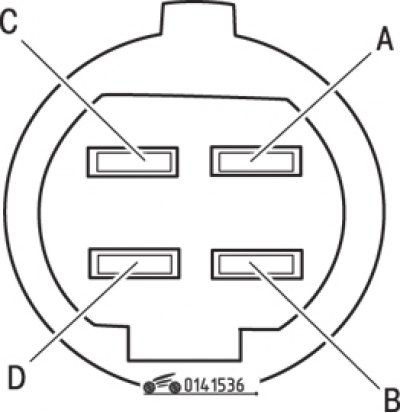
Figure 15.36. Throttle angle sensor connector pinout
Remove the rubber boot from the sensor connector and turn the ignition switch to the "ON" position. Measure the voltage between the sensor terminals and ground and record the readings (figure 15.36). Open the throttle fully and measure the voltage again. Compare the measurement results with the data given in the table. 15.13.
Table 15.13. Voltage at the contacts of the throttle angle sensor connector depending on the state of the contacts
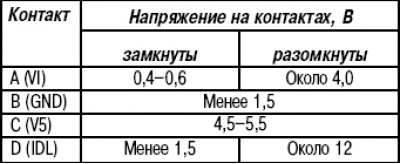
If from the given in the table. 15.13 only the voltage on contact "D" differs, check the position of the sensor. If the values on other contacts differ, measure the resistance between the sensor contacts.
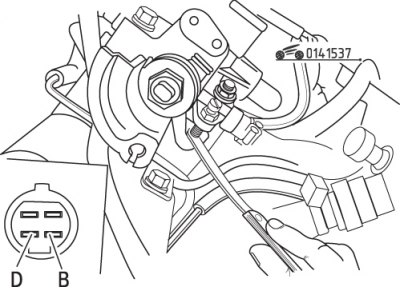
Figure 15.37. Installing a feeler gauge between the throttle lever and the adjusting screw when checking the resistance between contacts "B" and "D"
To check the sensor position on 1986 and 1987 models, insert a 0.4 mm thick feeler gauge between the throttle lever and the adjusting screw (figure 15.37) and check for a connection between contacts "B" and "D." Insert a 0.55 mm probe; the ohmmeter should read infinity. If the values are different, adjust the sensor by rotating it until it is in the correct position.
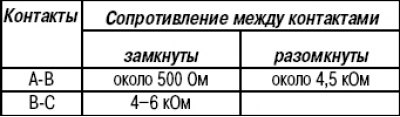
Disconnect the connector from the throttle angle sensor and measure the resistance between terminals "A" and "B", "B" and "C" (see Figure 15.36). If the resistance values differ from those given in the table. 15.14, replace the sensor.
Table 15.14. Resistance between the contacts of the throttle angle sensor connector depending on the state of the contacts
To replace the throttle angle sensor, disconnect the connector and remove the two screws. When installing the sensor, align the damper blade with the groove on the sensor, screw the sensor into place and secure with two screws. Adjust the position of the sensor.
Oxygen concentration sensor
To check the oxygen concentration sensor, start the engine and warm it up to operating temperature. Disconnect the connector and connect a voltmeter to the sensor side of the connector. Increase the engine speed to 4000 min⁻¹ – the voltmeter should show 0.55 V. Press and release the accelerator pedal several times, reading the readings. When the engine speed increases, the voltmeter readings should be within 0.5–1.0 V, and when the engine speed decreases, 0–0.4 V. If the voltage differs, replace the oxygen concentration sensor.
To replace the sensor, disconnect the connector and unscrew the sensor from the exhaust manifold.
Before installation, replace the sealing washer and lubricate the threads with a non-stick compound. Tighten the sensor securely.
Intake manifold pressure sensor (only for early turbocharged engines)
Disconnect the hose from the sensor. Create an air pressure of about 0.6 atm on the sensor.
Caution! The pressure must not exceed 0.85 atm. Otherwise, the valve will fail.
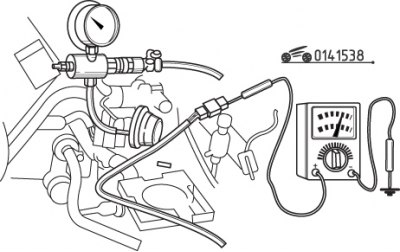
Figure 15.38. Checking the voltage at the contacts of the intake manifold pressure sensor connector when applying a pressure of 0.6 atm
Measure the voltage on the brown and white wire of the sensor connector (figure 15.38). When pressure is applied, the reading should not exceed 1.5 V, and when pressure is removed, it should be around 12 V. If the readings differ, check the wires and the resistance of the sensor.
To check the resistance, disconnect the connector and connect an ohmmeter to the sensor contacts. Create an air pressure of about 0.6 atm on the sensor and read the reading. The ohmmeter should show a closed circuit, otherwise replace the sensor.
Power steering switch
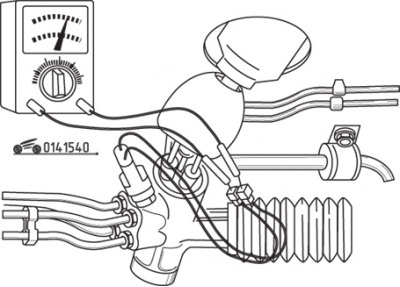
Figure 15.39. Measuring the resistance between the contacts of the power steering switch connector
To test the power steering switch, start the engine and let it idle. Disconnect the connector from the switch and connect an ohmmeter to the switch contacts (figure 15.39). Ask an assistant to turn the steering wheel all the way to the right or left, and the ohmmeter should show a closed circuit. At any intermediate position of the steering wheel, the ohmmeter should show infinity. If both tests are negative, replace the switch.
Install the new switch on a completely cool engine. With the engine off, turn the steering wheel in both directions to relieve residual pressure in the power steering. Disconnect the connector and unscrew the switch. Screw the new switch in by hand, wrapping it with Teflon tape first, then tighten it with a wrench. Connect the connector and check the power steering fluid level.
Brake light switch
Disconnect the connector from the brake light switch located under the instrument panel. Connect an ohmmeter to the contacts of the switch connector and measure the resistance with the brake pedal pressed – the resistance should be zero. Release the pedal – the resistance should be infinity. If the results of both tests are negative, adjust the position of the switch by turning it out or in.
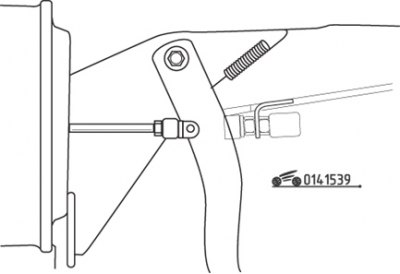
Figure 15.40. Location of the lock nut (1) for securing the brake light switch
To replace the switch, disconnect the connector, unscrew the lock nut from the switch stem side and remove the switch from the bracket (figure 15.40). Installation is carried out in the reverse order of removal. After installation, adjust the position of the switch.
Clutch release sensor
Disconnect the connector from the clutch release sensor and connect an ohmmeter to the sensor connector contacts. When the clutch pedal is released, the resistance should be zero, and when pressed, it should be infinity. If the readings differ, adjust the position of the sensor (similar to adjusting the brake light switch).
Neutral position sensor for manual transmission
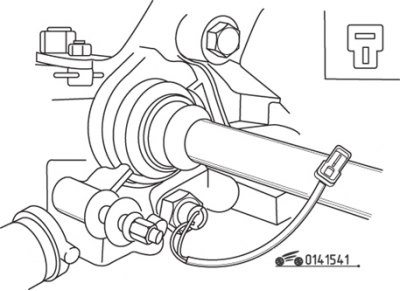
Figure 15.41. Location of the neutral position sensor of a manual transmission
Disconnect the connector from the neutral position sensor, which is screwed into the gearbox housing (figure 15.41). Connect an ohmmeter to the sensor contacts and measure the resistance. When the gear shift lever is in neutral, the resistance should be infinity. When any gear is engaged, the ohmmeter should show zero. If the readings differ, replace the sensor. To prevent oil leakage, wrap the sensor threads with Teflon tape during installation.
Deceleration sensor for models with automatic transmission
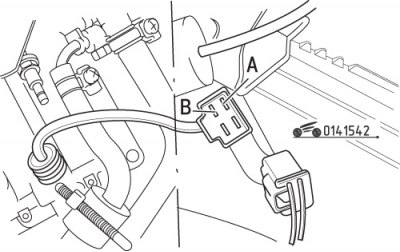
Figure 15.42. Location of contacts "A" and "B" of the sensor connector (models with automatic transmission)
The deceleration sensor is screwed into the automatic transmission housing. Disconnect the sensor connector located on the wire and connect an ohmmeter to contacts "A" and "B" on the sensor side (figure 15.42). When the selector lever is in the "park" or "neutral" position, the ohmmeter should show zero, and in any other selector position, the resistance should be equal to infinity. If the readings differ, replace the sensor.
5th gear shift sensor
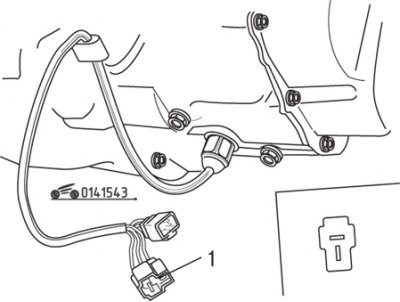
Figure 15.43. Location of contacts of the connector (1) of the 5th gear engagement sensor
The sensor is screwed into the gearbox housing. Disconnect the connector and connect an ohmmeter to the contacts of the connector located on the wire on the sensor side (figure 15.43). When the transmission is in 5th gear, the ohmmeter should show infinity, and when any other gear is engaged or when the transmission is in neutral, the resistance should be zero. If the readings differ, replace the sensor.
To replace the 5th gear sensor, raise the vehicle and secure it on stands. Place a pan under the gearbox and unscrew the sensor from the crankcase. Screw in the new sensor by hand, after wrapping its threads with Teflon tape, and tighten it securely with a wrench. Restore the gearbox oil level.
Main relay
Models produced in 1986–1987
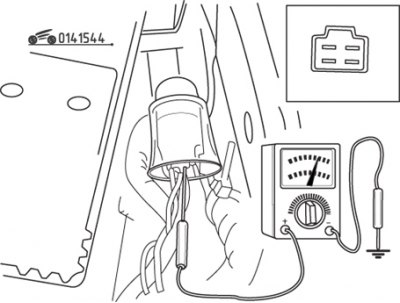
Figure 15.44. Measuring the voltage at the contacts of the main relay of 1986–1987 models
Measure the voltage at each contact of the main relay (figure 15.44). The voltage at contacts "A", "C" and "D" should be 12 V, and at contact "B," it should be zero. If the voltage readings differ, measure the relay's resistance.
Remove the relay from the vehicle and measure the resistance between terminals "A" and "B"; it should be approximately 70 ohms. Then apply battery voltage to terminal "A" and ground terminal "B" while monitoring the resistance between terminals "C" and "D"; it should be zero. If both tests are negative, replace the relay.
Models produced between 1988 and 1991
Make sure that when you turn the key in the ignition switch to the "ON" and "OFF" positions, the main relay makes a characteristic click.
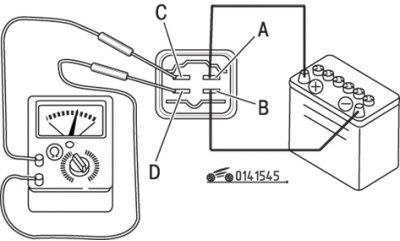
Figure 15.45. Measuring the resistance between the contacts of the main relay of 1988–1991 models
Make sure that the resistance between relay contacts "C" and "D" when the relay is powered by the battery should be zero, and when the power is disconnected between these contacts it should be equal to infinity (figure 15.45).
Control unit
Diagnostics and maintenance of the control unit must be performed by experienced specialists using specialized equipment, so contact a car service center or a specialized workshop.