


Checking the exhaust gas recirculation system
The arrangement of the system elements is shown in the figure 15.14, 15.15.
Check the condition of the vacuum hoses. Bends, loosening of the tightness of their fit, twisting and tears are not allowed. On vehicles produced between 1988 and 1991, check that the diaphragm under the recirculation valve moves freely without sticking; to do this, insert your hand under the valve and press on the diaphragm. Start the engine and check that as the engine speed increases, the diaphragm moves upward.
On 1986 and 1987 vehicles, disconnect the vacuum hose from the EGR valve and plug it; engine performance should not change. Otherwise, check the valve.
Connect a vacuum gauge to the disconnected hose (for turbocharged engines). There should be no vacuum at idle; the vacuum gauge should show vacuum at an engine speed of 2500 min⁻¹. Otherwise, check the EGR solenoid valve. Connect the hose.
On 1986 and 1987 vehicles with non-turbocharged engines, disconnect the hose from the EGR smoothing valve and plug it. Attach a piece of hose to the released fitting of the smoothing valve, increase the engine crankshaft speed to 2500 min⁻¹, blow into the hose and observe the vacuum gauge readings, which should increase. If the vacuum does not increase, check the smoothing valve. Connect the hoses.
On vehicles equipped with turbocharged engines, connect a vacuum gauge between the EGR solenoid valve and the EGR control valve. Increase the engine speed and read the vacuum gauge reading. Then disconnect the hose from the recirculation valve and close it with a plug, the reading should be less than the previous one. Otherwise, check the recirculation position sensor and the recirculation solenoid valve.
With the vacuum hose plugged, disconnect the connector from the temperature switch on the radiator expansion tank. Increase the engine speed to 2500 min⁻¹ – the vacuum gauge should not register a vacuum. Otherwise, check the recirculation solenoid valve.
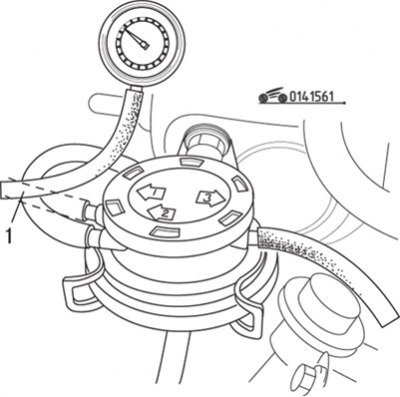
Figure 15.61. Disconnecting the hose (1) and connecting a vacuum gauge instead to check the recirculation smoothing valve
On 1986 and 1987 vehicles with non-turbocharged engines, disconnect the hose from the EGR smoothing valve and connect a vacuum gauge in its place (figure 15.61). Increase the engine speed to 2500 rpm, and the vacuum gauge reading should be at least 150 mmHg. If the reading is different, check the three-way solenoid valve. Disconnect the connector from the temperature switch on the expansion tank - the vacuum gauge should not register a vacuum. Otherwise, check the three-way solenoid valve.
To check the EGR check valve on turbocharged and non-turbocharged engines, warm up the engine to normal operating temperature, then disconnect the hose from the EGR valve and plug it; the nature of the engine's operation should not change. Otherwise, remove the valve and clean the exhaust channel and valve rod.
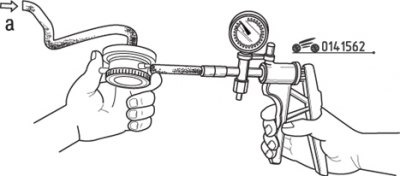
Figure 15.62. Checking the exhaust gas recirculation smoothing valve: a – blowing direction
Connect a vacuum pump to the EGR check valve and create a vacuum of at least 75 mmHg. The engine should start running intermittently or stall. If this does not happen, replace the valve. To check the recirculation smoothing valve (only in non-turbocharged engines) it must be removed from the engine. Connect a vacuum pump to fitting #3, close fitting #1 with a plug and, with the pump running, blow into the exhaust gas fitting – the vacuum should not change (figure 15.62). After releasing the pressure in the exhaust gas fitting, the vacuum should not remain. If the vacuum persists, replace the relief valve.
To check the recirculation position sensor (only in turbocharged engines) remove the rubber boot from the sensor connector without disconnecting the connector.
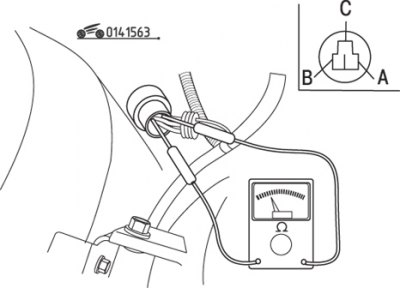
Figure 15.63. Measuring voltage at the contacts of the position sensor connector
Disconnect the vacuum hose from the EGR check valve and connect a vacuum pump. Turn the ignition switch to the "ON" position and measure the voltage at each connector pin (figure 15.63). The measurement conditions are given in the table. 15.15.
Table 15.15. Change in voltage at the contacts of the position sensor connector depending on the vacuum
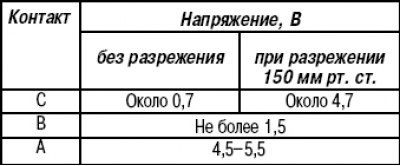
If the voltage at contacts "A" and "B" differs from the values given in the table. 15.15, check the wires and submit the control unit to a service center for inspection. If the voltage at contact "C" differs, check the resistance of the sensor, then check the wires and take the control unit to a service center for inspection.
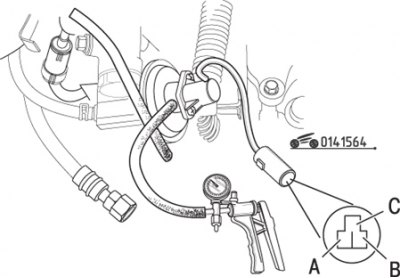
Figure 15.64. Measuring the resistance between the contacts of the position sensor connector
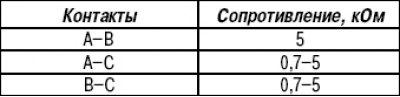
Disconnect the connector and measure the resistance between the contacts of the position sensor (figure 15.64). If any resistance differs from that given in the table. 15.16, replace the recirculation control valve assembly (the position sensor is not supplied separately).
Table 15.16. Resistance between the contacts of the position sensor connector
Recirculation electromagnetic valve (only in turbocharged engines) consists of two valves - ventilation and vacuum. To check the ventilation valve, disconnect the hoses and blow out the ventilation duct - air should pass freely.
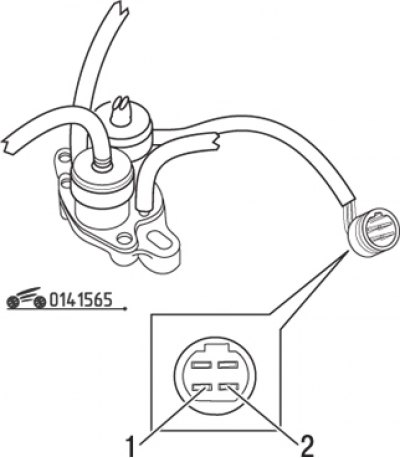
Figure 15.65. Location of connector contacts to which voltage from the battery must be applied when checking the ventilation electromagnetic valve: 1 - "mass"; 2 – positive voltage from the battery
Disconnect the connector and apply voltage from the battery to the connector contacts in accordance with the figure 15.65. Blow through the ventilation duct again – air should not pass through, otherwise replace the valve.
To check the vacuum valve, disconnect the hoses and blow out the vacuum channel - air should not pass through.
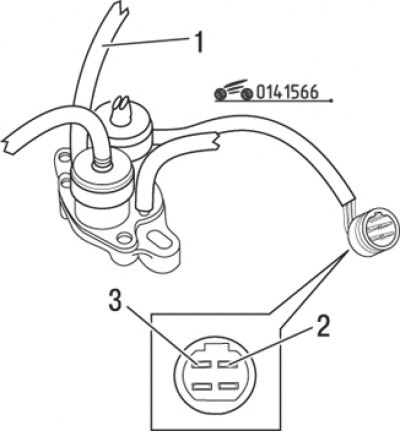
Figure 15.66. Location of connector contacts to which voltage from the battery must be applied when checking the recirculation electromagnetic valve: 1 – vacuum hose; 2 – "mass"; 3 – positive voltage from the battery
Disconnect the connector and apply voltage from the battery to the connector contacts in accordance with the figure 15.66. Blow through the vacuum channel again – air should pass freely, otherwise replace the valve.
Replacing exhaust gas recirculation system components
Remove the EGR valve only after the engine has completely cooled down. Label and disconnect the vacuum hoses, remove the three bolts and remove the valve. Remove any remaining gasket from the valve contact surfaces. Installation is carried out in the reverse order of removal.
To remove the EGR valve, mark all hoses with tape to ensure they are connected correctly. Release the spring clip and remove the valve. Installation is carried out in the reverse order of removal.
If the recirculation position sensor is faulty, it must be replaced as an assembly, as the sensor is not sold separately.
To replace the EGR solenoid valve, mark all hoses with tape to ensure they are connected correctly and disconnect them. Loosen the nuts and remove the solenoid valve from the engine compartment wall. Installation is carried out in the reverse order of removal.
(The full text is on the website: MazBook.ru)