
MazBook.ru
English Русский
Български
Беларускі
Український
Српски
Hrvatski
Română
Polski
Slovenský
Magyar
• Bookmark • Sitemap • Contacts •   
Cars Opel Cars Ford Cars Volkswagen Cars Audi Cars Kia Cars Renault Cars Peugeot


Familia Capella Mazda3 Mazda6 CX-? Others Articles
Capella 3 (1982-1992, petrol) Capella 3 and 4 (1982-1992) Capella 4 (1987-1992) Capella 5 (1991-1997) Capella 6 (1997-2005, petrol)

Checking the compression in the engine cylinders (Mazda Capella GE)

  • Home
  • Mazda Capella
  • Capella GE (1991-1997)
  • Power unit
  • Overhaul engines 1.6 and 1.8
  • Checking the compression in the engine cylinders
0
Contents: Checking with a vacuum gauge ⇓ Compression check ⇓
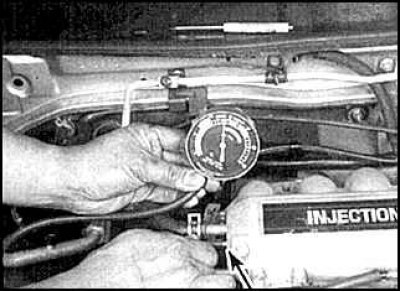
Checking with a vacuum gauge


Checking with a vacuum gauge


Connect the meter to the intake manifold. Warm up the engine and let it idle.

If the engine is in good condition, the gauge should read 17-22 inches and the needle should twitch evenly.

If the meter readings are lower than required, the following are likely causes: a leaking gasket between the intake manifold and the carburetor or throttle body, a leaking vacuum hose, or an out-of-adjustment of the ignition timing or camshaft rotation angle.

If the meter readings are 8 inches below normal, the intake manifold gasket is leaking or the injector is faulty.

If the needle drops 2 inches below the normal mark at regular intervals, the valves are leaking.

If the arrow jerks downwards very unevenly, the valve is stuck or the spark plugs are faulty.

Four inch needle vibration and exhaust fumes - valve guides are worn.

Rapid vibration when increasing engine speed - a leaking intake manifold or head gasket, worn valve springs, burnt valves, or faulty spark plugs.

A slight twitching of the arrow near the normal 1 inch mark indicates problems with the ignition.


Strong twitching of the needle - the cylinder head gasket is damaged.

If the needle slowly moves over large distances, the fuel is not mixed correctly, or the intake manifold or throttle body gasket is leaking.

Increase the RPM to 2500 and turn off the engine, the needle should drop to almost zero, then rise 5 inches above the normal mark and return to the normal mark.

If this does not happen, then the piston rings are worn out.

If there is a long delay, the exhaust system is clogged.

Compression check


1. Disable the ignition system by disconnecting the ignition high tension wire from the distributor cap and grounding it to the cylinder block.
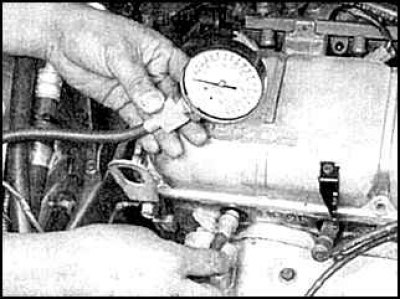
1. Disable the ignition system by disconnecting the ignition high tension wire from the distributor…


2. Connect a compression tester to the spark plug hole of cylinder N1.

3. Open the throttle valve fully and crank the engine crankshaft with the starter. After one or two revolutions, the compression pressure should rise to the maximum mark and then stabilize. Write down the result obtained.

4. Carry out a similar check with the remaining cylinders and record the readings obtained.

5. The pressure in all cylinders should be the same. A difference of more than 2 bar between any two cylinders indicates a malfunction. In a healthy engine, pressure should build up quickly. Low pressure in the first stroke, gradually increasing in subsequent strokes, indicates that the piston rings are worn out. Low first stroke pressure that does not increase with subsequent strokes indicates a valve leak or a blown head gasket. Deposits on the bottom of the valves can also cause low compression.


6. If you have any doubts during the inspection, please contact experienced specialists.

7. If the pressure in any cylinder is too low, perform the following check to determine the cause. Pour a teaspoon of clean motor oil into the cylinder through the spark plug hole and repeat the pressure check.

8. If the compression pressure increases after adding oil, this means that the piston or cylinder is worn out. If the pressure does not increase, then the cause is worn or burnt valves or a blown cylinder head gasket.

9. Low pressure in two adjacent cylinders almost always means that the head gasket between them is blown.

10. If one of the cylinders is approximately 20% lower in pressure than the others and the engine is not idling properly, this means that the cause may be a worn camshaft cam.

11. If the pressure is too high, then most likely the combustion chamber walls are covered with carbon deposits.

12. Once the check is complete, screw the spark plugs back into place and connect the ignition system.
This article is available at: russian, bulgarian, belarusian, ukrainian, serbian, croatian, romanian, polish, slovak, hungarian
This text was checked by: Evgeny Mereshnikov
Share with friends on social networks:

Previous
Capella 5 » Overhaul engines 1.6 and 1.8
Next

Engine disassembly sequence
Engine Removal — methods and safety precautions
Alternatives to engine overhaul
General notes on engine overhaul
Repair work without removing the engine from the car
Removal and installation the engine
Preparing for engine overhaul
Engine overhaul
Overhaul and inspection of the cylinder head
Valve repair
More articles on repairing other Mazda models
Checking the compression in the cylinders Mazda Familia 6 (1989-1994)
Measuring compression in engine cylinders Mazda3 BK (2003-2009)
Measuring compression in engine cylinders Mazda6 GG (2002-2008)
Checking the compression in the cylinders Mazda CX-5KE (2012-2017)
Checking the compression in the cylinders Mazda 121 (3) (1996-2003)
Link in different formats to this article
Comments and feedback from visitors
No comments yet


How much will 20 + 16 ?


Capella 6 (1997-2005, petrol) 
  • General information
  • Introduction to guide
  • User manual
  • Troubleshooting
  • Maintenance
  • Power unit
  • 4-cylinder engines
  • 6-cylinder engines
  • Engine overhaul
  • Cooling and ventilation
  • Power and exhaust systems
  • Engine electrics
  • Control system
  • Transmission
  • Mechanical gearbox
  • Automatic gearbox
  • Clutch and drive shafts
  • Chassis
  • Brake system
  • Car suspension
  • Steering
  • Body
  • Exterior (external elements)
  • Interior (internal elements)
  • Doors, windows and locks
  • Electrical equipment
  • Equipment and devices
  • Electrical circuits
Capella 5 (1991-1997) 
  • General information
  • User manual
  • Maintenance
  • Helpful hints
  • Power unit
  • Petrol engines 1.6 and 1.8
  • Petrol engines 2.0
  • 2.5 petrol engines
  • Overhaul engines 1.6 and 1.8
  • Overhaul engines 2.0 and 2.5
  • Diesel engine 2.0
  • Engine electrics
  • Cooling system
  • Air conditioner
  • Carburetor Nikki 30/34
  • Power system (1.6 and 1.8)
  • Power system (2.0 and 2.5)
  • Control system
  • Transmission
  • Mechanical gearbox
  • Automatic gearbox
  • Clutch and axles
  • Chassis
  • Brake system
  • Suspension and wheels
  • Steering
  • Body
  • Exterior (external elements)
  • Interior (internal elements)
  • Doors and windows
  • Electrical equipment
  • Equipment and devices
  • Electrical circuits
Capella 4 (1987-1992) 
  • General information
  • Introduction to manual
  • Vehicle specifications
  • Power unit
  • Engine repair
  • Lubrication system
  • Cooling system
  • Fuel system (carburetor)
  • Fuel injection (FE)
  • Fuel injection (DOHC)
  • Fuel system (diesel)
  • Ignition system
  • Transmission
  • Clutch
  • Gearbox
  • Drive shafts
  • Chassis
  • Front suspension
  • Rear suspension
  • Steering system
  • Brake system
  • Electrical equipment
  • Equipment and devices
  • Electrical circuits
Capella 3 and 4 (1982-1992) 
  • General information
  • User manual
  • Maintenance
  • Power unit
  • Gasoline engine
  • Engine overhaul (gasoline)
  • Diesel engine
  • Cooling and heating
  • Supply system
  • Ignition system
  • Emission reduction
  • Transmission
  • Clutch
  • Mechanical gearbox
  • Automatic gearbox
  • Drive shafts
  • Chassis
  • Brake system
  • Suspension and wheels
  • Steering
  • Body
  • Exterior (external elements)
  • Interior (internal elements)
  • Electrical equipment
  • Equipment and devices
  • Power devices
  • Electrical circuits
Capella 3 (1982-1992, petrol) 
  • General information
  • User manual
  • Maintenance
  • Troubleshooting
  • Late models
  • Power unit
  • Engine in car
  • Engine overhaul
  • Cooling and heating system
  • Fuel and exhaust system
  • Engine electrical system
  • Emission control system
  • Transmission
  • Mechanical gearbox
  • Automatic gearbox
  • Clutch and drive shafts
  • Chassis
  • Brake system
  • Suspension and wheels
  • Steering
  • Body
  • Exterior (external elements)
  • Interior (internal elements)
  • Electrical equipment
  • Equipment and devices
  • Lighting and lamps
  • Electrical circuits
MazBook.ru © 2018–2026 · Mobile version · Articles and news · Sitemap: EN BG BY UA RS HR RO PL SK HU · Feedback · Site search · Add to bookmarks Familia 5 (BF) · Familia 6 (BG) · Capella 3 (GC) · Capella 3 and 4 (GC) · Capella 4 (GD) · Capella 5 (GE) · Capella 6 (GF) · Mazda3 BK · Mazda6 GG · CX-5KE · Mazda 121 (3) · Mazda BT-50 (1) ·
By continuing to use the site, you agree to the use of cookies 🔐