


Contents: Removal ⇓ Installation ⇓
Note: If brake fluid leaks from the cylinder, the cylinder must be replaced. The manufacturer does not recommend repairing the wheel cylinder.
Removal
1. Raise the rear of the vehicle and support it on jack stands. Place chocks under the front wheels.
2. Remove the brake pads (see paragraph 6).
3. Remove all dirt from around the wheel cylinder.
[Based on website data: MazBook]
4. Disconnect the brake line (figure 7.4).
Note: Use a spanner to loosen the hydraulic system fittings to reduce the risk of stripping the edges. Do not separate the line from the wheel cylinder.
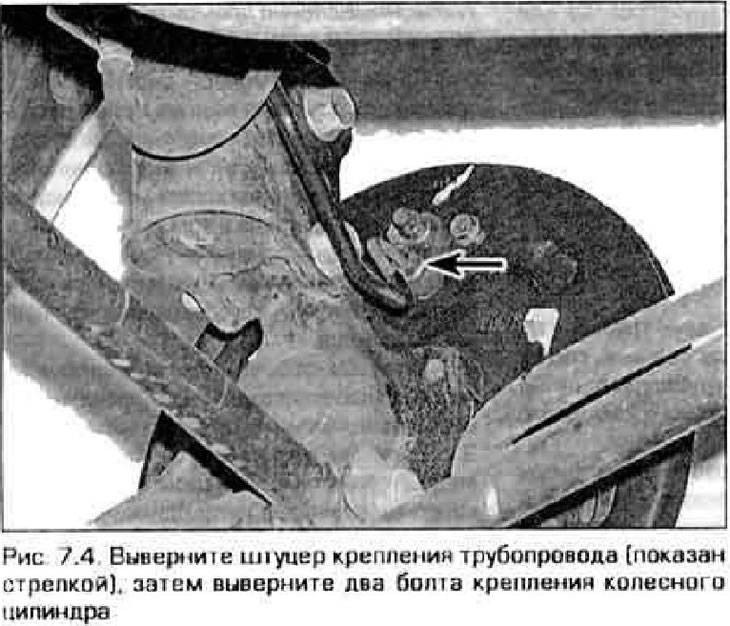
5. Unscrew the wheel cylinder mounting bytes.
6. Remove the wheel cylinder from the rear brake shield and place it on a clean workbench. Immediately plug the hydraulic line with a plug to prevent brake fluid from leaking out.
Note: If brake fluid gets on the brake pad linings, replace the pads and clean the brake drum with brake cleaner.
Installation
7. Apply a small amount of sealant to the mating surfaces of the cylinder and the rear shield. Install the wheel cylinder, connect the pipeline to it and tighten the nipple of its fastening. Do not overtighten the pipe fitting.
8. Insert the cylinder mounting bolts and tighten them to the specified torque. Tighten the pipe fitting. Install the pads (see paragraph 6).
9. Bleed the brake system (see paragraph 10).
10. Check the operation of the brake system before driving.
Warning. Do not drive on the road if you are not sure that the braking system is in good working order.