
MazBook.ru
English Русский
Български
Беларускі
Український
Српски
Hrvatski
Română
Polski
Slovenský
Magyar
• Bookmark • Sitemap • Contacts •   
Cars Opel Cars Ford Cars Volkswagen Cars Audi Cars Kia Cars Renault Cars Peugeot


Familia Capella Mazda3 Mazda6 CX-? Others Articles
Capella 3 (1982-1992, petrol) Capella 3 and 4 (1982-1992) Capella 4 (1987-1992) Capella 5 (1991-1997) Capella 6 (1997-2005, petrol)

Master cylinder — removal and installation (Mazda Capella GF)

  • Home
  • Mazda Capella
  • Capella GF (1997-2005)
  • Chassis
  • Brake system
  • Master cylinder — removal and installation
0
Contents: Removal ⇓ Installation ⇓
Note: If the master cylinder is faulty, replace it. The manufacturer does not recommend repairing the master cylinder.


Removal


1. The master cylinder is located in the engine compartment and is attached to the vacuum booster housing.

2. If your vehicle is equipped with a cruise control system, disconnect the system actuator and place it nearby.

3. On models with a manual transmission, disconnect the clutch hydraulic supply hose from the brake fluid reservoir.

4. Remove as much brake fluid as possible from the reservoir (using a syringe or douche).

Warning. If you use a culinary syringe, do not use it for cooking.


The original article is posted on [MazBook.ru]

5. Place a rag under the master cylinder and prepare plugs to seal the lines.

Warning. Brake fluid corrodes paint. Cover all painted surfaces and be careful not to spill brake fluid on them.


6. Disconnect the lines from the master cylinder (figure 8.6) using a spanner, move them aside and plug them with plugs (to prevent contamination).
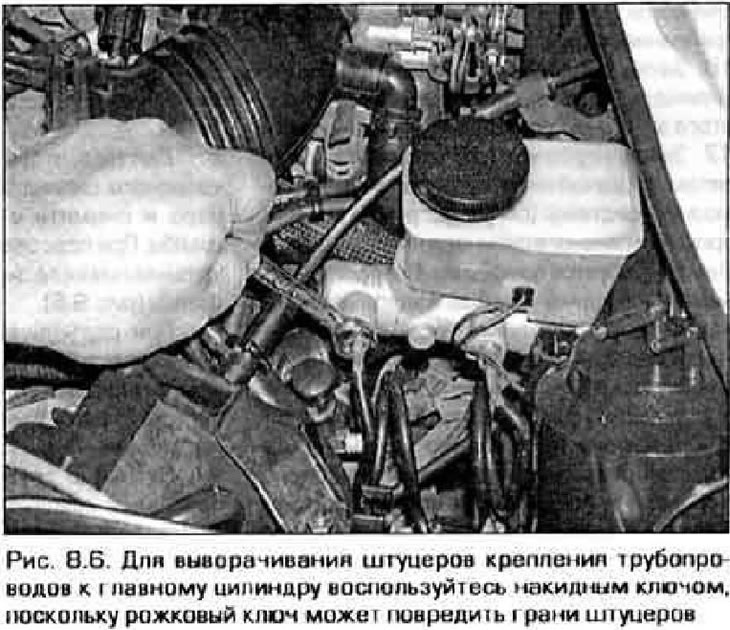
6. Disconnect the lines from the master cylinder (figure 8.6) using a spanner, move them aside and…


7. Disconnect the low brake fluid level indicator switch wiring connector, then remove the master cylinder to booster mounting nuts (figure 8.7). Remove the master cylinder from the studs and remove it from the engine compartment. Be careful not to spill brake fluid.
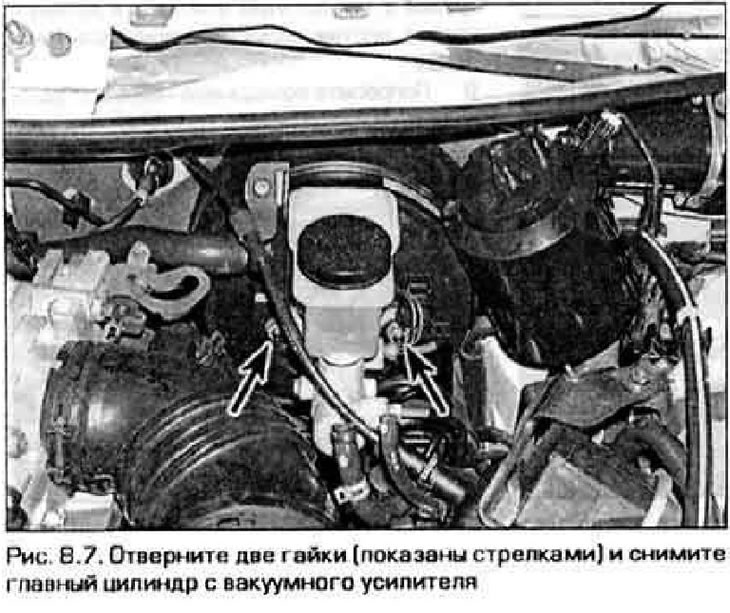


7. Disconnect the low brake fluid level indicator switch wiring connector, then remove the master…


Installation


8. Before installing on the vehicle, bleed the master cylinder. To do this, secure the master cylinder in a vice, clamping it by the flange.

9. Insert two bleeder tubes into the cylinder outlet ports (figure B.9).
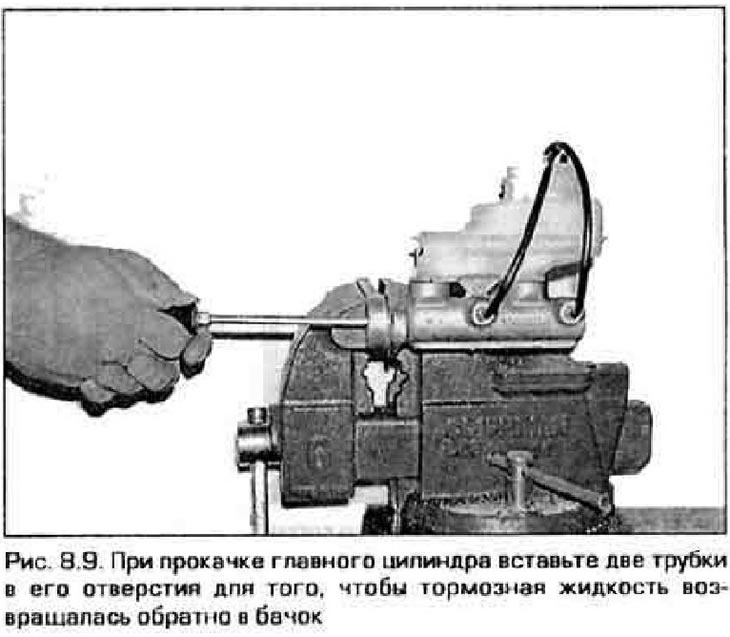
9. Insert two bleeder tubes into the cylinder outlet ports (figure B.9).


10. Fill the reservoir with the recommended type of brake fluid (see chapter 1).

11. Slowly push the cylinder pistons down (a large Phillips screwdriver is suitable for this). In this case, air will be forced out of the cylinder and into the tank. Since the tubes are immersed in brake fluid, air will not be able to escape into the cylinder on the return stroke of the pistons.

12. Repeat this procedure until. until air bubbles stop coming out of the tubes.

13. Remove the tubes (one by one) and insert plugs to prevent brake fluid leakage. Place the cap on the master cylinder reservoir.


14. Install the master cylinder onto the vacuum booster studs and tighten the cylinder mounting nuts by hand.

Note: Don't forget to install a new gasket.


15. Connect the brake system lines to the master cylinder. If necessary, rock the master cylinder to facilitate screwing in the pipe mounting fittings.

16. Tighten the master cylinder mounting nuts to the specified torque, then tighten the pipe fastenings.

17. Fill the reservoir with brake fluid, then bleed the master cylinder and brake system (see paragraph 10). To bleed the master cylinder in a car, you will need an assistant. Ask him to press and hold the brake pedal. Loosen the hose connection and allow the fluid and air to escape from the cylinder. Repeat this procedure for both lines until no more brake fluid containing air bubbles comes out of the master cylinder.

Warning. Brake fluid corrodes paint. Cover all painted surfaces and be careful not to spill brake fluid on them. After bleeding is complete, immediately remove all traces of bleeding brake fluid.


18. Check the operation of the brake system before driving.

Warning. Do not drive on the road if you are not sure that the braking system is in good working order.
This article is available at: russian, bulgarian, belarusian, ukrainian, serbian, croatian, romanian, polish, slovak, hungarian
This text was checked by: German Vorobyov
Share with friends on social networks:

Previous
Capella 6 » Brake system
Next

Wheel cylinder — removal and installation
Drum brake shoes — replacement
Brake disc — inspection, removal and installation
Disc Brake Caliper — removal and installation
Disc brake pads — replacement
Brake system pipes and hoses — inspection and replacement
Bleeding the hydraulic brake system
Vacuum booster — inspection, removal and installation
Brake pedal height and free travel adjustment
Parking brake adjustment
More articles on repairing other Mazda models
Brake master cylinder and vacuum booster Mazda Familia 5 (1985-1989)
Master Brake Cylinder — Description Mazda3 BK (2003-2009)
Master Brake Cylinder — Description Mazda6 GG (2002-2008)
Removal and installation the clutch master cylinder Mazda CX-5KE (2012-2017)
Clutch master cylinder Mazda BT-50 (1) (2006-2011)
Link in different formats to this article
Comments and feedback from visitors
No comments yet


How much will 46 + 43 ?


Capella 6 (1997-2005, petrol) 
  • General information
  • Introduction to guide
  • User manual
  • Troubleshooting
  • Maintenance
  • Power unit
  • 4-cylinder engines
  • 6-cylinder engines
  • Engine overhaul
  • Cooling and ventilation
  • Power and exhaust systems
  • Engine electrics
  • Control system
  • Transmission
  • Mechanical gearbox
  • Automatic gearbox
  • Clutch and drive shafts
  • Chassis
  • Brake system
  • Car suspension
  • Steering
  • Body
  • Exterior (external elements)
  • Interior (internal elements)
  • Doors, windows and locks
  • Electrical equipment
  • Equipment and devices
  • Electrical circuits
Capella 5 (1991-1997) 
  • General information
  • User manual
  • Maintenance
  • Helpful hints
  • Power unit
  • Petrol engines 1.6 and 1.8
  • Petrol engines 2.0
  • 2.5 petrol engines
  • Overhaul engines 1.6 and 1.8
  • Overhaul engines 2.0 and 2.5
  • Diesel engine 2.0
  • Engine electrics
  • Cooling system
  • Air conditioner
  • Carburetor Nikki 30/34
  • Power system (1.6 and 1.8)
  • Power system (2.0 and 2.5)
  • Control system
  • Transmission
  • Mechanical gearbox
  • Automatic gearbox
  • Clutch and axles
  • Chassis
  • Brake system
  • Suspension and wheels
  • Steering
  • Body
  • Exterior (external elements)
  • Interior (internal elements)
  • Doors and windows
  • Electrical equipment
  • Equipment and devices
  • Electrical circuits
Capella 4 (1987-1992) 
  • General information
  • Introduction to manual
  • Vehicle specifications
  • Power unit
  • Engine repair
  • Lubrication system
  • Cooling system
  • Fuel system (carburetor)
  • Fuel injection (FE)
  • Fuel injection (DOHC)
  • Fuel system (diesel)
  • Ignition system
  • Transmission
  • Clutch
  • Gearbox
  • Drive shafts
  • Chassis
  • Front suspension
  • Rear suspension
  • Steering system
  • Brake system
  • Electrical equipment
  • Equipment and devices
  • Electrical circuits
Capella 3 and 4 (1982-1992) 
  • General information
  • User manual
  • Maintenance
  • Power unit
  • Gasoline engine
  • Engine overhaul (gasoline)
  • Diesel engine
  • Cooling and heating
  • Supply system
  • Ignition system
  • Emission reduction
  • Transmission
  • Clutch
  • Mechanical gearbox
  • Automatic gearbox
  • Drive shafts
  • Chassis
  • Brake system
  • Suspension and wheels
  • Steering
  • Body
  • Exterior (external elements)
  • Interior (internal elements)
  • Electrical equipment
  • Equipment and devices
  • Power devices
  • Electrical circuits
Capella 3 (1982-1992, petrol) 
  • General information
  • User manual
  • Maintenance
  • Troubleshooting
  • Late models
  • Power unit
  • Engine in car
  • Engine overhaul
  • Cooling and heating system
  • Fuel and exhaust system
  • Engine electrical system
  • Emission control system
  • Transmission
  • Mechanical gearbox
  • Automatic gearbox
  • Clutch and drive shafts
  • Chassis
  • Brake system
  • Suspension and wheels
  • Steering
  • Body
  • Exterior (external elements)
  • Interior (internal elements)
  • Electrical equipment
  • Equipment and devices
  • Lighting and lamps
  • Electrical circuits
MazBook.ru © 2018–2026 · Mobile version · Articles and news · Sitemap: EN BG BY UA RS HR RO PL SK HU · Feedback · Site search · Add to bookmarks Familia 5 (BF) · Familia 6 (BG) · Capella 3 (GC) · Capella 3 and 4 (GC) · Capella 4 (GD) · Capella 5 (GE) · Capella 6 (GF) · Mazda3 BK · Mazda6 GG · CX-5KE · Mazda 121 (3) · Mazda BT-50 (1) ·
By continuing to use the site, you agree to the use of cookies 🔐