


Caution! When bleeding the brake system, take precautions to protect your eyes. If brake fluid gets into your eyes, rinse immediately with plenty of water and seek medical attention.
1. Bleeding the brake system is necessary to remove air that has entered it when replacing lines, hoses, wheel cylinders or the master cylinder. Bleeding all four wheel cylinders may be necessary if air has entered the system due to a low fluid level in the master cylinder reservoir, or if the lines are disconnected from the master cylinder.
2. If you disconnected the line only from the wheel cylinder, you only need to bleed that wheel cylinder.
3. If you have disconnected the line between the master cylinder and any of the wheel cylinders, you will need to bleed that portion of the hydraulic system.
4. Press the brake pedal several times with the engine off to remove the vacuum from the vacuum booster.
5. Remove the master cylinder reservoir cap and fill it with brake fluid. Replace the cover.
Note: While bleeding, periodically check the brake fluid level in the reservoir and top up as needed. Prevent air from entering the master cylinder due to insufficient brake fluid.
6. To bleed the brake system, you will need an assistant, fresh brake fluid, a transparent container, a rubber tube with a diameter that matches the diameter of the bleed screw, and a wrench to loosen and tighten the bleed screw.
7. To bleed air from all four tires, start with the rear right tire. Loosen the screw, then tighten it so that no liquid comes out, but the screw can be easily unscrewed.
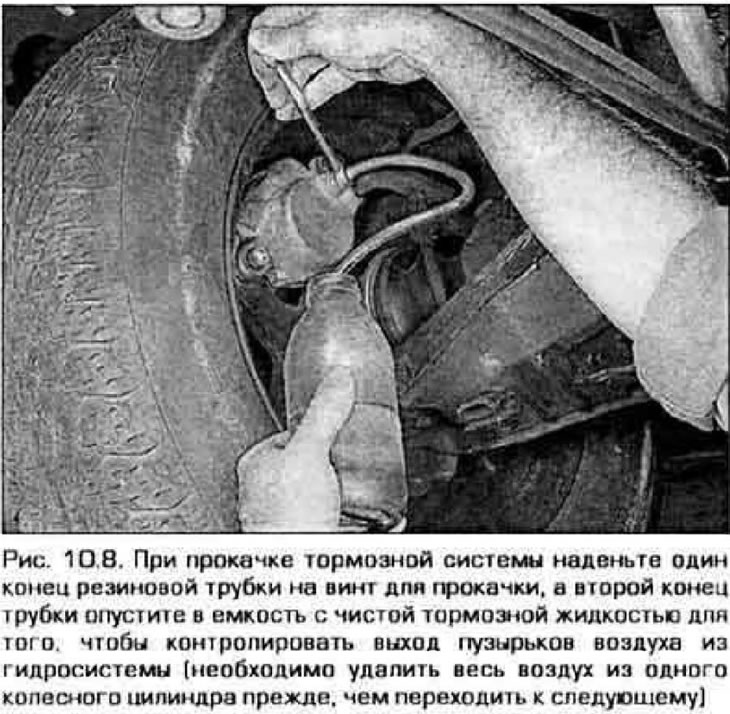
8. Place one end of the rubber tube on the bleed screw and release the other end of the tube into a transparent container filled with clean brake fluid (figure 10.8).
9. Ask an assistant to press and hold the brake pedal.
10. With the brake pedal depressed, unscrew the bleed screw and watch as brake fluid with air bubbles comes out of the rubber hose. Once the fluid stops flowing, tighten the bleed screw and have the assistant release the brake pedal.
11. Repeat the procedure described in pl. 9 and 10 until air bubbles stop coming out of the hose. Then repeat the bleeding procedure for the left front, then left rear and right front wheels (in exactly that order). Don't forget to periodically top up the brake fluid in the master cylinder reservoir.
12. Only add fresh, clean brake fluid. Old brake fluid accumulates moisture, which reduces the effectiveness of the braking system.
13. After completing bleeding, add fluid to the master cylinder reservoir up to the MAX mark.
14. Check the operation of the brakes. At the end of the brake pedal travel, you should feel a hard stop, without elasticity. If necessary. repeat the brake system bleeding procedure.
Warning. Do not drive on the road if you are not sure that the braking system is in good working order.