


2. Steel pipes and flexible rubber hoses are available from your dealer or parts stores. Do not, under any circumstances, install pipes or flexible hoses that are not specifically designed for your vehicle model.
3. When installing the pipeline, ensure a gap of at least 2 cm between it and the moving parts of the vehicle.
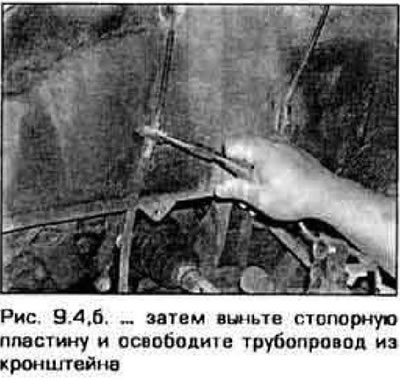
4. Use a box wrench to disconnect a pipe or hose (pic. 9.4,a). Then remove the stop plate and remove the pipeline from the bracket (pic. 9.4.6).
 |  |
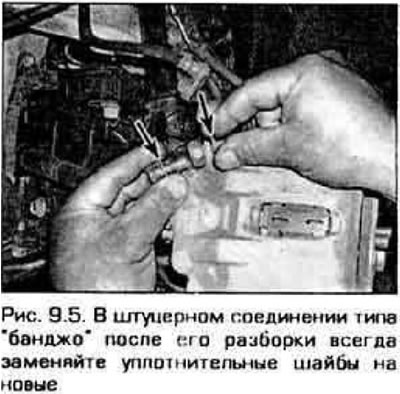
5. In order to disconnect the hose from the wheel cylinder, unscrew the fitting bolt and remove the sealing washers from it. Always install new sealing washers when connecting the hose (pic. 9.5).
6. When disconnecting two pipelines, use regular wrenches. When connecting two pipelines, do not twist or overstretch them.
7. Steel pipelines are usually attached to the chassis elements with clamps when laying. Before removing the pipeline, first unfasten it from the clamps. When installing the pipeline, secure it with all clamps (old or. in case of damage, new), because they protect the pipeline from vibration, which most often causes pipeline breakage.
8. When replacing piping, make sure that the new piping is exactly the same as the old one. NEVER use copper piping! Purchase only genuine parts from a dealer or parts stores.
9. When installing steel piping, make sure it is securely fastened and does not come into contact with moving or hot parts.
10. After installing the pipeline, check the level of brake fluid in the reservoir of the main cylinder and bring it to the required level. Bleed the brake system (see paragraph 10) and check the brake system before driving.
Warning. Do not drive on the road if you are not sure that the brake system is working properly.