MazBook.ru
English Русский
Български
Беларускі
Український
Српски
Hrvatski
Română
Polski
Slovenský
Magyar
• Bookmark • Sitemap • Contacts •   
Cars Opel Cars Ford Cars Volkswagen Cars Audi Cars Kia Cars Renault Cars Peugeot


Familia Capella Mazda3 Mazda6 CX-? Others Articles
Capella 3 (1982-1992, petrol) Capella 3 and 4 (1982-1992) Capella 4 (1987-1992) Capella 5 (1991-1997) Capella 6 (1997-2005, petrol)

Anti-lock braking System-basic information and fault codes (Mazda Capella GF)

  • Home
  • Mazda Capella
  • Capella GF (1997-2005)
  • Chassis
  • Brake system
  • Anti-lock braking System-basic information and fault codes
0
Contents: General information ⇓ Anti-lock braking system fault codes ⇓ ABS system error codes ⇓

General information


1. In a conventional braking system, when you press the brake pedal hard, the wheels lock up (that is, they stop rotating) and the car becomes uncontrollable. The anti-lock braking system (ABS) is designed to prevent the wheels from locking. This effect is achieved by briefly reducing the pressure in the wheel brake cylinders (the pressure in the cylinders becomes not constant, but pulsating).

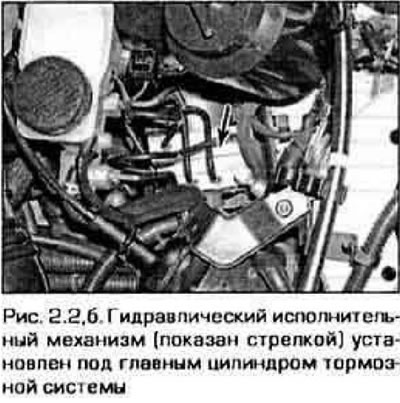
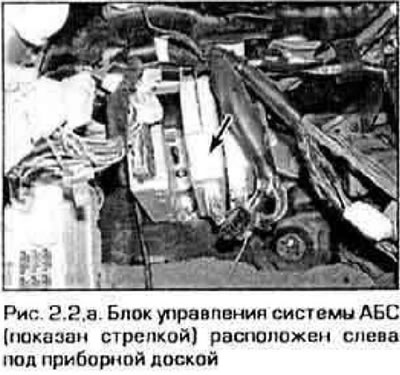
2. ABS consists of two main systems: electrical and hydraulic. The electrical part of the system consists of four wheel sensors with toothed disks and inductive converters, a control unit (figure 2.2,a) and electrical wires connecting the system components. The hydraulic part of the system consists of a block of hydraulic actuators (figure 2.2,b). wheel cylinders and the pipes connecting these components.
2. ABS consists of two main systems: electrical and hydraulic. The electrical part of the system…

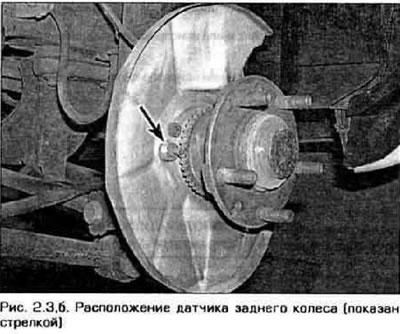
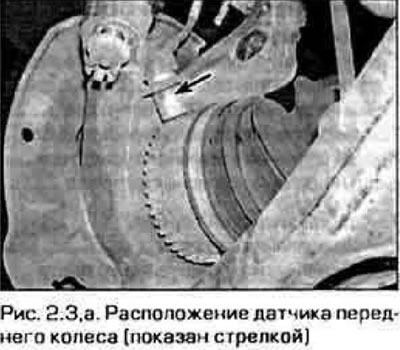
3. In principle, the ABS works very simply: wheel sensors monitor the rotational speed of the wheels and transmit this information to the control unit (figure 2.3, a, b). The control unit constantly compares the signals from these sensors. As long as the signals do not differ from each other, the system remains passive. However, if one of the wheels slows down, the signal from the sensor of that wheel begins to differ from the signals from the other sensors. This is how the control unit "learns" about the blocking of one of the car's wheels. At the same time, the control unit sends a signal to the hydraulic actuator, which reduces the pressure of the brake fluid in the wheel cylinder of the locked wheel. As soon as the wheel is unlocked and its rotation speed begins to match the rotation speed of the other wheels, the signal from the sensor of this wheel also begins to match the signals from the sensors of the other wheels. At this point, the ABS is switched off again.


3. In principle, the ABS works very simply: wheel sensors monitor the rotational speed of the…

4. In fact, the ABS system is much more complex and we do not recommend that you diagnose and repair this system yourself. If your vehicle's anti-lock braking system is faulty, contact a specialist service station.

Anti-lock braking system fault codes


5. When the engine starts, the ABS warning light on the dashboard should come on and then go out. However, under certain conditions, the light remains on. In this case, a fault code remains in the memory of the ABS control unit. Reading fault codes from the control unit memory can be done in two ways. Models produced from 1993 to 1997 have a data link connector (DLC) located in the engine compartment for this purpose. In models produced since 1998, a special scanner is connected to a 16-pin connector located in the vehicle interior. If you do not have this scanner, fault codes can be retrieved using a code reader available at dealers and some service stations.


6. In models produced from 1993 to 1997, access to the ABS control unit self-diagnosis system is carried out as follows. In the data transfer connector, short-circuit the FBS and GND terminals. Also, connect a voltmeter to the TBS terminals and the vehicle body (to any grounding point) (figure 2.6). Turn the ignition key to the ON position (but don't start the engine) and watch the fluctuations of the voltmeter needle. For this purpose you will need an arrow-type voltmeter. Make sure the battery voltage is at least 11 V, the gear shift lever is in neutral, all electrical consumers are turned off, the throttle is closed, and the engine is warmed up to operating temperature.
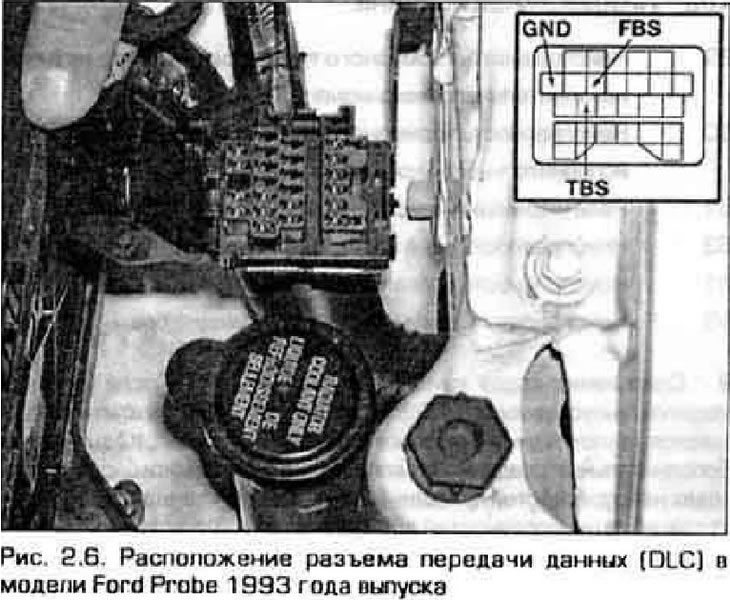
6. In models produced from 1993 to 1997, access to the ABS control unit self-diagnosis system is…


7. Error codes are determined by counting the oscillations of the voltmeter needle. If there are no fault codes, the ABS warning light should come on and immediately go out. If there are fault codes in the control unit's memory, the warning lamp will indicate their meaning using a series of flashes. For example, fault code 22 (electromagnetic valve) is indicated as follows; two long flashes, then a pause, then two short flashes.


8. Below is a breakdown of the most common ABS fault codes. Troubleshooting should be carried out by a dealer or a specialized service station.

9. Reading fault codes in models produced since 1998 is carried out using a special scanner. Additional information on hardware and fault codes is provided in chapter 6. Troubleshooting should be carried out by a dealer or a specialized service station.

10. After the fault has been corrected, its code should be deleted from the control unit memory. Fault codes can be erased from the control unit memory only using a scanner. If you do not have a scanner, please contact a specialized service station. Additional information on hardware and fault codes is provided in chapter 6.

ABS system error codes
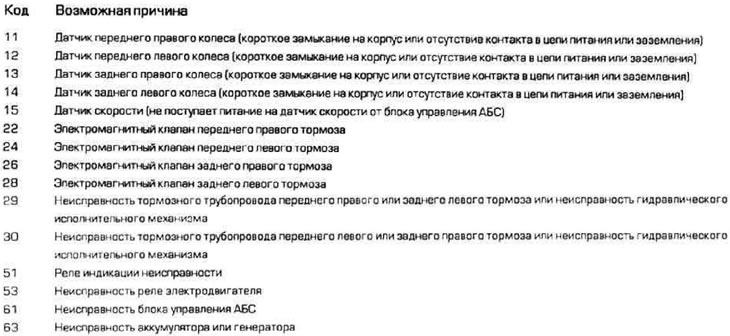


ABS system error codes
This article is available at: russian, bulgarian, belarusian, ukrainian, serbian, croatian, romanian, polish, slovak, hungarian
This text was checked by: German Vorobyov
Share with friends on social networks:

Previous
Capella 6 » Brake system
Next

Basic information about the braking system
Technical data of the brake system
Disc brake pads — replacement
Disc Brake Caliper — removal and installation
Brake disc — inspection, removal and installation
Drum brake shoes — replacement
Wheel cylinder — removal and installation
More articles on repairing other Mazda models
Anti-lock braking system (ABS) Mazda Familia 6 (1989-1994)
Removal and installation the speedometer sensor of a car (without… Mazda3 BK (2003-2009)
Removal and installation the speedometer sensor of a car (without… Mazda6 GG (2002-2008)
Shift lock system Mazda CX-5KE (2012-2017)
Scheme 7. Anti-lock braking system Mazda BT-50 (1) (2006-2011)
Link in different formats to this article
Comments and feedback from visitors
No comments yet


How much will 50 + 17 ?


Capella 6 (1997-2005, petrol) 
  • General information
  • Introduction to guide
  • User manual
  • Troubleshooting
  • Maintenance
  • Power unit
  • 4-cylinder engines
  • 6-cylinder engines
  • Engine overhaul
  • Cooling and ventilation
  • Power and exhaust systems
  • Engine electrics
  • Control system
  • Transmission
  • Mechanical gearbox
  • Automatic gearbox
  • Clutch and drive shafts
  • Chassis
  • Brake system
  • Car suspension
  • Steering
  • Body
  • Exterior (external elements)
  • Interior (internal elements)
  • Doors, windows and locks
  • Electrical equipment
  • Equipment and devices
  • Electrical circuits
Capella 5 (1991-1997) 
  • General information
  • User manual
  • Maintenance
  • Helpful hints
  • Power unit
  • Petrol engines 1.6 and 1.8
  • Petrol engines 2.0
  • 2.5 petrol engines
  • Overhaul engines 1.6 and 1.8
  • Overhaul engines 2.0 and 2.5
  • Diesel engine 2.0
  • Engine electrics
  • Cooling system
  • Air conditioner
  • Carburetor Nikki 30/34
  • Power system (1.6 and 1.8)
  • Power system (2.0 and 2.5)
  • Control system
  • Transmission
  • Mechanical gearbox
  • Automatic gearbox
  • Clutch and axles
  • Chassis
  • Brake system
  • Suspension and wheels
  • Steering
  • Body
  • Exterior (external elements)
  • Interior (internal elements)
  • Doors and windows
  • Electrical equipment
  • Equipment and devices
  • Electrical circuits
Capella 4 (1987-1992) 
  • General information
  • Introduction to manual
  • Vehicle specifications
  • Power unit
  • Engine repair
  • Lubrication system
  • Cooling system
  • Fuel system (carburetor)
  • Fuel injection (FE)
  • Fuel injection (DOHC)
  • Fuel system (diesel)
  • Ignition system
  • Transmission
  • Clutch
  • Gearbox
  • Drive shafts
  • Chassis
  • Front suspension
  • Rear suspension
  • Steering system
  • Brake system
  • Electrical equipment
  • Equipment and devices
  • Electrical circuits
Capella 3 and 4 (1982-1992) 
  • General information
  • User manual
  • Maintenance
  • Power unit
  • Gasoline engine
  • Engine overhaul (gasoline)
  • Diesel engine
  • Cooling and heating
  • Supply system
  • Ignition system
  • Emission reduction
  • Transmission
  • Clutch
  • Mechanical gearbox
  • Automatic gearbox
  • Drive shafts
  • Chassis
  • Brake system
  • Suspension and wheels
  • Steering
  • Body
  • Exterior (external elements)
  • Interior (internal elements)
  • Electrical equipment
  • Equipment and devices
  • Power devices
  • Electrical circuits
Capella 3 (1982-1992, petrol) 
  • General information
  • User manual
  • Maintenance
  • Troubleshooting
  • Late models
  • Power unit
  • Engine in car
  • Engine overhaul
  • Cooling and heating system
  • Fuel and exhaust system
  • Engine electrical system
  • Emission control system
  • Transmission
  • Mechanical gearbox
  • Automatic gearbox
  • Clutch and drive shafts
  • Chassis
  • Brake system
  • Suspension and wheels
  • Steering
  • Body
  • Exterior (external elements)
  • Interior (internal elements)
  • Electrical equipment
  • Equipment and devices
  • Lighting and lamps
  • Electrical circuits
MazBook.ru © 2018–2026 · Mobile version · Articles and news · Sitemap: EN BG BY UA RS HR RO PL SK HU · Feedback · Site search · Add to bookmarks Familia 5 (BF) · Familia 6 (BG) · Capella 3 (GC) · Capella 3 and 4 (GC) · Capella 4 (GD) · Capella 5 (GE) · Capella 6 (GF) · Mazda3 BK · Mazda6 GG · CX-5KE · Mazda 121 (3) · Mazda BT-50 (1) ·
By continuing to use the site, you agree to the use of cookies 🔐