
MazBook.ru
English Русский
Български
Беларускі
Український
Српски
Hrvatski
Română
Polski
Slovenský
Magyar
• Bookmark • Sitemap • Contacts •   
Cars Opel Cars Ford Cars Volkswagen Cars Audi Cars Kia Cars Renault Cars Peugeot


Familia Capella Mazda3 Mazda6 CX-? Others Articles
Mazda 121 (3) (1996-2003) Mazda BT-50 (1) (2006-2011)

Automatic transmission: checking fluid level/changing fluid and filter (Mazda 121 (3))

  • Home
  • Mazda
  • 121 JASM (1996-2003)
  • General information
  • Maintenance
  • Automatic transmission: checking fluid level/changing fluid and filter
0
Contents: Examination ⇓ Fluid replacement/mesh filter…⇓
Necessary tools:
  • To replace the fluid (oil): Allen key to unscrew the bolt in the filler hole.
  • Sealing ring for bolt.
  • Filter with new sealing ring.

Materials required: Automatic transmission fluid according to Ford WSD-M2C 199-A specification or Tutela CVT Universal. The same applies to the Mazda 121 model.

Examination


The correct fluid level is very important for the correct operation of the automatic transmission. Therefore, it is necessary to check it very carefully.
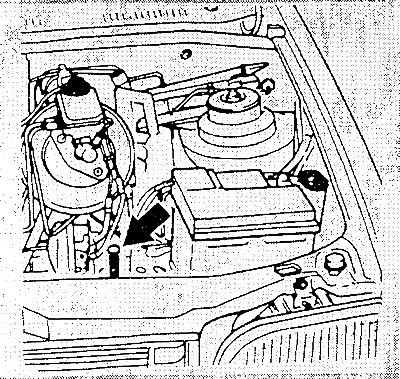
The dipstick for checking the level is located in the engine compartment. Through its tube, you can…


The dipstick for checking the level is located in the engine compartment. Through its tube, you can pour fluid into the gearbox.

Attention! The check must be carried out with the gearbox warmed up.


Drive at least 10 km, preferably at high speed. The fluid temperature will be 60-70°C.

Place the unloaded vehicle on a horizontal surface without turning off the engine. Apply the parking brake.

Move the selector to the "N" position. Do not step on the gas - the engine must idle during the test.
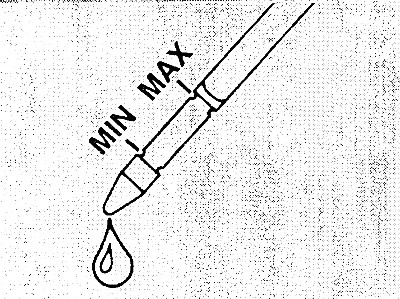
Pull out the dipstick and wipe it with a clean cloth. Then insert it back, pull it out and…


Pull out the dipstick and wipe it with a clean cloth. Then insert it back, pull it out and determine the fluid level.


The level should be between the "MIN" and "MAX" marks. The difference between the marks corresponds to a liquid volume of 250-300 cm³.

Caution! When the fluid level is low, the pump will make a sound of air being sucked in. This will cause the fluid to foam, and the level reading may be incorrect. In this case, turn off the engine, add some fluid after about 2 minutes, and then check the level again with the engine running.


If you need to add liquid, use a clean funnel with a fine mesh.

Fill the fluid with the engine off through the tube to measure its level in the gearbox.

Attention! Do not pour too much liquid, as this may cause malfunctions in the automatic system. In this case, excess liquid must be drained.


Check the fluid on the dipstick for appearance and smell. Normal fluid should be clean and red. Burnt friction linings cause a burnt smell and darken the fluid. If the fluid contains metal filings or becomes thick and sticky, the gearbox must be removed and repaired (in the workshop). Contamination of the fluid may cause malfunctions in the transmission control system.

After checking the level and adding fluid, insert the dipstick back.

Press the brake pedal and slowly shift the selector through all ranges. Finally, check the fluid level again.

Fluid replacement/mesh filter replacement


When replacing the fluid, it is necessary to maintain absolute cleanliness. The smallest contamination can lead to the failure of the automatic system.

Caution: Without automatic transmission fluid, the engine cannot be started and the vehicle cannot be towed.


The fluid must be replaced when the gearbox is warm.

Raise and support the vehicle, remove the lower engine cover.

Place a container underneath to catch the drain.

Remove the transmission fluid drain bolt and allow the fluid to drain completely.

Caution: If the fluid has a burnt smell, is dark in color, or contains metal shavings, the gearbox needs to be repaired.


Tighten the drain bolt with a new seal, unscrew the bolts and remove the transmission pan.

Wipe and clean the magnets in it from steel filings.
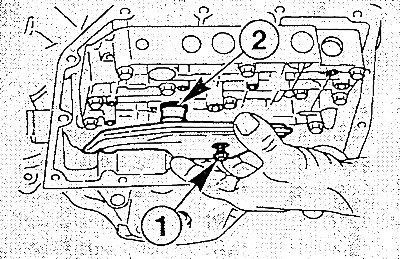
Unscrew the filter bolt (1) and remove the filter.


Unscrew the filter bolt (1) and remove the filter.

Install a new filter with a new sealing ring (2) and tighten the mounting bolt to 10 Nm.
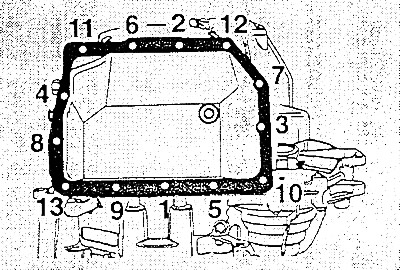
Install the pan with a new gasket and tighten its bolts first to 3 Nm, then to 10 Nm in the…


Install the pan with a new gasket and tighten its bolts first to 3 Nm, then to 10 Nm in the sequence shown. Do not overtighten the bolts, otherwise the gasket will be deformed.


Install the lower engine cover.

Lower the car.

Add 3.5 liters of automatic transmission fluid.

Caution: Fill only with recommended fluid.


Check fluids as described above.
This article is available at: russian, bulgarian, belarusian, ukrainian, serbian, croatian, romanian, polish, slovak, hungarian
This text was checked by: Evgeny Mereshnikov
Share with friends on social networks:

Previous
Mazda 121 (3) » Maintenance
Next

Manual transmission: checking the oil level
Checking the rubber boots of the drive shafts
Gearbox/Main gear
Replacing spark plugs/checking electrical connections
Visual inspection of the exhaust system
Steering/Front Axle
Checking the steering rod/axle joint dust caps
Checking the steering wheel covers
Checking Power Steering Fluid
Brakes, wheels and tires
More articles on repairing other Mazda models
Automatic transmission — checking the oil level Mazda Familia 6 (1989-1994)
Checking the automatic transmission fluid level Mazda Capella 5 (1991-1997)
Checking the Automatic Transmission Fluid Level Mazda3 BK (2003-2009)
Checking the Automatic Transmission Fluid Level Mazda6 GG (2002-2008)
Adjusting the level of the working fluid of the automatic transmission Mazda CX-5KE (2012-2017)
Link in different formats to this article
Comments and feedback from visitors
No comments yet


How much will 23 + 34 ?


Mazda BT-50 (1) (2006-2011) 
  • General information
  • Introduction to guide
  • User manual
  • Maintenance
  • Power unit
  • Engine repair (diesel)
  • Cooling and lubrication system
  • Fuel injection system
  • Intake and exhaust system
  • Engine electrical equipment
  • Transmission
  • Clutch
  • Mechanical gearbox
  • All-wheel drive system
  • Transfer case and gearboxes
  • Chassis
  • Front suspension
  • Rear suspension
  • Steering
  • Brake system
  • Body
  • Exterior (external elements)
  • Interior (internal elements)
  • Heating and air conditioning
  • Security system SRS
  • Electrical equipment
  • Equipment and devices
  • Electrical circuits
Mazda 121 (3) (1996-2003) 
  • General information
  • User manual
  • Maintenance
  • Power unit
  • Petrol engine 1.3 l
  • Petrol engine 1.25/1.4 l
  • Diesel engine
  • Lubrication system
  • Cooling system
  • Ignition system
  • Supply system
  • Fuel injection (gasoline)
  • Fuel injection (diesel)
  • Exhaust system
  • Transmission
  • Clutch
  • Car gearbox
  • Chassis
  • Front suspension
  • Rear suspension
  • Steering
  • Brake system
  • Wheels and tires
  • Body
  • Exterior (external elements)
  • Interior (internal elements)
  • Doors, windows and locks
  • Heating system
  • Electrical equipment
  • Troubleshooting
  • Equipment and devices
  • Lighting system
  • Power devices
  • Electrical circuits
MazBook.ru © 2018–2026 · Mobile version · Articles and news · Sitemap: EN BG BY UA RS HR RO PL SK HU · Feedback · Site search · Add to bookmarks Familia 5 (BF) · Familia 6 (BG) · Capella 3 (GC) · Capella 3 and 4 (GC) · Capella 4 (GD) · Capella 5 (GE) · Capella 6 (GF) · Mazda3 BK · Mazda6 GG · CX-5KE · Mazda 121 (3) · Mazda BT-50 (1) ·
By continuing to use the site, you agree to the use of cookies 🔐