


2. Clean the cylinder head.
a) Clean the cylinder head surface from any remaining gasket.
Note: Be careful not to damage the surface.
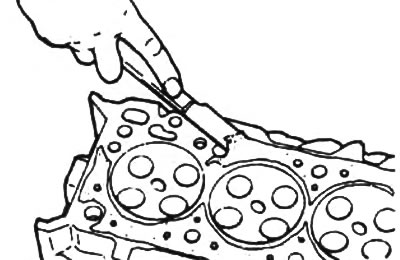
b) Clean the surfaces of the combustion chambers of the cylinder head with a wire brush, removing any remaining carbon deposits.
c) Clean the surface of the cylinder head that mates with the surface of the cylinder block using a soft brush and solvent.
3. Using penetrating dye, check for cracks in the combustion chambers, intake and exhaust ports, and gas joint surfaces. If cracks are present, replace the cylinder head.
4. Check the valves for proper fit. Replace them if necessary.
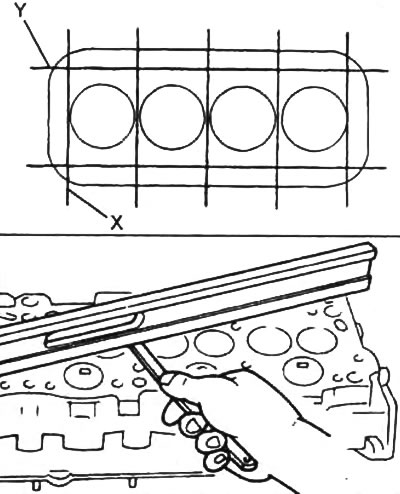
5. Check the cylinder head. Using a precision ruler and a flat feeler gauge, as shown in the figure, check the non-flatness of the working surfaces of the cylinder head mating with the surface of the cylinder block, intake and exhaust manifold.
Caution: Handle the cylinder head carefully, being careful not to damage its lower surface.
Maximum permissible non-flatness of the surface mating with the cylinder block surface:
- in the direction "X" - 0.02 m/m
- in the direction "Y" - 0.05 m/m
The maximum permissible non-flatness of the surface mating with the surfaces of the intake and exhaust manifolds is 0.05 mm
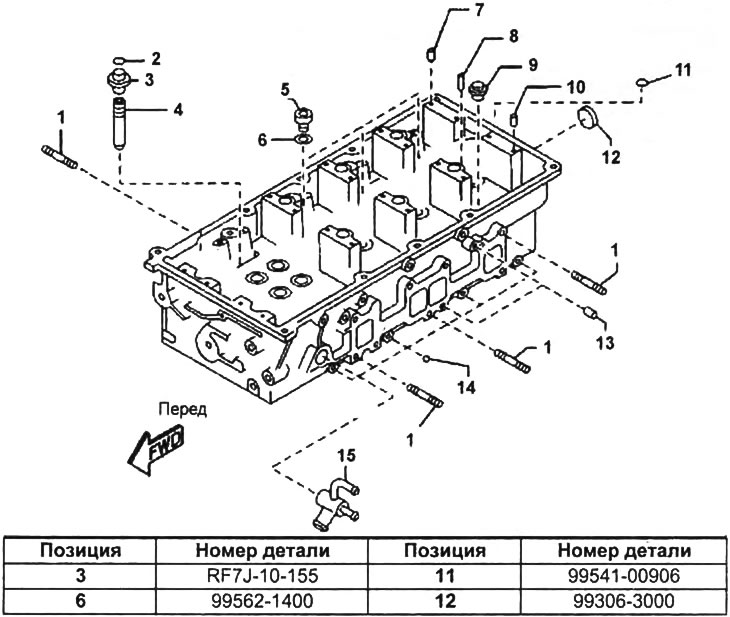
Cylinder head.
1 - hairpin,
2 - retaining ring,
3 - oil seal,
4 - valve guide bushing,
5 - valve,
6 - gasket,
7, 8, 10 - pin,
9 - threaded plug,
11 - sealing ring,
12 - sealing plug,
13 - plug,
14 - steel ball,
15 - cooling system pipe.
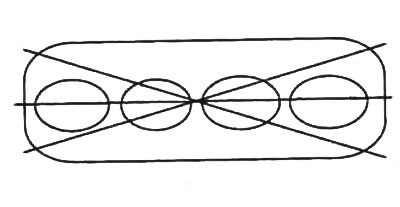
If the out-of-flatness value exceeds the maximum permissible value, replace the cylinder head or grind it.
- Grinding value - 0.15 mm
6. Clean the valves.
a) Use a scraper to remove carbon deposits from the valve plate.
b) Use a brush to thoroughly clean the valve.
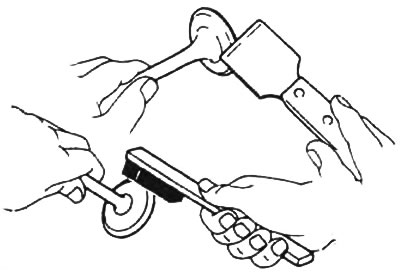
7. Check and grind the valves.
a) Check the thickness of the cylindrical part of the valve plate.
Valve Plate Thickness:
- inlet - 1.55 - 1.85 mm
- release - 1.80 - 2.10 mm
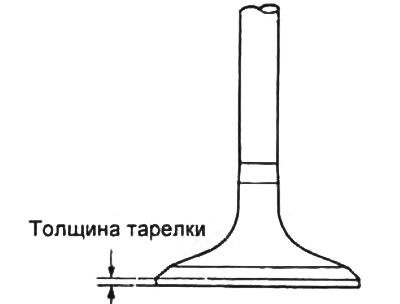
If the thickness of the cylindrical portion of the valve plate is less than the specified value, replace the valve.
b) Check the overall length of the valve.
Nominal length:
- intake - 111.65 -112.25 mm
- release - 111.6 - 112.2 mm
Minimum length:
- inlet - 111.50 mm
- release - 111.44 mm
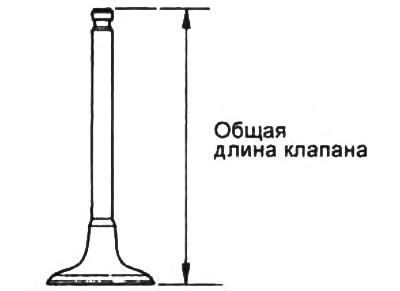
If the overall length is less than the minimum, replace the valve.
c) Check the condition of the end surface of the valves for wear.
If the valve end is worn, regrind the end or replace the valve.
d) Using a bore gauge, measure the inner diameter of the valve guide bushings at three levels and two planes.
- Nominal diameter - 6.025 - 6.045 mm
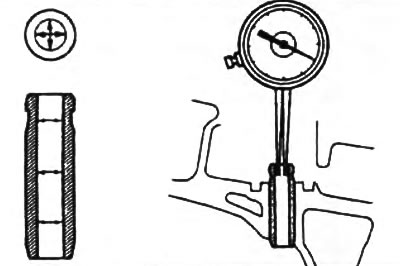
If necessary, replace the valve guide bushing,
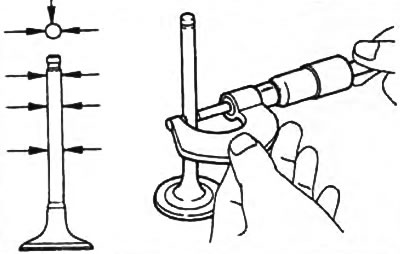
d) Using a micrometer, measure the diameter of the valve stem at three levels and two planes.
Nominal diameter:
- intake 5.970 - 5.985 mm
- release - 5,965 - 5,980 mm
Minimum diameter:
- inlet - 5.920 mm
- release - 5.915 mm
Article is based on website data Mazbook
Replace the valve if necessary.
8. Check the valve seat chamfer surface for damage. If necessary, use a valve seat cutter or valve lapping tool to obtain the specified profile.
- Apply a thin layer of white paint to the valve seat. Press the valve face against the seat, but do not rotate the valve. Then remove the valve and inspect the seat and valve face.
- If paint remains around the entire circumference (360°) of the valve bevel, the valve is concentric. Otherwise, replace the valve.
- If paint shows up all the way around (360°) the valve seat, the valve guide and valve seat are concentric. Otherwise, regrind the chamfer.
- Make sure the contact patch is in the middle of the valve face and is the correct width.
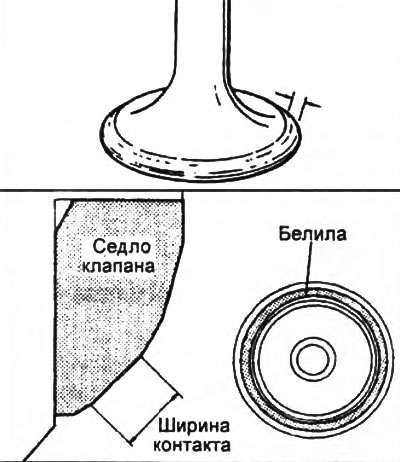
- Normal contact patch width is 13 - 1.9 mm
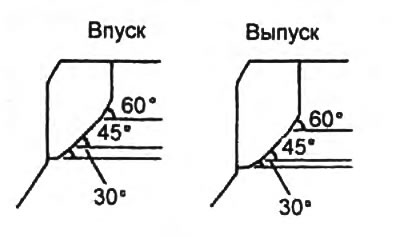
Otherwise, adjust the chamfer as follows:
- If the contact patch is located too high on the valve chamfer, use 60° and 45° cutters to regrind the seat.
- If the contact patch is located too low on the valve chamfer, use 30° and 45° cutters to regrind the seat.
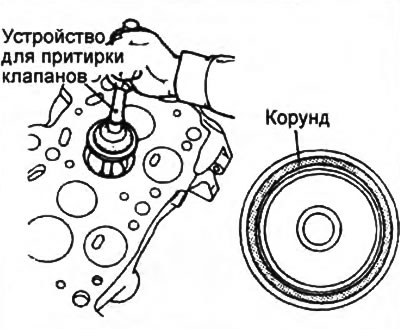
9. Grind the valve. To grind the valve, apply a thin layer of motor oil mixed with a small amount of corundum to the seat surface, and then lightly tap the valve while rotating it. After grinding, clean the valve and valve seat.
Attention:
- When lapping the valve, be careful and cautious so that the corundum does not stick to the valve stem.
- The position of the valve contact relative to the valve seat must be at the center of the circle, and the contact width must have standard designations.
10. Check the position of the valve plate relative to the plane of the cylinder head.
Nominal clearance:
- inlet - 0.79 - 1.27 mm
- release - 0.84 - 1.32 mm
Maximum clearance:
- inlet - 1.68 mm
- release - 1.73 mm
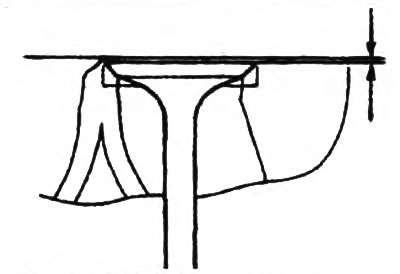
If the clearance is greater than maximum, replace the cylinder head.
11. Check the valve springs.
a) Using a metal square (90°), check that the spring is not perpendicular.
- Maximum permissible non-perpendicularity is 1.60 mm (2°)
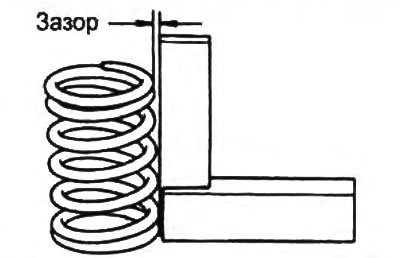
If the deviation from perpendicularity is outside the permissible limits, replace the spring,
b) Using a spring tester, measure the force required to compress the spring to the installed length of 39.0 mm.
- Force - 172.9 - 195.6 N
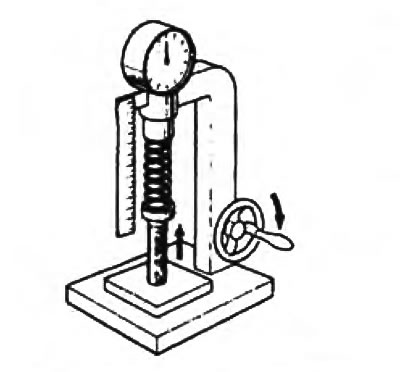
If the force is outside the specified limits, replace the valve spring.
12. Check the clearance between the adjusting screw and the rocker as shown in the figure. If the clearance is not within the nominal value, adjust it.
- Nominal clearance "A" - 0 - 4 mm
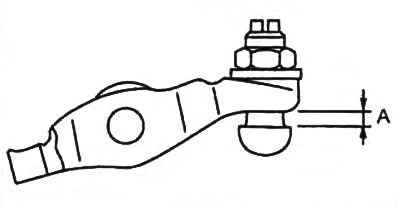
13. Check the camshaft and bearings.
A. Check the camshaft for bending,
a) Place the camshaft on the prisms.
b) Using a dial indicator, check the runout of the camshaft relative to the center journal.
- Maximum runout - 0.03 mm
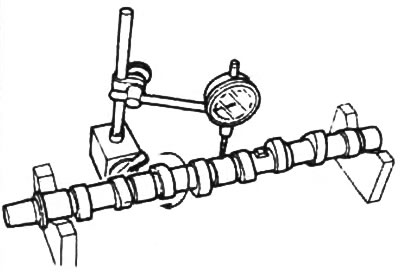
If the runout exceeds the permissible value, replace the camshaft.
B. Measure the camshaft lobe height.
Nominal height:
- intake - 42.067 - 42.167 mm
- release - 41,949 - 42,049 mm
Minimum height:
- inlet - 41.717 mm
- release - 41.599 mm
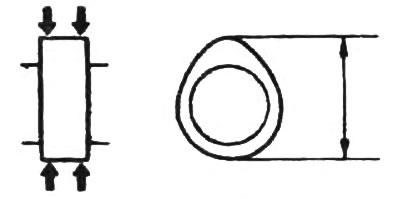
If the cam lobe height is less than minimum, replace the camshaft.
B. Measure the diameter of the camshaft bearing journals at the locations shown in the illustration. If the diameter is less than the minimum, replace the camshaft.
Nominal diameter:
- neck No.1 - 31.940 - 31.965 mm
- n92 necks - No.4 - 25.910 - 25.935 mm
- neck No.5 - 25.940 - 25.965 mm
Minimum diameter:
- neck No.1 - 31.890 mm
- necks #2 - #4 — 25.860 mm
- neck No.5 - 25.890 mm
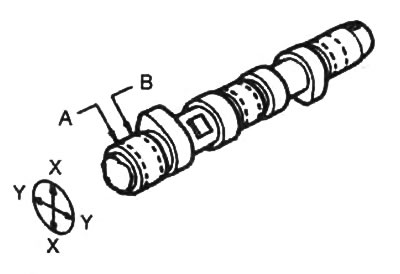
G. Check the radial oil clearance in the camshaft bearings.
a) Clean the camshaft and cylinder head beds.
b) Place a plastic feeler gauge on each camshaft bearing journal.
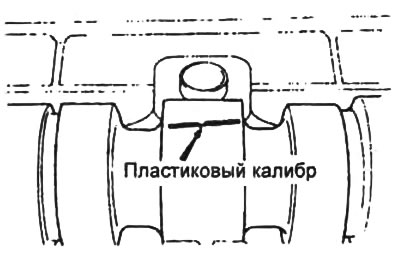
c) Install the camshaft bearing caps (see chapter "Engine. Mechanical part").
- Tightening torque: 8-10 Nm
d) Remove the camshaft bearing caps (see chapter "Engine. Mechanical part").
d) After measuring the width of the gauge, determine the gap
Nominal clearance:
- neck No.1 - 0.035 - 0.081 mm
- necks No.2 - No.4 - 0.065 - 0.111 mm
- neck No.5 - 0.056 - 0.081 mm
Maximum clearance:
- neck N91 - 0.12 mm
- necks No.2 - No.4 - 0.15 mm
- neck No.5 - 0.16 mm
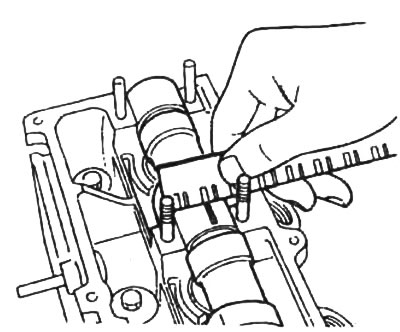
If the clearance exceeds the specified limit, replace the cylinder head and camshaft.
D. Check the axial clearance of the camshaft. To do this, install the camshaft. Using a dial indicator, measure the axial clearance while moving the camshaft back and forth.
Axial clearance:
- nominal - 0.03 - 0.16 mm
- maximum - 0.20 mm
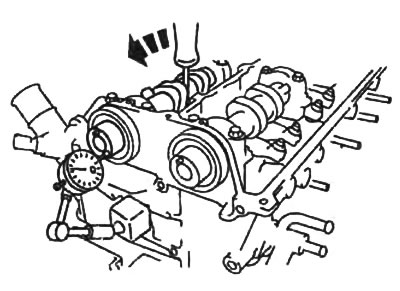
If the axial clearance is greater than maximum, replace the camshaft or cylinder head.