

Assembly Notes
1. Adjust the clearance of the axle gears and satellites,
a) Install the pointer indicator on the satellite as shown in the figure.
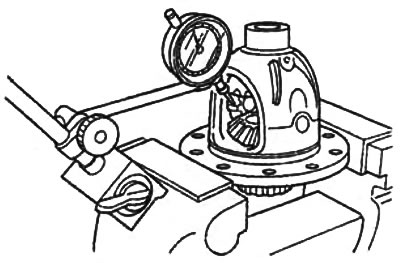
b) Fix one of the axle gears from rotating.
c) Measure the clearance by moving the satellite.
- Backlash - 0-0.1 mm
If necessary, adjust the clearance by selecting the thickness of the thrust washers.
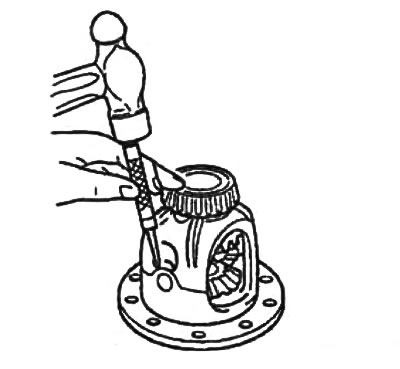
2. Install the axle gears, thrust washers, satellites, satellite shaft and axle pin. Using a rod of suitable diameter, install the satellite shaft pin so that the pin does not protrude from the housing.
3. Install the final drive driven gear.
a) Apply sealant to the contact surfaces of the driven gear and differential housing.
b) Install the driven gear and tighten the bolts.
- Tightening torque - 130 - 100 Nm
4. Using a press and a mandrel, press the side bearings onto the differential housing.
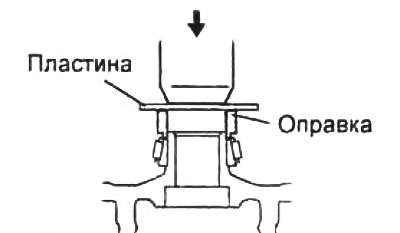
5. Using a hammer and a drift, install the oil deflector.
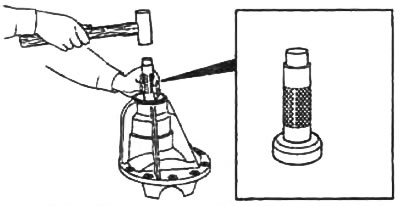
6. Using a press and mandrel, press the outer race of the front bearing into the gearbox housing.
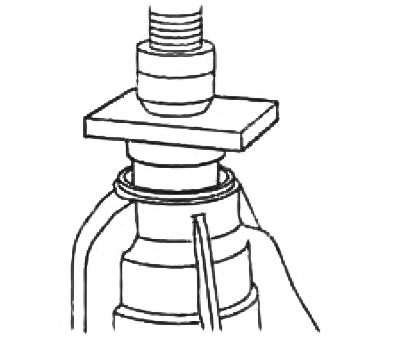
7. Using a press and a special mandrel, press the outer ring of the rear bearing into the gearbox housing.
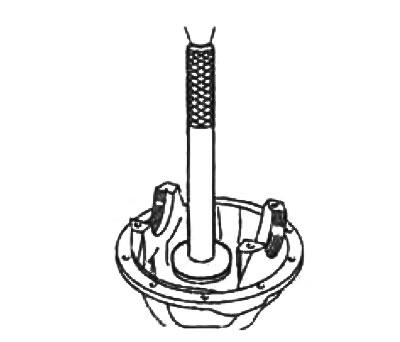
8. Adjusting the height of the drive gear.
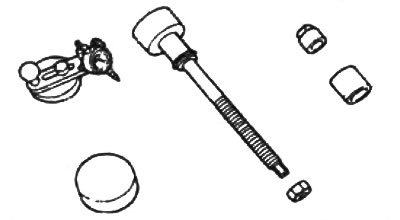
Special devices for adjustment
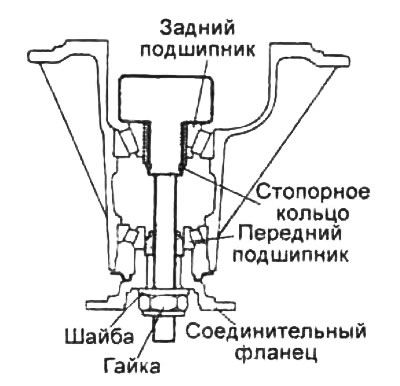
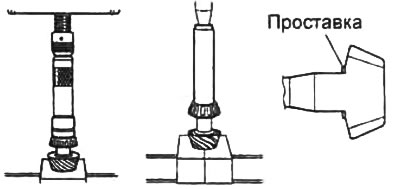
a) Place the rear bearing on the special tool and install the tool together with the rear bearing into the gearbox housing.
b) Install the front bearing and washer onto the special tool. Tighten the special tool nut so that it can be rotated by hand.
Caution: Do not install adjusting shims.
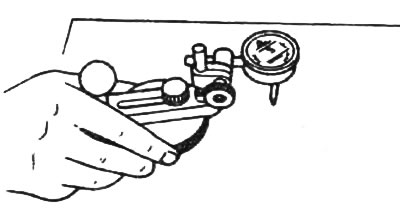
c) Place the special device with the pointer indicator on a flat surface and set the indicator arrow to zero.
d) Install the device with the indicator as shown in the figure.
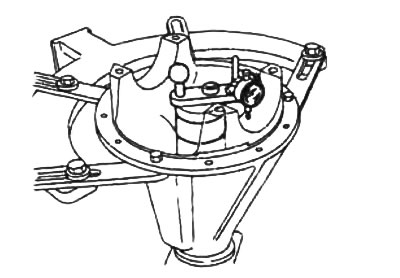
d) Place the indicator measuring tip on the place of the gearbox housing where the side bearing beds are located. Measure the positions of the lowest points of the right and left bearing beds.
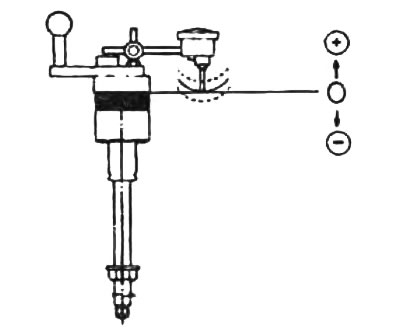
e) Add the two quantities (right and left), defined in point "d", and divide the resulting amount by 2.
From the result, subtract the number printed on the end of the drive gear and divide by 100 (the absence of a number corresponds to the value zero).
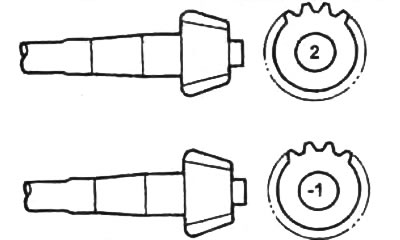
Meaning of marks on the drive gear:
- "2" — +0.02 mm
- "-1" — - 0.01 mm
Example:
The value of the two measured quantities is 0.14 and 0.26 mm and the number on the drive gear is 2.
(0,18 + 0,26)/2 - 2/100 = 0,20
The adjustment index value for this pinion and gearbox housing assembly is 0.20mm.
Select adjusting shims of this thickness and install them between the bearing housing and the gearbox housing.
Note:
- select the thickness of the set of adjusting shims with an accuracy of 0±0.03 mm;
- no more than five pads can be used.
9. Using a press and special mandrels, press the rear bearing onto the drive pinion shaft.
10. Adjusting the preload of the drive gear bearings.
Caution: Do not install the oil seal.
a) Install the pinion gear, new spacer sleeve, coupling flange, washer and new adjusting nut into the bearing housing. Temporarily tighten the adjusting nut.
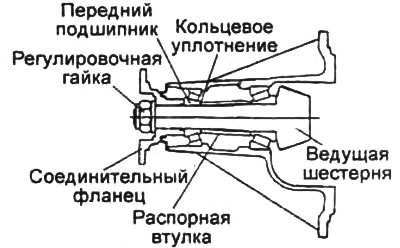
b) To install the bearings, turn the connecting flange by hand.
c) To achieve the set bearing preload, hold the connecting flange with a special device and tighten the adjusting nut to the lower tightening torque value.
- Tightening torque - 298 - 500 Nm
- Preload of pinion bearings - 2.55 - 4.00 Nm
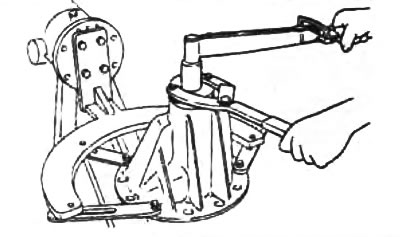
Note: If the specified preload cannot be achieved, disassemble the assembly, re-adjust the pinion height, and adjust the preload using a new spacer sleeve.
d) Remove the adjusting nut, washer and connecting flange.
11. Using a drift and hammer, press the seal completely into the housing.
Note: Lubricate the sealing lip of the oil seal with transmission oil.
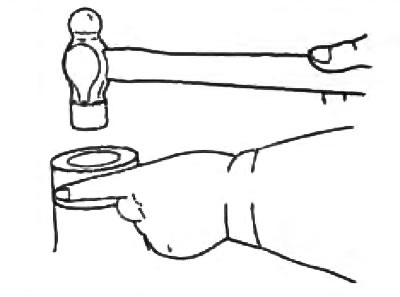
12. Install the differential and adjust the gear play.
a) Install the differential into the gearbox housing.
b) Press the differential housing to the left side of the gearbox housing. Measure the distance between the side bearing and the gearbox housing. The measured distance is the total thickness of the side spacers.
c) Distribute the total thickness of the shims obtained in point "b" equally between the left and right sides and install the corresponding shims. Install the side bearing caps.
d) Make four marks on the driven gear at 90° intervals.
d) Install the pointer indicator on the gearbox housing so that its pin contacts one of the teeth of the driven gear at a right angle.
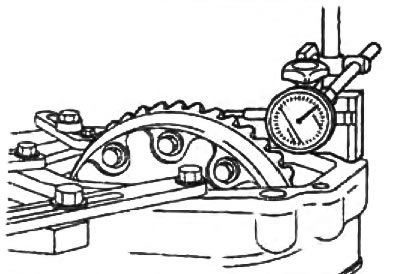
e) Hold the coupling flange and rotate the driven gear to measure the backlash at the four marked positions. Make sure that the minimum backlash is not less than 0.05 mm, and that the backlash at other positions does not differ from the measured value by less than 0.03 mm.
Note: The various clearance measurements must fall between the minimum and maximum clearance limits.
- Standard play values are 0.12 - 0.20 mm
- The maximum difference between clearances is 0.03 mm
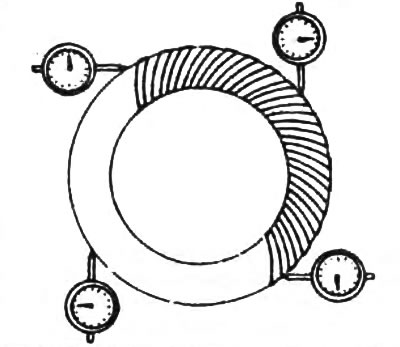
If the clearance value does not fit within the established norms, adjust it by reducing the thickness of the gaskets on one side of the differential and increasing it on the other by the same amount.
g) Using a torque wrench, turn the drive gear 3 times and then measure the rotating resistance.
- The torque of rotation resistance is less than 2.4 Nm
If the clearance is within the norm, but the rotation resistance of the drive gear exceeds the norm, then adjust the rotation resistance by reducing the thickness of the side bearing gaskets.
Note: The thickness of the spacers should be reduced by the same amount on both sides.
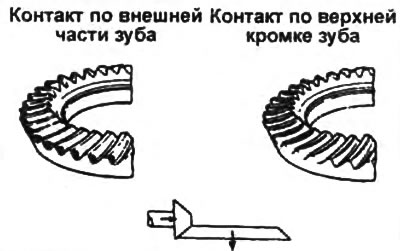
13. Checking and adjusting the contact patch in the main gear.
a) Apply a thin layer of red lead to both surfaces of the 6-8 teeth of the driven gear of the main transmission.
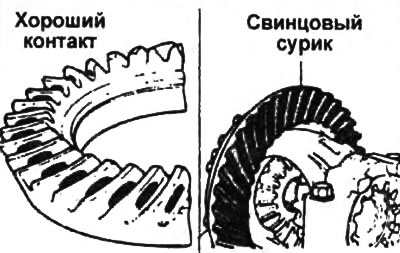
b) Turn the drive gear back and forth several times and check the contact of the teeth.
c) If the contact is good, remove the lead red applied for testing.
d) If the contact is poor, adjust the height of the drive gear and then adjust the backlash.
Contact along the inside of the tooth and along the base of the tooth.
Select a set of shims to move the drive gear along its axis away from the driven gear.
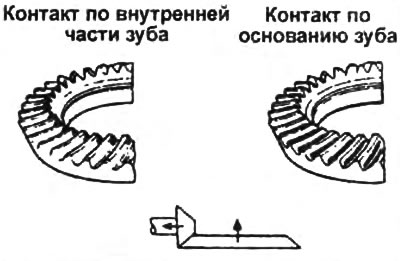
Contact along the outer part of the tooth and along the upper edge of the tooth.
Select a set of shims to move the drive gear along its axis towards the driven gear.