


Warnings!
- Be sure to replace all the pads on one axle of the car, even if only one is worn out. If old brake pads are reinstalled, they must be marked before removal.
- Work on the brake mechanisms of each wheel in turn; if necessary, the assembled brake mechanism on the other wheel will act as the original.
- Remember that when brake pads are in use, dust is generated from their abrasion, which contains asbestos, which is harmful to health.
Remove the cap from the brake fluid reservoir and drain approximately 1 liter of brake fluid.
Loosen the front wheel mounting bolts, raise the front of the vehicle, securely support it on stands and remove the front wheels.
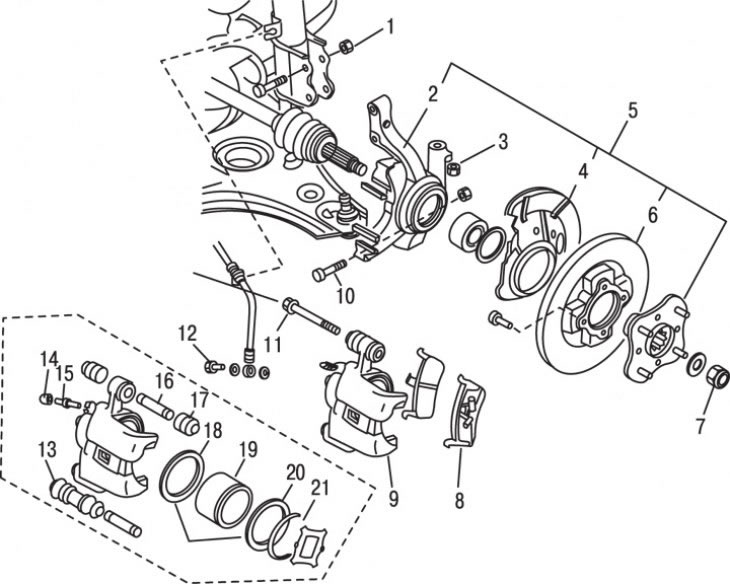
Figure 10.2. Front disc brake mechanism and steering knuckle: 1 – bolt and nut; 2 – steering knuckle; 3 – nut; 4 – front brake protective cover; 5 – front wheel hub assembly; 6 – brake disc; 7 – hub nuts; 8 – outer brake shoe; 9 – support; 10 – bolt and nut; 11 – caliper mounting bolts; 12 – hollow bolt for fastening the brake hose; 13 – bushing; 14 – rubber cap; 15 – air bleed nipple; 16 – guide pin; 17 – dust cover; 18 – piston seal; 19 – piston; 20 – dust seal; 21 – retainer
Remove the two caliper mounting bolts (figure 10.2).
Rotate the caliper upward, moving it away from the brake disc. Support the caliper with your hands or secure it to the suspension strut with twine or wire so that it does not hang down by the brake hose.
Use a screwdriver to remove the retaining clips and remove the outer brake shoe. Remove the noise insulation pad from the back of the brake pad.
Remove the inner brake pad by lifting it out of the caliper and take out the noise insulation lining.
Inspect the caliper boot by carefully peeling back the edges of the boot and checking for any fluid leaks. If a leak is found, remove the caliper for overhaul or replacement.
Use a C-clamp to press the piston into the caliper until it stops.
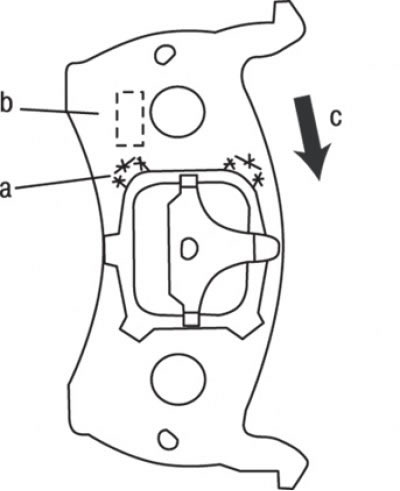
Figure 10.3. Installation position of noise insulation pads on brake pads: a - removed protrusions; b – mark indicating right or left side; c – direction of rotation of the brake disc
Install noise-insulating pads on new brake pads (figure 10.3).
Position the inner brake pad correctly and snap it onto the piston.
Insert the outer brake pad and snap it into the caliper.
Lower the caliper into place.
Install the caliper mounting bolts and tighten them to the specified torque.
Press the brake pedal several times to ensure that the brake pads are seated with a certain gap in relation to the brake disc, then fill the reservoir with brake fluid.
Install the wheels and lower the vehicle. Tighten the wheel nuts to the specified torque.
Avoid hard braking as much as possible for the first few hundred kilometers of your vehicle until the new pads are fully seated.