


Clean the outside of the caliper with brake fluid, denatured alcohol, or a brake cleaning system (never use gasoline or kerosene), then place the support on a clean workbench.
Unscrew the bleed nipple.
If the piston has not been removed, remove it from the caliper by applying low-pressure air to the brake cylinder through the brake hose connection hole, using a wooden block instead of the brake pads. Use only enough air pressure to push the piston out of the hole. If the piston is ejected with great force, even if the wooden block remains in place, the piston may be damaged.
Caution: When using compressed air to remove the piston, never place your fingers in front of the piston to try to catch or protect it, as this could cause serious injury.
Remove the retainer and dust seal from the caliper piston bore.
Using a wooden or plastic tool, pry the piston seal out of the groove in the caliper cylinder. Using metal tools may damage the caliper cylinder.
Remove the dust boots, guide pins and bushings from the caliper ears.
Clean the remaining parts with brake fluid. Wait until all the brake fluid has drained, and then shake the parts vigorously to remove as much fluid as possible.
Carefully inspect the caliper piston and cylinder for nicks, scoring, corrosion, and abrasions. If surface defects are found, replace the parts. It is permissible to treat the caliper cylinder with fine-grained sandpaper to remove traces of light corrosion and stains. Inspect bolts, pins and bushings for signs of corrosion and damage, replace worn parts as necessary.
When assembling, lubricate the piston bore and seal with clean brake fluid. Apply red grease from the repair kit to the piston seal.
Install the seal into the groove of the caliper cylinder.
Place the dust seal on the piston. Apply some of the orange grease from the repair kit to the dust seal, then install the piston and dust seal into the caliper cylinder. Install the dust seal retainer.
Screw the air bleed nipple into the caliper.
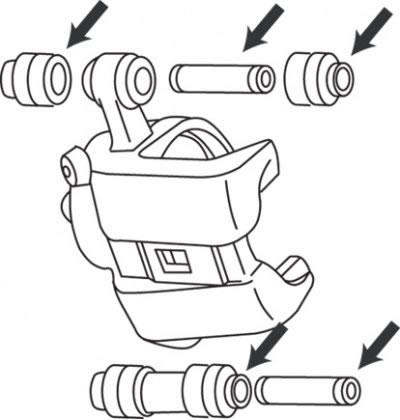
Figure 10.4. Lubrication points for caliper boots, guide pins and pins
Lubricate the dust boots, guide pins and pins with orange grease and install into the caliper (figure 10.4).
Apply a light coat of lubricant to the brake pad linings (mazda specification number 817 549 248) or a special soundproofing compound. Avoid contact of lubricant with friction surfaces. Install the brake pads.
Install the caliper and bleed the air from the hydraulic drive of the brake system.
(The original article is available on: «MAZBOOK»)