


2. Place the car with the charged battery as close to your car as possible so that the batteries are practically next to each other, but do not allow the cars to touch.
3. Turn off all non-essential power consumers.
4. Unscrew the caps of both batteries and place rags on the open batteries (except for batteries that do not require maintenance).
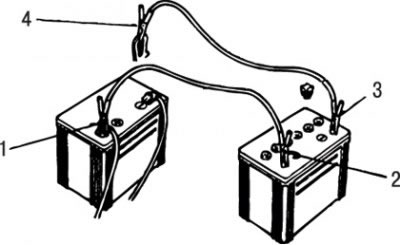
Figure 1.38. Sequence of connecting wires when starting the engine using a donor battery: a - discharged battery; b – auxiliary battery; 1 – positive terminal of auxiliary battery; 2 – positive terminal of the discharged battery; 3 – negative terminal of auxiliary battery; 4 – "mass" stationary metal point
5. First, connect one end of the cable to the positive terminal of the discharged battery, then the other end of the same cable to the positive terminal of the "donor" battery (figure 1.38). Next, connect one end of the second wire to the negative terminal of the auxiliary battery, and then the other end to the "ground" stationary metal point (for example, to the engine mount). Do not connect the cable from the negative terminal of the booster battery to the negative terminal of the dead battery.
6. Run the auxiliary vehicle's engine at high speed until the generator begins to generate voltage.
(The original text is published on MazBook.ru)
7. If the engine does not start immediately, allow the starter time to cool down. Then start the engine of the auxiliary vehicle, which will charge the discharged battery a little.
8. When removing the jumper cables, first disconnect the cable from the negative terminal of the charged jumper battery.