


Contents: Speedometer ⇓ Direction indicator/hazard warning…⇓ Coolant temperature gauge ⇓ Fuel level indicator ⇓ Control lamps ⇓ Switching the fuel level indicator…⇓ Trip meter ⇓ Tachometer ⇓ Hood release button ⇓ Adjusting the instrument panel…⇓ Heated rear window switch ⇓ Rear window wiper and washer switch ⇓ Watch ⇓ Headlight washer switch ⇓ Shock absorber regulator ⇓ Cigarette lighter ⇓ Ashtray ⇓ Lockable storage compartment under…⇓ Glove box ⇓
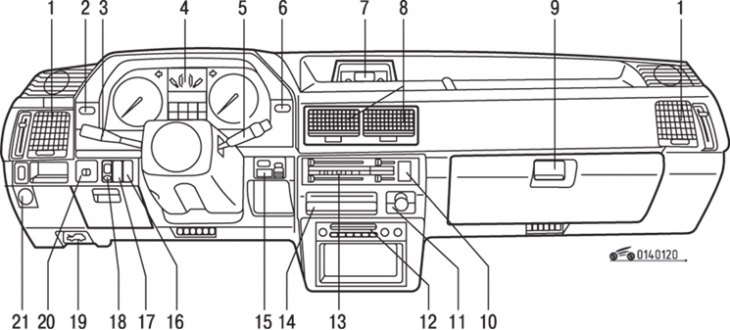
Figure 1.20. Controls, instruments and equipment: 1 – side ventilation nozzles; 2 – rear window heating switch; 3 – light switch; 4 – instrument cluster; 5 – Windscreen wiper and washer switch; 6 – Hazard warning light switch; 7 o'clock; 8 – central ventilation nozzles; 9 – glove compartment; 10 – air conditioning switch; 11 – cigarette lighter; 12 – radio; 13 – Heater/air conditioning control unit; 14 – ashtray; 15 – air damper control handle (gasoline engine); 16 – headlight washer switch; 17 – Rear window wiper and washer switch; 18 – instrument lighting control; 19 – hood lock release button; 20 – Electrically adjustable outside rearview mirror position switch; 21 – shock absorber regulator;
The arrangement of instruments and controls is shown in the figure 1.20.
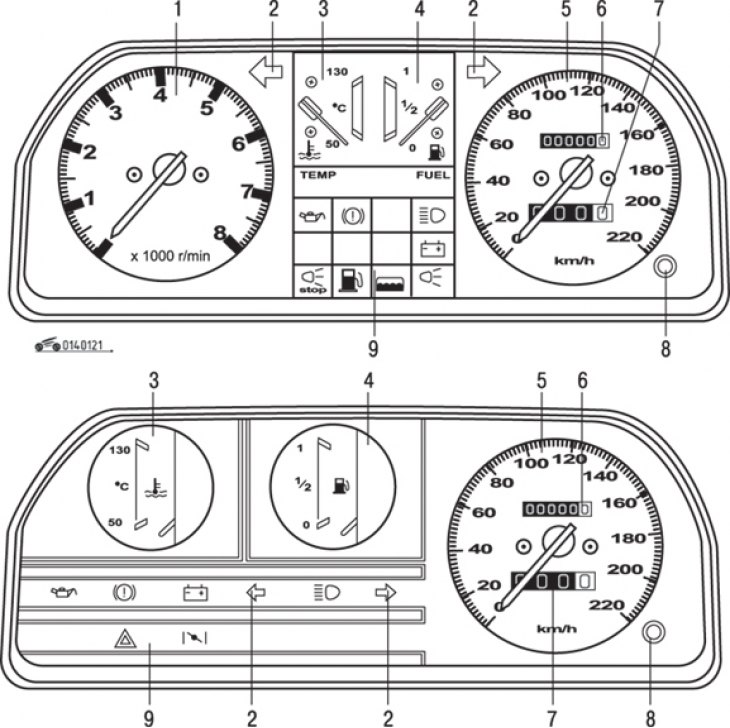
Figure 1.21. Instrument clusters with analog instruments (type A): 1 – tachometer; 2 – direction indicator/hazard warning lights; 3 – coolant temperature gauge; 4 – fuel level indicator; 5 – speedometer; 6 – total mileage counter; 7* – daily mileage counter; 8* – trip meter reset button; 9 – control lamps
The appearance of the combinations with analog instruments is shown in the figure 1.21, the combination with electronic devices is shown in the figure 1.22.
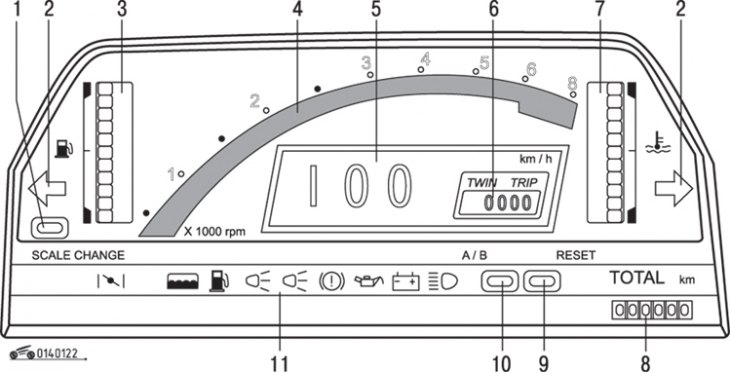
Figure 1.22. Instrument cluster with electronic instruments (type B): 1 – button for switching indication ranges; 2 – direction indicator/hazard warning lights; 3 – fuel level indicator; 4 – tachometer; 5 – speedometer; 6* – daily mileage counter; 7 – coolant temperature gauge; 8 – total mileage counter; 9* – trip meter reset button; 10 – daily mileage counter; 11 – control lamps
Note: The list of controls and instrumentation depends on the vehicle configuration or is installed upon request.
Speedometer
Shows the vehicle speed in km/h.
Total mileage counter
The counter shows the total mileage of the vehicle.
Trip meter
Shows the mileage since it was last reset.
Trip meter reset button
Pressing the button resets the counter.
Direction indicator/hazard warning light indicator lamps
If the turn signal indicator lamps do not function properly, the turn signal system is faulty. The fault must be corrected as quickly as possible.
Both direction indicator lamps will light simultaneously if the hazard warning lights are activated.
Coolant temperature gauge
Shows the temperature of the coolant in the engine cooling system.
For type A:
if the gauge needle goes outside the normal range, the engine is overheated.
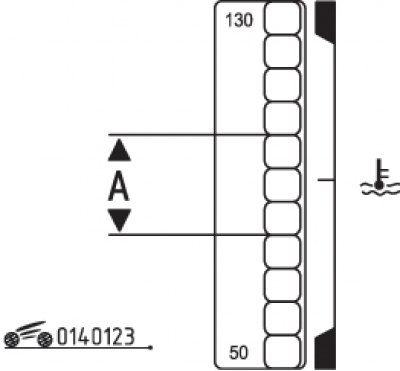
Figure 1.23. Normal temperature zone (A) shown by the electronic coolant temperature gauge
For type B:
Attention!
when the engine is overheated, all indicator zones flash (figure 1.23).
If the engine overheats, take the following measures.
1. Stop the car on the side of the road.
2. Turn off the air conditioner.
3. Stop the engine if coolant or steam comes out of the radiator. Turn the ignition key back to the "ON" ("II") position without starting the engine. In this position of the ignition key, the fan operates in automatic mode. If it does not work, please contact your Mazda service center for advice.
4. If coolant does not come out, leave the engine idling and open the hood for more effective cooling.
5. If the temperature does not decrease when the engine is idling, stop the engine and wait until it cools down.
Caution! If the coolant temperature gauge is faulty, a signal will be given in the form of flashing zones "H" (130°C) and "C" (50°C). Take the necessary measures to eliminate the cause of the fault as soon as possible (only on vehicles with electronic instruments).
6. Check the coolant supply hose at the connection points for leaks. Stop the engine immediately if you detect a coolant leak.
7. Check the coolant level if there is no leakage. If necessary, add the prescribed coolant.
Fuel level indicator
The fuel gauge shows how much fuel is in the fuel tank. Tank capacity is 60 l.
Caution! For Type B: If the lowest zone of the gauge starts flashing, the fuel level in the tank has dropped to approximately 5 liters.
If the ignition was not turned off when refueling, it will take a significant amount of time for the indicator to reach the required fuel level. Therefore, when refueling, turn off the ignition. If the fuel gauge malfunctions, the "F" ("1") and ("0") segments will flash. Take the necessary measures to correct the cause of the malfunction as soon as possible.
Control lamps
Caution! The warning lights can be checked by turning the ignition key to the "ON" ("ll") position without starting the engine or applying the parking brake. If the warning lights do not illuminate, they should be checked by a Mazda service workshop.
 High beam indicator lamp
Lights up when the high beam is on.
 Battery charging indicator light
Lights up when the ignition is turned on and goes out after the engine starts. The generator is driven by a durable V-belt. If the indicator light comes on while driving, you must do the following.
1. Stop the car.
2. With the engine running, check the tension of the V-belt and its condition.
3. If the V-belt is in good condition, then there is a problem with the battery charging system. It is recommended to identify the fault as soon as possible and take the vehicle to the dealer for repair.
 Low brake fluid and parking brake warning light
Parking brake applied warning signal
When the parking brake and ignition are on, the indicator lamp comes on. It should go out when the parking brake is released.
Brake fluid level warning signal
If this lamp comes on after the parking brake is released with the ignition on, it means the brake fluid level in the reservoir is too low. If the indicator light comes on while driving, you must do the following.
1. Check that the parking brake lever is fully released.
2. If this is the case and the indicator light remains on, carefully pull the vehicle over to the side of the road.
3. With the engine running, immediately check the brake fluid level and top up if necessary. Check all components of the hydraulic brake system for leaks.
4. If any leaks or faulty brakes are detected, the warning light will remain on – you cannot continue driving the vehicle. The vehicle must be towed to a Mazda dealer to have the brake system inspected and any necessary repairs made.
Caution! If the brake fluid level in the reservoir is too low, immediately contact your nearest service center to have the brake system checked. When driving, you need to press harder on the brake pedal when braking and take into account the possibility of increasing the braking distance and free pedal travel.
 Hazard warning light indicator
Lights up when the hazard warning light system is activated.
At the same time, all direction indicators flash simultaneously.
 Low oil pressure warning light
Lights up when the oil pressure is below the maximum permissible level.
If this warning light comes on while driving, you must stop driving, stop the engine, check the engine oil level and, if necessary, top it up to normal.
If the warning light is on even though the engine oil level is normal, you should not continue driving. The engine must not be allowed to run even at idle speed – qualified assistance is required.
Caution! If the above instructions are not followed and the vehicle continues to be used, the engine may be seriously damaged.
 Low fuel level warning lamp and buzzer
The low fuel indicator lamp and warning sound come on when approximately 10 litres of fuel remain in the fuel tank.
 Brake light burnout indicator lamp
If a brake light bulb burns out or a malfunction occurs in the brake light electrical circuit, the indicator lamp lights up. Correct the problem immediately.
 Washer fluid reservoir level indicator light
The warning lamp comes on as soon as the fluid level in the windshield washer reservoir drops to the lowest level. Check the fluid level and add fluid if necessary.
 Upshift indicator light
If this warning light comes on, it means that the fuel consumption in the gear engaged is excessively high. In this case, to reduce fuel consumption, shift the gearbox to the next higher gear.
 Accelerator pedal overpressure warning light
This indicator lamp comes on if the accelerator pedal is pressed too much. In this case, to reduce fuel consumption, release the accelerator pedal until the lamp goes out.
 Rear fog light indicator lamp
This indicator lamp comes on when the rear fog lights are switched on.
 Air damper indicator light
The indicator lamp lights up when the air damper control handle is pulled out.
 Rear side light bulb burnout indicator lamp
If this indicator light comes on, it means that the rear parking light is not working or the electrical circuit is damaged. The malfunction must be corrected immediately.
Cold engine start indicator light (diesel engine)
The control lamp lights up when the cold diesel engine starter handle is pulled out.
 Coolant level indicator/warning light (for diesel engine)
When the ignition is on, this indicator lamp lights to check the operation of the bulb and should go out after the engine starts. If the warning light comes on or the warning signal sounds while driving, you must perform the following steps.
1. Stop the car on the side of the road.
2. Turn off the engine and let it cool. If there is no coolant leak, check the coolant level in the expansion tank and radiator. Add coolant if necessary.
3. If the warning light does not go out, have the vehicle towed to the nearest Mazda service center.
Caution: Since the engine is made of aluminum alloy, be sure to use ethylene glycol-based antifreeze.
 Water separator operation indicator/warning light (for diesel engine)
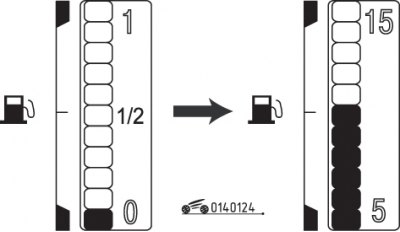
Figure 1.24. Switching the fuel level indicator to the lower range of 5–15 l when pressing the button "SCALE CHANGE"
Switching the fuel level indicator display range
(only in the electronic instrument cluster). If you press the button "SCALE CHANGE", the lower range of the fuel level indicator 5–15 l will be shown in an expanded form (figure 1.24). After about 5 seconds, the countdown will switch back to normal.
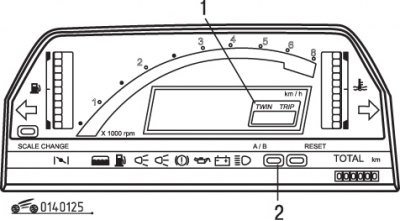
Figure 1.25. Location of the trip meter (1) and the switch button (2) in the instrument cluster
Trip meter
(only in the electronic instrument cluster). The meter can be used to measure two different sections of the route. Pressing the button will switch between the "A" and "B" readings (figure 1.25). The "A" (or "B") reading can be set back to zero by holding down the reset button for approximately 1 second. You could, for example, use one meter to measure fuel consumption and another meter to measure distance traveled. The daily mileage readings in km correspond to the speedometer readings.
Tachometer
Determines the engine crankshaft speed in thousands of revolutions per minute.
Caution! Do not run the engine in the red tachometer range—this may cause serious engine damage.
Hood release button
The hood opens after pulling the hood release button towards you – the hood is released from the locking device and rises upward under the action of the spring.
Unlock the hood latch and lift it.
Use the support rod to secure the hood in the open position.
Before closing the hood, install the support rod back into the holder.
Lower the hood and allow it to engage the latch.
Adjusting the instrument panel lighting
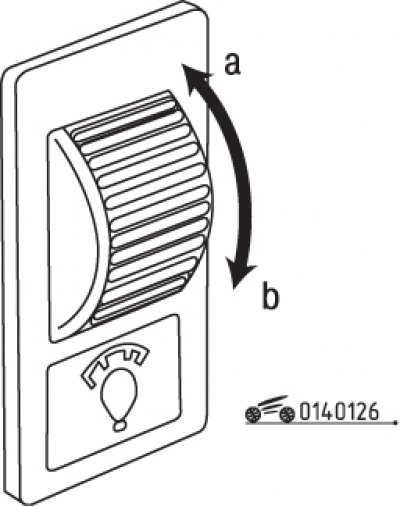
Figure 1.26. Direction of rotation of the control to increase (a) or decrease (b) the brightness of the instrument panel backlight
Rotating the knob sets the brightness of the instrument panel lighting (figure 1.26).
Heated rear window switch
The rear window heating can be switched on when the ignition is on (the key position in the ignition switch is "ON"/"II") by pressing the switch.
When the rear window heating is on, the indicator lamp comes on.
Attention! Do not use sharp objects or abrasive cleaning agents to clean the interior of the rear window, as this may damage the wire heating elements.
Rear window wiper and washer switch
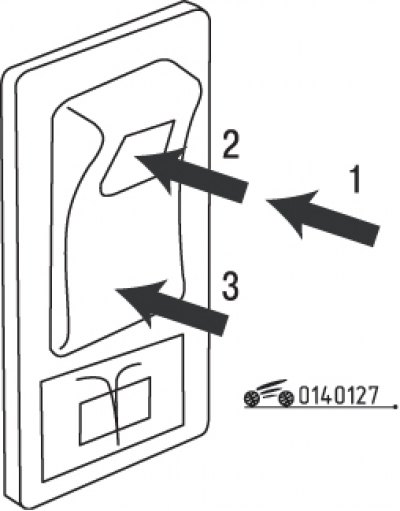
Figure 1.27. Rear window wiper and washer switch: 1 – turning on only the windshield wiper; 2 – turning on the windshield wiper and washer; 3 – turning on only the windshield washer
The rear window wiper and washer are activated by the switch shown in the figure 1.27.
Caution: If the washer does not work, check the fluid level in the washer reservoir.
Watch
To set the time, turn the key in the ignition switch to the "ON" ("II") position.
Pressing the "RESET" button resets the minutes display to zero.
Releasing the button will set the full hour.
For example, if the button is pressed between 0:01 and 9:29, the display will change to 9:00. Between 9:30 and 9:59, it will change to 10:00. The time can be set in a similar way, for example, using a time signal transmitted by radio.
If the "HOUR" button is pressed, the hour display will change.
If the "MIN" button is pressed, the minutes display will change.
Headlight washer switch
Washing fluid will spray onto the headlight lenses if the switch is turned on while the ignition is on.
Shock absorber regulator
Adjustable shock absorbers can be installed in three different positions: "SPORT", "NORMAL" and "AUTO".
Caution! The headlight washer must not be turned on for more than 10 seconds.
To improve dynamic performance, all shock absorbers are set to "SPORT" mode. In this mode, when the switch is in the "SPORT" position, the front and rear shock absorbers are set to "stiff.".
To ensure soft, smooth dynamic properties (NORMAL mode), all shock absorbers are set "soft".
Automatic adjustment ("AUTO" mode) has the following functions.
Stability at high speeds
To improve dynamic performance, the front shock absorbers are set to "hard" when the speed reaches approximately 80 km/h. This setting is released again when the speed drops to approximately 60 km/h.
| Switch position | Shock absorber | |
| front | rear | |
| On | Hard | Fine |
| On | Fine | Fine |
Oscillation about the transverse axis during braking
To prevent vibrations relative to the transverse axis during braking, all shock absorbers are set to the "rigid" mode.
Holding a vehicle during a rollover
The lateral force is determined by the steering wheel rotation and the vehicle speed. When a certain value is exceeded, the shock absorbers are set to the "hard" mode, which prevents the body from tipping over.
Cigarette lighter
The cigarette lighter is turned on by pressing it until it locks into place. After heating, it returns to its original position with a click and can be used. To use the cigarette lighter with the engine off, turn the key in the ignition switch to the "ACC" ("I") position.
Ashtray
To remove the ashtray from its socket, pull it forward as far as it will go and press down on the retaining spring.
If you are not using the ashtray, close it.
Caution! Do not use the ashtray to collect waste.
Lockable storage compartment under the steering column
The drawer can be opened by pulling down on the recessed handle.
Glove box
To open the glove compartment, pull its lid down.
If the lid has a lock, insert the key and turn it to the left until the lid opens.