
MazBook.ru
English Русский
Български
Беларускі
Український
Српски
Hrvatski
Română
Polski
Slovenský
Magyar
• Bookmark • Sitemap • Contacts •   
Cars Opel Cars Ford Cars Volkswagen Cars Audi Cars Kia Cars Renault Cars Peugeot


Familia Capella Mazda3 Mazda6 CX-? Others Articles
Capella 3 (1982-1992, petrol) Capella 3 and 4 (1982-1992) Capella 4 (1987-1992) Capella 5 (1991-1997) Capella 6 (1997-2005, petrol)

Starting the engine (Mazda Capella GC)

  • Home
  • Mazda Capella
  • Capella GC (1982-1992)
  • General information
  • User manual
  • Starting the engine
0
Contents: Ignition switch ⇓ Starting an engine not equipped with…⇓ Starting a cold diesel engine ⇓ Starting a hot diesel engine ⇓
Caution! Remove the key from the ignition only after the vehicle has come to a complete stop to prevent the steering lock from engaging. After the vehicle has come to a complete stop, always apply the parking brake.


Ignition switch
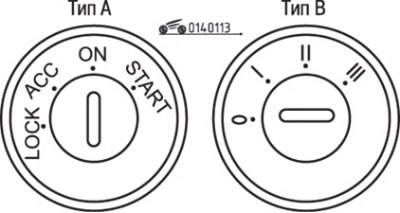


Figure 1.13. Key positions in the ignition switch

Figure 1.13. Key positions in the ignition switch


The key in the ignition switch can be in the following positions (figure 1.13).

"LOCK" ("0") position


Ignition off, steering wheel locked (with the key removed), electrical equipment cannot work.

"ACC" position ("I")


The steering wheel is locked, electrical equipment can operate.

Position "ON" ("II")


The steering wheel is unlocked, electrical equipment can operate.

Position "START" ("III")


Starting the engine.

If the key in the ignition switch does not turn or turns with difficulty, you should slightly shake the steering wheel left and right and at the same time turn the key to the "ON" ("II") position - the wheel will unlock.

Caution! While driving, never turn the ignition key to the "LOCK" ("0") or "ACC" ("I") position.


The steering lock cannot replace the parking brake. Before leaving the vehicle, stop the engine, set the automatic transmission control lever (if it is installed) into position "P" (parking) and apply the parking brake.

When turning on the ignition, do not put your hand through the steering wheel, as injury may occur if the steering wheel suddenly starts to turn.

Caution! When the engine is not running, do not leave the ignition key in the "ON" ("II") position, as this key position will discharge the battery.


To make it easier to insert the key into the ignition switch at night, the ignition switch light will come on for approximately 20 seconds when the driver's door is opened.

Starting an engine not equipped with a fuel injection system


To start, do the following:
  • Fasten your seat belts.
  • Release the parking brake lever.


Cars with manual transmission


Press the clutch pedal and move the gear shift lever to neutral position. When starting, keep the clutch pedal in the lowest position.

Caution! Engage the starter for no more than 10 seconds. If the engine does not start immediately, wait 5–10 seconds, then repeat the starting process; otherwise, the starter may be damaged.


Cars with automatic transmission


Set the selector lever to "P" (park) or "N" (neutral).

Pull the choke control handle only to start or warm up the engine. Pull the choke knob all the way out.

Once the engine has warmed up to normal operating temperature, push the choke knob back in fully.

When the choke control handle is pulled out, the choke control lamp comes on and goes out when the handle is pushed back in.


Starting a cold diesel engine


Caution! There is a risk of poisoning when operating the engine in a closed area.


To start, do the following:
  • 1. Turn the ignition switch key to the "ON" ("I") position.
  • 2. Wait for a while until the glow plug indicator goes out.
  • 3. After this, turn the key in the ignition switch to the position "START" ("III") and start the engine without pressing the accelerator pedal. In cold weather, to start the engine, press the accelerator pedal all the way down.

In cold weather, pull the cold start button all the way out, turn it to the right, and turn the ignition key to the "ON" ("II") position. On a vehicle with a manual transmission, press the clutch pedal while starting the engine – the starter should only rotate the engine crankshaft. Turn the key in the ignition switch to the position "START" ("III") and hold it in this position until the engine starts. Press the accelerator pedal to increase engine speed slightly and release it once the engine starts to run smoothly. Once the engine has warmed up to normal operating temperature, turn the cold start button to the left and push it back in. While warming up the engine at idle, the cold engine start button should remain pulled out. Do not operate the engine at high speeds or heavy loads until the engine has reached normal operating temperature.

Caution! To facilitate starting a cold engine, turn off all electrical consumers.


If the engine fails to start, turn the ignition key back to the "LOCK" ("0") or "ACC" ("I") position. Wait 5 seconds before attempting to start the engine again, otherwise the glow plugs will not operate.


When the button is pulled out, the cold engine start indicator lights up.

Starting a hot diesel engine


To start, do the following:
  • 1. Turn the ignition switch key to the "ON" ("I") position.
  • 2. Wait for a while until the glow plug indicator goes out.
  • 3. After this, turn the key in the ignition switch to the position "START" ("III") and start the engine without pressing the accelerator pedal.
This article is available at: russian, bulgarian, belarusian, ukrainian, serbian, croatian, romanian, polish, slovak, hungarian
This text was checked by: Georgy Afanasyev
Share with friends on social networks:

Previous
Capella 3 and 4 » User manual
Next

Refueling a car
Height-adjustable steering column
Rearview mirrors
Radiator grille cover
Rear door/trunk lid
Transmission
Technical characteristics of gearboxes
Device for maintaining a constant speed of movement (cruise control)
Lighting and light signaling
Glass cleaners and washers
More articles on repairing other Mazda models
Starting the engine from an auxiliary source Mazda Familia 6 (1989-1994)
Starting the engine Mazda3 BK (2003-2009)
Starting the engine Mazda6 GG (2002-2008)
Instructions for starting the engine with an over-rich fuel-air… Mazda CX-5KE (2012-2017)
Starting the engine from an auxiliary battery Mazda 121 (3) (1996-2003)
Link in different formats to this article
Comments and feedback from visitors
No comments yet


How much will 38 + 23 ?


Capella 6 (1997-2005, petrol) 
  • General information
  • Introduction to guide
  • User manual
  • Troubleshooting
  • Maintenance
  • Power unit
  • 4-cylinder engines
  • 6-cylinder engines
  • Engine overhaul
  • Cooling and ventilation
  • Power and exhaust systems
  • Engine electrics
  • Control system
  • Transmission
  • Mechanical gearbox
  • Automatic gearbox
  • Clutch and drive shafts
  • Chassis
  • Brake system
  • Car suspension
  • Steering
  • Body
  • Exterior (external elements)
  • Interior (internal elements)
  • Doors, windows and locks
  • Electrical equipment
  • Equipment and devices
  • Electrical circuits
Capella 5 (1991-1997) 
  • General information
  • User manual
  • Maintenance
  • Helpful hints
  • Power unit
  • Petrol engines 1.6 and 1.8
  • Petrol engines 2.0
  • 2.5 petrol engines
  • Overhaul engines 1.6 and 1.8
  • Overhaul engines 2.0 and 2.5
  • Diesel engine 2.0
  • Engine electrics
  • Cooling system
  • Air conditioner
  • Carburetor Nikki 30/34
  • Power system (1.6 and 1.8)
  • Power system (2.0 and 2.5)
  • Control system
  • Transmission
  • Mechanical gearbox
  • Automatic gearbox
  • Clutch and axles
  • Chassis
  • Brake system
  • Suspension and wheels
  • Steering
  • Body
  • Exterior (external elements)
  • Interior (internal elements)
  • Doors and windows
  • Electrical equipment
  • Equipment and devices
  • Electrical circuits
Capella 4 (1987-1992) 
  • General information
  • Introduction to manual
  • Vehicle specifications
  • Power unit
  • Engine repair
  • Lubrication system
  • Cooling system
  • Fuel system (carburetor)
  • Fuel injection (FE)
  • Fuel injection (DOHC)
  • Fuel system (diesel)
  • Ignition system
  • Transmission
  • Clutch
  • Gearbox
  • Drive shafts
  • Chassis
  • Front suspension
  • Rear suspension
  • Steering system
  • Brake system
  • Electrical equipment
  • Equipment and devices
  • Electrical circuits
Capella 3 and 4 (1982-1992) 
  • General information
  • User manual
  • Maintenance
  • Power unit
  • Gasoline engine
  • Engine overhaul (gasoline)
  • Diesel engine
  • Cooling and heating
  • Supply system
  • Ignition system
  • Emission reduction
  • Transmission
  • Clutch
  • Mechanical gearbox
  • Automatic gearbox
  • Drive shafts
  • Chassis
  • Brake system
  • Suspension and wheels
  • Steering
  • Body
  • Exterior (external elements)
  • Interior (internal elements)
  • Electrical equipment
  • Equipment and devices
  • Power devices
  • Electrical circuits
Capella 3 (1982-1992, petrol) 
  • General information
  • User manual
  • Maintenance
  • Troubleshooting
  • Late models
  • Power unit
  • Engine in car
  • Engine overhaul
  • Cooling and heating system
  • Fuel and exhaust system
  • Engine electrical system
  • Emission control system
  • Transmission
  • Mechanical gearbox
  • Automatic gearbox
  • Clutch and drive shafts
  • Chassis
  • Brake system
  • Suspension and wheels
  • Steering
  • Body
  • Exterior (external elements)
  • Interior (internal elements)
  • Electrical equipment
  • Equipment and devices
  • Lighting and lamps
  • Electrical circuits
MazBook.ru © 2018–2026 · Mobile version · Articles and news · Sitemap: EN BG BY UA RS HR RO PL SK HU · Feedback · Site search · Add to bookmarks Familia 5 (BF) · Familia 6 (BG) · Capella 3 (GC) · Capella 3 and 4 (GC) · Capella 4 (GD) · Capella 5 (GE) · Capella 6 (GF) · Mazda3 BK · Mazda6 GG · CX-5KE · Mazda 121 (3) · Mazda BT-50 (1) ·
By continuing to use the site, you agree to the use of cookies 🔐