


Disconnect the battery and pull the plug out of the pneumatic switch socket.
Raise the front of the car and place it on jack stands
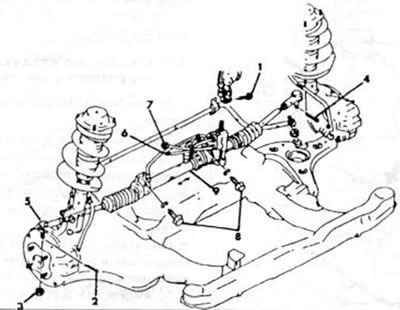
Release the bolts (1) from the cardan joint with the crosspiece of the intermediate steering shaft on the gear and knock it out.
Remove the cotter pin (2) and slotted nut (3) of the tie rod joint and use a suitable puller to push the ball-head bolt out of the independent suspension arm, as already shown in Figure 185.
If power steering is installed, disconnect the drain (6) and pressure (7) hoses from the steering system. Power steering fluid will leak from the connections, and a suitable container should be placed underneath to collect it.
Loosen the steering clamp bolts. Make sure that the rubber bushings of both supports are not the same.
Unscrew the mudguard on the left side.
Remove the steering from the underside of the vehicle through the hole in the tie rod and remove the rubber mounts.
The steering control is installed in the reverse order of removal. Install both rubber mounts in accordance with the original location. Tighten the steering column mounting bolts to a torque of 36–54 Nm.
Engage the intermediate steering shaft with the gear, align the threaded hole with the groove and insert the clamping bolt. Tighten the nut to a torque of 18–27 Nm. The steering wheel should be level when the steering wheel is in the center position.
Reconnect the tie rods and tighten the nuts to 30–45 Nm. Check the steering collars for rotation. If they don't turn, then they need to be released from the outside (small clamp) and scroll accordingly.
If power steering is installed (servo control), then the installation must be filled with liquid and air must be removed, as described below. After installation, check the front wheel track width setting.
[The article is based on website data: Mazbook.ru]