

Caution! Gasoline is highly flammable. Use extreme caution when working around the fuel system. Do not smoke, use open flames, or use portable lamps with open bulbs in the work area. Do not work in a garage where there are gas appliances with a pilot light (like water heaters and dryers). Since gasoline is also a carcinogen, wear protective gloves when working with it. If gasoline does come into contact with your skin, wash it off with soap and water. Immediately absorb spilled gasoline with a rag. Do not store this rag in the garage. Keep a carbon dioxide fire extinguisher nearby. The fuel system is always under positive pressure, so before disconnecting any fuel line, first relieve the pressure in the system.
1. If you smell gasoline in the cabin, check the fuel system immediately.
2. Remove the fuel tank filler cap and carefully inspect its seal. If the seal is torn or damaged by corrosion, replace the plug,
3. Inspect the fuel supply and return hoses for breaks and cracks. Check the tightness of the fuel line fittings.
Caution! Your vehicle is equipped with a fuel injection system that is always under positive pressure. Before disassembling any connection, first relieve the pressure in the system (see chapter 4).
4. If the fuel injectors are visible, check them for leaks (wet spots around the injectors). The leak may be fixed by replacing the injector sealing ring (see chapter 4).
5. Since some elements of the fuel system - the fuel tank and partially the fuel supply and return hoses - are located under the vehicle, it is more convenient to inspect them on a lift. If there is no lift, place the car on stands
The original article is on [MazBook.ru]
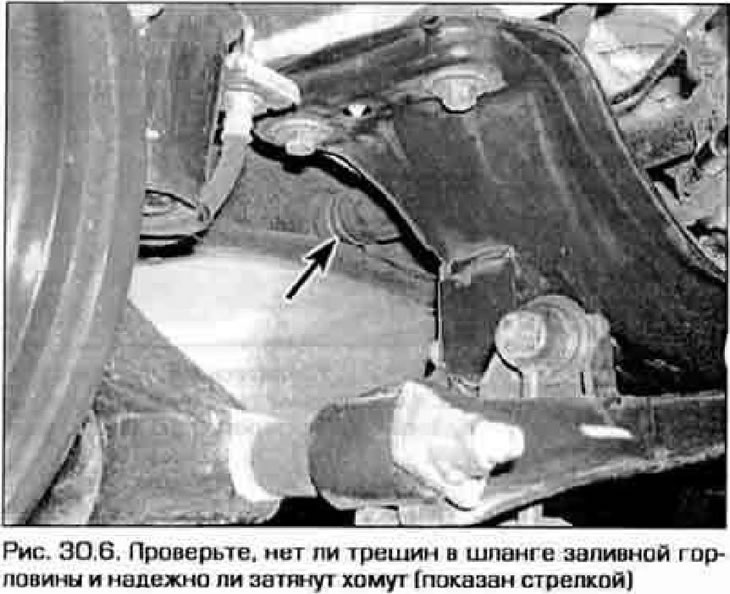
6. Inspect the fuel tank and filler neck for holes, cracks, and other damage. The connection between the filler neck and the tank is particularly at risk of damage. Sometimes a leak may appear in this place due to a poorly tightened clamp or due to decomposition of the rubber (figure 30.6). Inspect all tank support brackets and clamps to ensure the tank is securely fastened.
Warning! Do not attempt to repair the tank under any circumstances (except rubber parts). A welding torch or any other open flame will cause an explosion of fuel vapors, which are always present in the tank.
7. Carefully inspect the hoses and metal tubes coming from the tank. Check the tightness of the connections and the serviceability of the hoses and tubes. Replace faulty sections (see chapter 4).
8. The source of the gasoline smell may be the fuel vapor collection system. This system is designed to store fuel vapors in a carbon canister until they can be directed into the intake manifold, where they mix with the incoming air and burn in the cylinders.
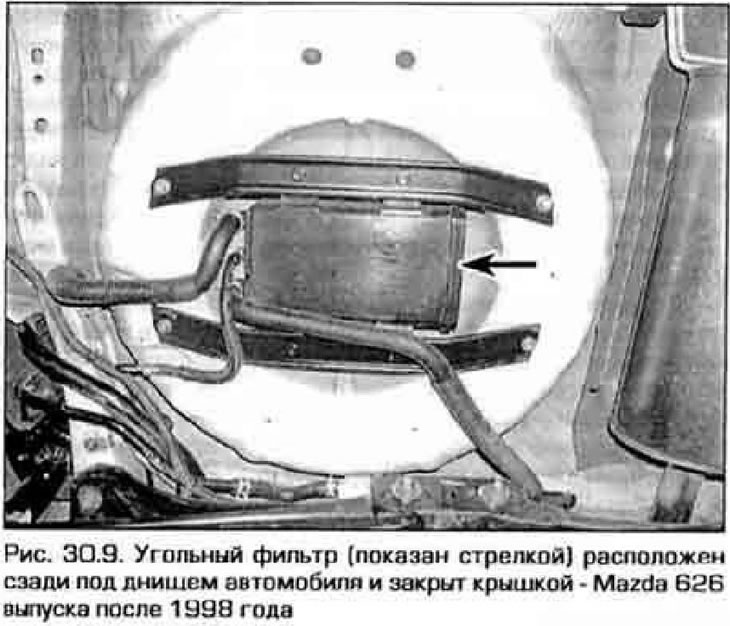
9. A persistent leak of gasoline in the engine compartment is a symptom of a faulty fuel vapor recovery system. If you detect a gasoline smell and have examined all possible sources described above, check the carbon canister located behind the upper mount of the front left suspension (on older models) or at the back under the bottom of the car (i started producing models in 1998) (figure 30.9).