
MazBook.ru
English Русский
Български
Беларускі
Український
Српски
Hrvatski
Română
Polski
Slovenský
Magyar
• Bookmark • Sitemap • Contacts •   
Cars Opel Cars Ford Cars Volkswagen Cars Audi Cars Kia Cars Renault Cars Peugeot


Familia Capella Mazda3 Mazda6 CX-? Others Articles
Capella 3 (1982-1992, petrol) Capella 3 and 4 (1982-1992) Capella 4 (1987-1992) Capella 5 (1991-1997) Capella 6 (1997-2005, petrol)

Checking and adjusting valve clearances (models produced since 1998) (Mazda Capella GF)

  • Home
  • Mazda Capella
  • Capella GF (1997-2005)
  • General information
  • Maintenance
  • Checking and adjusting valve clearances (models produced since 1998)
0
Contents: Adjustment with the timing belt…⇓ Adjustment without removing the…⇓
Every 100,000 km or once every four years.

Note: With the camshafts installed, it is impossible to adjust the valve clearances without a special proprietary tool. At the time of writing, this tool was only available from the vehicle manufacturer. We tried to make a similar device in our workshop, but the attempt was unsuccessful due to too small clearances in the seating of the tappets. However, since the scheduled timing belt check and adjustment coincides with the timing belt replacement, the car owner can adjust the timing belt clearances without any tools by removing the camshafts before installing the new timing belt.


1. Disconnect the negative cable from the battery.

Warning. If your vehicle is equipped with an anti-theft audio system, make sure you know the unlock code to unlock the system after it is turned on again before disconnecting the battery.


2. On a 4-cylinder model, remove anything that is in the way of removing the valve cover (see chapter 2A).

3. On a V-engine model, remove the air intake tract components and anything that interferes with the valve cover (see chapter 2B).

4. Blow off any dust and dirt from the valve cover with compressed air, then remove the spark plugs (see paragraph 19).

5. Remove the valve cover (see chapters 2A, 2B)

6. Set piston No. 1 to TDC of the compression stroke (see chapters 2A or 2B).

7. Measure the valve clearances with a feeler gauge as shown in the figure 31.7,a-c. Write down the values of the gaps that do not correspond Technical data. These values will be needed later to select the thickness of the adjusting shims.
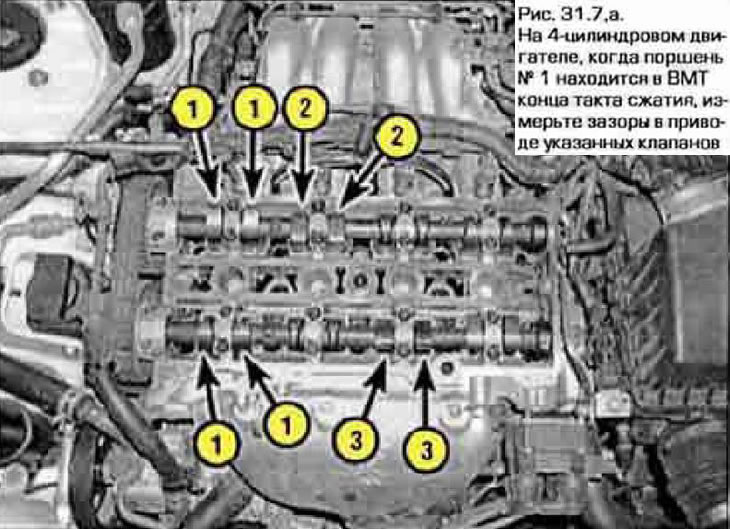
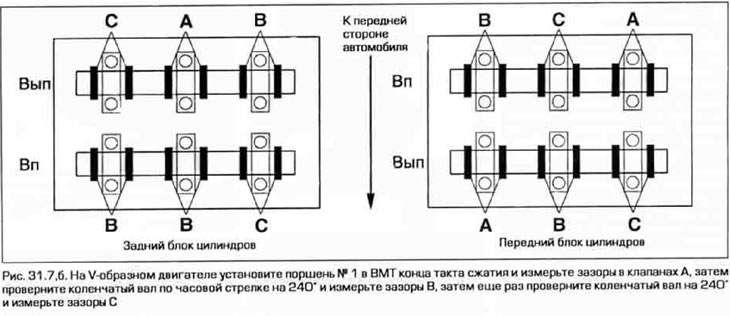
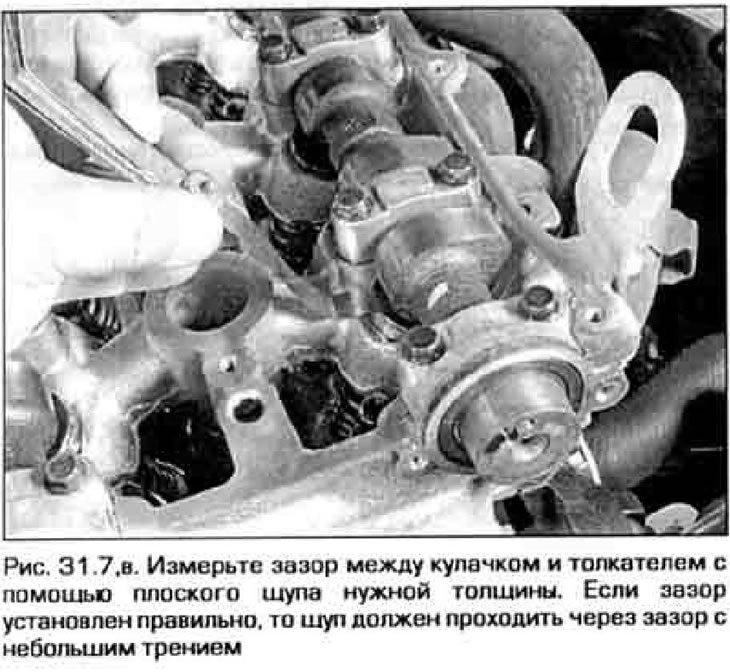
7. Measure the valve clearances with a feeler gauge as shown in the figure 31.7,a-c. Write down the…


7. Measure the valve clearances with a feeler gauge as shown in the figure 31.7,a-c. Write down the…


7. Measure the valve clearances with a feeler gauge as shown in the figure 31.7,a-c. Write down the…


8. On a 4-cylinder engine, rotate the crankshaft a full revolution and align the marks again. Measure the clearances in the remaining valves (figure 31.8).
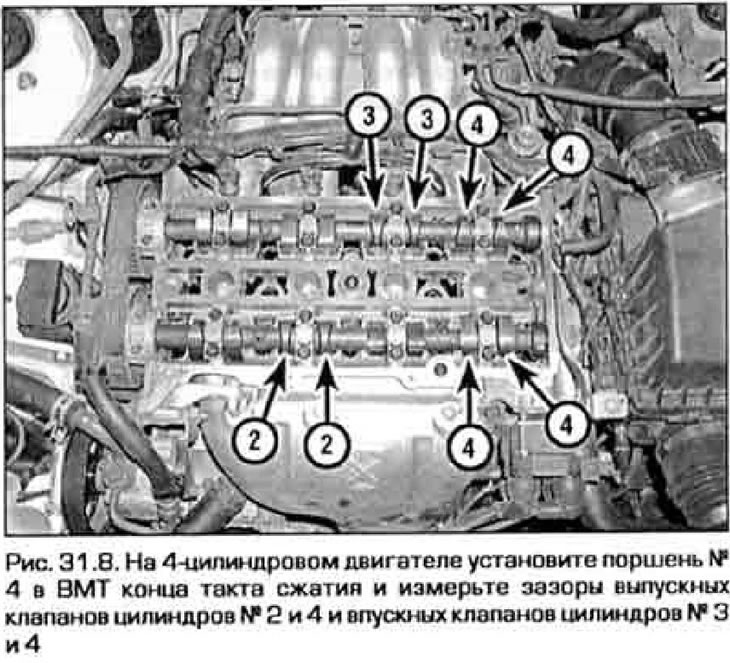
8. On a 4-cylinder engine, rotate the crankshaft a full revolution and align the marks again.…


9. On a V-engine, turn the crankshaft clockwise 2/3 of a turn (270°) and measure the clearances in the valves marked. Letter B in Figure 31.7,6. Then turn the crankshaft another 2/3 of a revolution and measure the valve clearances C.


10. If all clearances are within tolerance, reinstall all removed parts. If the clearances of some valves require adjustment, the car owner is advised to combine this adjustment with replacing the timing belt. If the belt is in good condition and does not require replacement, then a special tool will be required to adjust the valves. Both adjustment methods are described below.

Adjustment with the timing belt removed


11. Remove the timing belt and camshafts as described in the chapter 2A or 2B.

12. Remove the adjusting shims one by one from all tappets where the incorrect clearance is registered. Measure the thickness of each shim and calculate the required thickness as indicated below in steps 17 and 18.

13. Insert shims of the required thickness, then install the camshafts and their bearing caps in place, tightening their mounting bolts to the torque specified in the Technical Data chapter 2A or 2B.

14. Measure the valve clearances again as described in steps. 6 to 10. If the gaps are adjusted correctly, install the timing belt and complete the engine assembly (in the reverse order of disassembly operations). If not all clearances are set correctly, remove the camshafts and repeat the steps described in paragraphs. 12 and 13.

Adjustment without removing the timing belt


Note: This type of surgery requires the use of a special device.


15. Turn the crankshaft so that the cam lobe of the valve you are going to adjust is facing upward and does not touch the gasket being replaced.

16. Turn the plunger with the cutout towards the spark plug. Then press the pusher with the tool downwards. The device is a plate that is bolted to the camshaft support caps. A screw clamp is attached to the plate, which is located above the pusher, and with the help of which the pusher can be pressed down, thus releasing the adjusting gasket. On a V-shaped engine, unscrew the inner bolts of the outer camshaft covers (except for the large stop cap). On a 4-cylinder engine, remove the inner bolts of the covers between which the adjustable valve is located. Attach the fixture with long bolts over the caps so that the fixture clamp is positioned over the valve being adjusted. Press the valve lifter down with the fixture clamp and push the adjusting washer out from the top of the lifter towards the spark plug using a small screwdriver, magnet or tweezers.


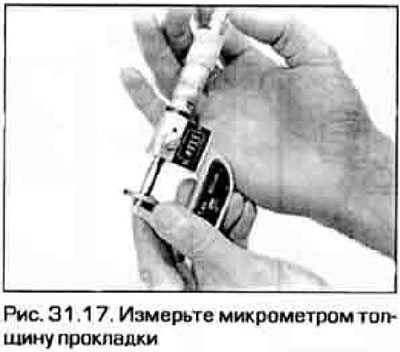
17. Measure the thickness of the gasket with a micrometer (figure 31.17). To calculate the thickness of the gasket that will provide the required clearance, use the formula:

N = T + (AV)

where T is the thickness of the old gasket;
A - measured gap;
N - thickness of the new gasket;
V - required clearance (see Technical data at the beginning of the chapter).
V - required clearance (see Technical data at the beginning of the chapter).


18. Select a gasket with a thickness closest to the calculated one. Spare parts are available in 17 sizes of gaskets with a pitch of 0.05 mm in the range from 2.5 mm to 3.3 mm.

Note: It is often possible to simply transfer the gasket from one valve where it does not provide the required clearance to another valve. Thus, careful analysis of the thickness of the required and available gaskets allows you to reduce the number of purchased parts.


19. After selecting the correct gasket, press the pusher again and insert the gasket into its end. Check the gap to ensure the gasket is properly fitted and installed.

20. Repeat these steps for all valves that require clearance adjustment.

21. Installation of spark plugs, valve covers, high-voltage wires, etc. is performed in the reverse order of their removal.
This article is available at: russian, bulgarian, belarusian, ukrainian, serbian, croatian, romanian, polish, slovak, hungarian
This text was checked by: German Vorobyov
Share with friends on social networks:

Previous
Capella 6 » Maintenance
Next

Check the fuel system every 50,000 km or every two years
Exhaust system check — every 50,000 km or every two years
Manual transmission oil change — every 50,000 km or every two years
Automatic transmission fluid change — every 50,000 km or every two…
Check suspension and steering — every 50,000 km or every two years
Replace the fuel filter every 100,000 km or every four years
More articles on repairing other Mazda models
Adjusting clearances in the valve drive mechanism Mazda Familia 5 (1985-1989)
Checking thermal clearances in the valve drive mechanism Mazda3 BK (2003-2009)
Checking thermal clearances in the valve drive mechanism Mazda6 GG (2002-2008)
Checking the electric valve timing motor Mazda CX-5KE (2012-2017)
Checking and adjusting thermal clearances in the valve drive Mazda BT-50 (1) (2006-2011)
Link in different formats to this article
Comments and feedback from visitors
No comments yet


How much will 39 + 20 ?


Capella 6 (1997-2005, petrol) 
  • General information
  • Introduction to guide
  • User manual
  • Troubleshooting
  • Maintenance
  • Power unit
  • 4-cylinder engines
  • 6-cylinder engines
  • Engine overhaul
  • Cooling and ventilation
  • Power and exhaust systems
  • Engine electrics
  • Control system
  • Transmission
  • Mechanical gearbox
  • Automatic gearbox
  • Clutch and drive shafts
  • Chassis
  • Brake system
  • Car suspension
  • Steering
  • Body
  • Exterior (external elements)
  • Interior (internal elements)
  • Doors, windows and locks
  • Electrical equipment
  • Equipment and devices
  • Electrical circuits
Capella 5 (1991-1997) 
  • General information
  • User manual
  • Maintenance
  • Helpful hints
  • Power unit
  • Petrol engines 1.6 and 1.8
  • Petrol engines 2.0
  • 2.5 petrol engines
  • Overhaul engines 1.6 and 1.8
  • Overhaul engines 2.0 and 2.5
  • Diesel engine 2.0
  • Engine electrics
  • Cooling system
  • Air conditioner
  • Carburetor Nikki 30/34
  • Power system (1.6 and 1.8)
  • Power system (2.0 and 2.5)
  • Control system
  • Transmission
  • Mechanical gearbox
  • Automatic gearbox
  • Clutch and axles
  • Chassis
  • Brake system
  • Suspension and wheels
  • Steering
  • Body
  • Exterior (external elements)
  • Interior (internal elements)
  • Doors and windows
  • Electrical equipment
  • Equipment and devices
  • Electrical circuits
Capella 4 (1987-1992) 
  • General information
  • Introduction to manual
  • Vehicle specifications
  • Power unit
  • Engine repair
  • Lubrication system
  • Cooling system
  • Fuel system (carburetor)
  • Fuel injection (FE)
  • Fuel injection (DOHC)
  • Fuel system (diesel)
  • Ignition system
  • Transmission
  • Clutch
  • Gearbox
  • Drive shafts
  • Chassis
  • Front suspension
  • Rear suspension
  • Steering system
  • Brake system
  • Electrical equipment
  • Equipment and devices
  • Electrical circuits
Capella 3 and 4 (1982-1992) 
  • General information
  • User manual
  • Maintenance
  • Power unit
  • Gasoline engine
  • Engine overhaul (gasoline)
  • Diesel engine
  • Cooling and heating
  • Supply system
  • Ignition system
  • Emission reduction
  • Transmission
  • Clutch
  • Mechanical gearbox
  • Automatic gearbox
  • Drive shafts
  • Chassis
  • Brake system
  • Suspension and wheels
  • Steering
  • Body
  • Exterior (external elements)
  • Interior (internal elements)
  • Electrical equipment
  • Equipment and devices
  • Power devices
  • Electrical circuits
Capella 3 (1982-1992, petrol) 
  • General information
  • User manual
  • Maintenance
  • Troubleshooting
  • Late models
  • Power unit
  • Engine in car
  • Engine overhaul
  • Cooling and heating system
  • Fuel and exhaust system
  • Engine electrical system
  • Emission control system
  • Transmission
  • Mechanical gearbox
  • Automatic gearbox
  • Clutch and drive shafts
  • Chassis
  • Brake system
  • Suspension and wheels
  • Steering
  • Body
  • Exterior (external elements)
  • Interior (internal elements)
  • Electrical equipment
  • Equipment and devices
  • Lighting and lamps
  • Electrical circuits
MazBook.ru © 2018–2026 · Mobile version · Articles and news · Sitemap: EN BG BY UA RS HR RO PL SK HU · Feedback · Site search · Add to bookmarks Familia 5 (BF) · Familia 6 (BG) · Capella 3 (GC) · Capella 3 and 4 (GC) · Capella 4 (GD) · Capella 5 (GE) · Capella 6 (GF) · Mazda3 BK · Mazda6 GG · CX-5KE · Mazda 121 (3) · Mazda BT-50 (1) ·
By continuing to use the site, you agree to the use of cookies 🔐