

Note: Suspension and steering components should be checked periodically. Malfunctions in these systems can lead to increased and uneven tire wear. deterioration of controllability, reduction in vehicle fuel economy and even an accident. Detailed illustrations of steering and suspension see Chapter 10.
Checking shock absorbers
1. Place the vehicle on a level surface, turn off the engine and apply the parking brake. Check your tire pressure,
2. Press on one corner of the car and release it. Observe the car's oscillations. The car should return to its original position after one or two oscillations.
3. If the vehicle continues to wobble or if it does not return to its original position, a possible cause may be a faulty shock absorber.
4. Perform the same check on other corners of the vehicle.
Text taken from an online platform: mazbook.ru
5. Raise the vehicle and support it securely.
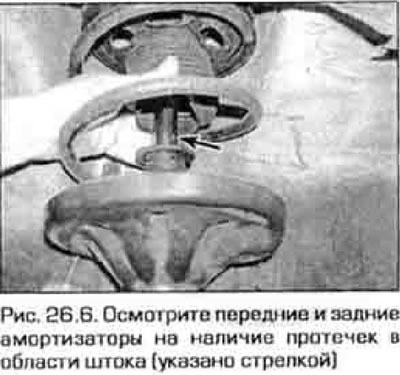
6. Inspect the shock absorbers for signs of fluid leakage (Fig. 26.6). Make sure that the source of the leak, if detected, is the shock absorber and not some other component. If a shock absorber leak is detected, replace it as an assembly.
7. Inspect the shock absorbers for damage. Check the shock absorber mounts. If the shock absorber is damaged, replace it.
8. The procedure for replacing shock absorbers is described in chapter 10.
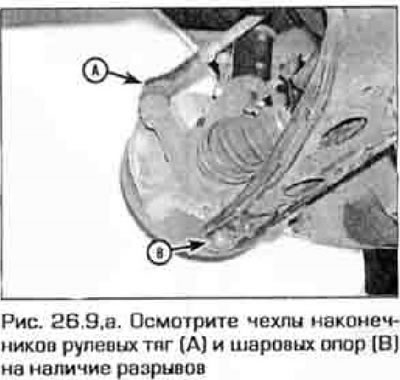
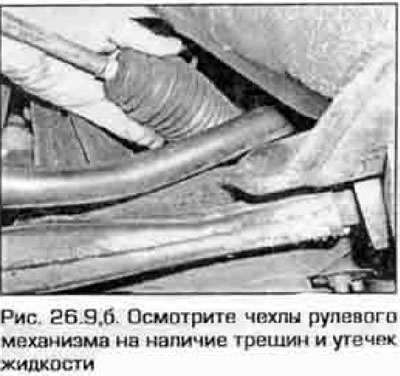
9. Inspect steering and suspension components (front and back) for damage and deformation. Pay attention to seals, covers and bushings, traces of leakage of various types of liquids. Pay special attention to the condition of the lower control arm bushings and the anti-roll bar (figure 26.9, a-c).
 |
 |
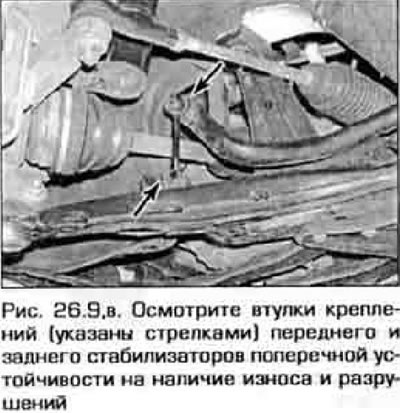
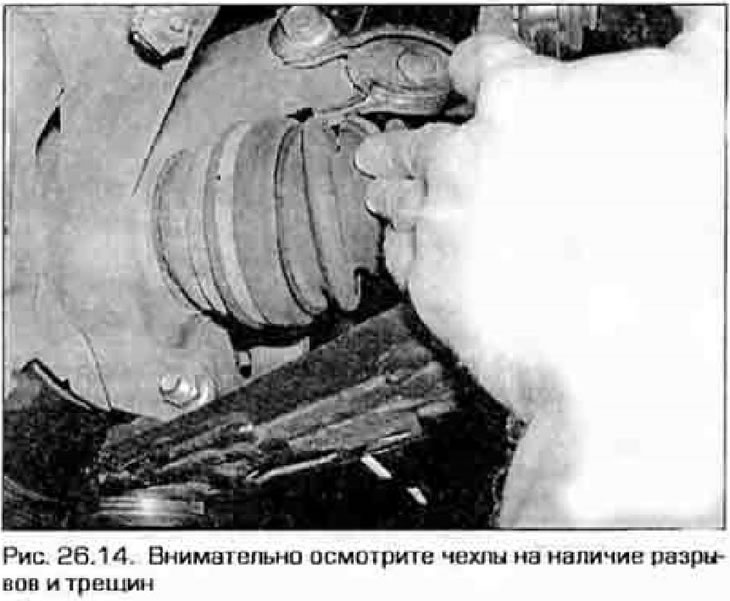
10. Clean the lower part of the steering knuckle and ball joint. Have an assistant rock the wheel in and out by grasping the underside of the tire while you observe the ball joint of the steering knuckle on the lower control arm. If there is play in the ball joint, the joint should be replaced.
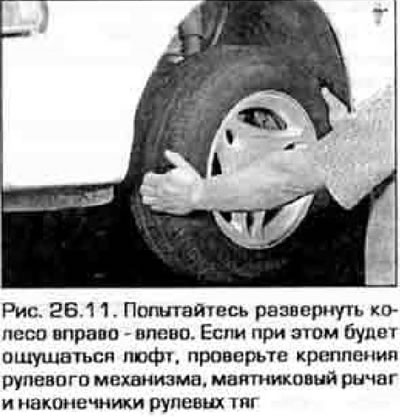
11. Set the steering wheel to the straight-ahead position. Grasp the front tire as shown in Figure 26.11 and try to turn the wheel left and right. If you feel any play, it could be due to wear in the swingarm hinges or tie rod ends, or loose steering gear fasteners.
12. Additional information and illustrations on suspension and steering can be found in Chapter 10.
Checking the drive shaft covers
13. Drive shaft boots are very important because they protect the constant velocity joints (CV joints) from water and dirt. Exposure to oil can cause the material of the covers to decompose and cause them to age prematurely, so it's a good idea to wash the covers with soap and water. Outer CV joints operate under more severe conditions and wear out faster than inner ones, so outer joints require special attention.
14. Inspect the covers for cracks and tears, and check the tightness of the clamps (figure 26.14). If damage to the covers or fluid leaks from underneath them are detected, the covers must be replaced as indicated in chapter 8.