


Contents: Front and rear disc brakes ⇓ Rear drum brakes ⇓ Checking the brake servo ⇓ Parking brake ⇓
Caution! Dust generated by brake pad wear may contain asbestos, which is harmful to health. Do not blow off this dust with compressed air and be careful not to inhale it. When working with brakes, it is recommended to wear a respirator or at least a gauze bandage. Do not use gasoline-based solvents to clean brake system parts. Use only special fluids for cleaning brake systems. Whenever possible, purchase asbestos-free replacement pads.
Note: More detailed photographs of the brake system components are provided in chapter 9.
1. It is not a bad idea to check your brake system whenever possible, not just as part of the maintenance schedule. This should be done especially if, for some reason, the wheels have been removed, as well as if there is any suspicion of a malfunction.
2. The following symptoms may indicate a potential problem with the brake system.
- The car pulls to one side when braking
- The brakes are making noise or squealing
- The brake pedal travel is large
- Soft pedal
- Brake fluid leak (usually on the inner surface of the wheel rim)
3. Loosen the wheel hub nuts.
4. Raise the vehicle and place it on secure supports.
5. Remove the wheels.
Front and rear disc brakes
6. The brake caliper controls two slave cylinders - outer and inner. When the wheel is removed, both pads are visible.
7. Look at the ends of the pads and assess their thickness (figure 16.7,a,6). If the thickness of the friction linings is less than the value specified in the Technical Data at the beginning of the chapter, the pads must be replaced.
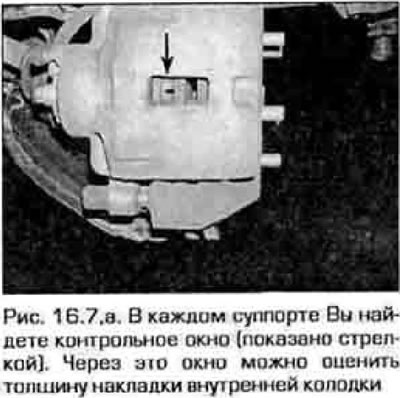
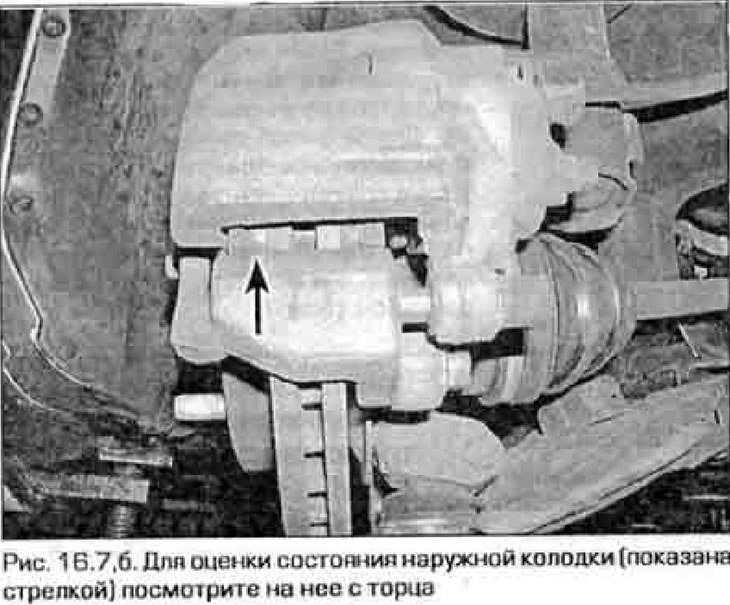
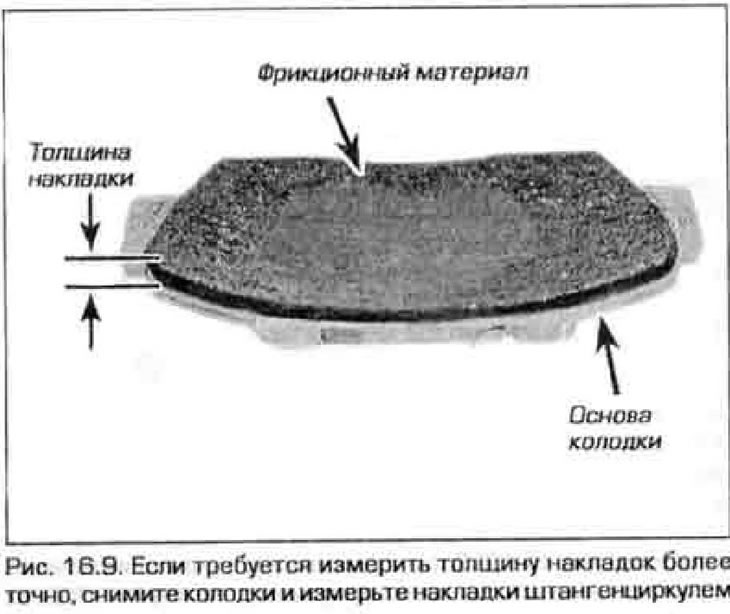
Note: Keep in mind that the overlays are riveted or glued to the steel base plate. The thickness of the base plate must be taken into account when measuring the thickness of the overlays.
8. If it is not possible to estimate the thickness of the linings with a sufficient degree of certainty using the above method, disassemble the brake and remove the pads for a more reliable inspection (see chapter 9).
9. After removing the pads, wash them with brake cleaner and measure the thickness with a caliper or micrometer (figure 16.9).
10. Measure the disc thickness with a micrometer and compare the result with the value specified in the Technical Data. If the disc thickness is less than the permissible limit, replace it (see chapter 9). If the disc thickness is within acceptable limits, check its condition. Inspect the disc for cracks, galling, or burns. If the disk has such damage, remove it and send it for repair (see chapter 9).
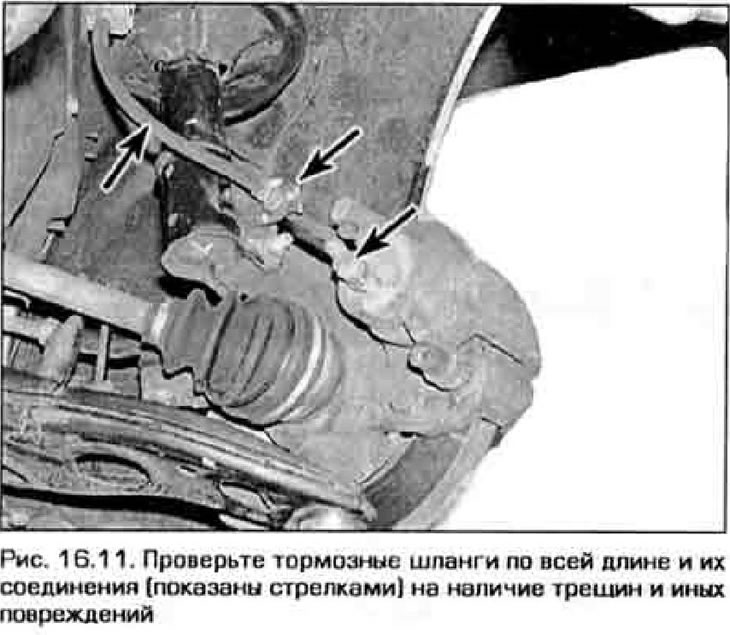
11. Before installing the wheels, inspect all brake lines, especially rubber hoses, for damage, signs of leaks, corrosion, kinks, abrasions, etc. (figure 16.11). Inspect the pipeline connections, check the tightness of the fittings. Make sure that the tubes and hoses do not touch the suspension parts, wheels, or exhaust system components.
Rear drum brakes
12. Release the parking brake. Unscrew the two screws that secure the drum and knock it off the hub flange with a mallet.
13. Remove the drum. If the drum does not come off easily, wet the center of the hub with thin oil and allow it to fill the seat between the hub and the drum. Tap around the center of the drum with a hammer. If the drum still cannot be removed, tap it from the back side.
14. After removing the drum, clean the brake using brake cleaning fluid
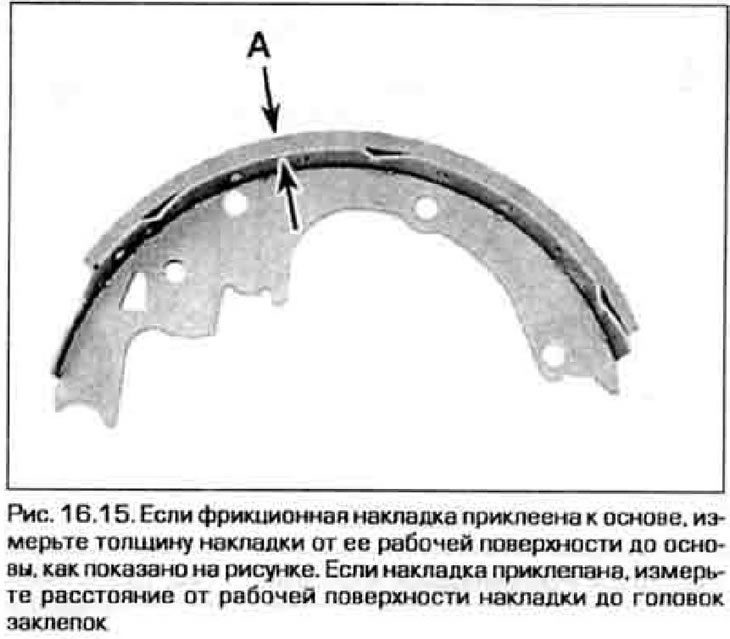
15. Measure the thickness of the linings of both pads. If there is less than 1.5 mm left from the working surface of the pad to the rivet heads or less than 3 mm to the steel base of the pad (if the pads are glued), then such pads need to be replaced (figure 16.15). The pads should also be replaced if there are cracks, polished areas or traces of brake fluid on the linings.
16. Make sure that all brake springs are connected to their proper locations and are in good condition (see photos in Chapter 9).
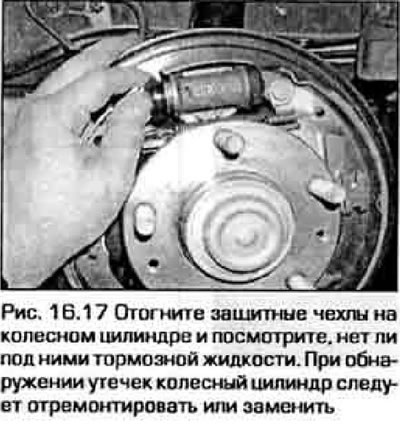
17. Inspect the brake components for signs of brake fluid leaks. Use your finger or a small screwdriver to bend back the protective caps on the ends of the wheel cylinders (figure 16.17). If there is brake fluid underneath them, the corresponding wheel cylinder must be replaced immediately (see chapter 9). Also check all brake hoses and their connections for leaks.
16. Wipe the inside of the drum with a rag soaked in denatured alcohol or brake cleaner. Do not scatter asbestos dust!
19. Inspect the inside of the drum for cracks, tears, deep scratches and "hard spots" which are visible as small areas of different color. If the defects cannot be removed with fine sandpaper, the drum must be sent to specialists for repair.
20. Do the same with the second drum. If the test shows that the brakes are working, reinstall the drums and wheels and lower the vehicle to the ground.
Checking the brake servo
21. Sit in the driver's seat and do the following.
22. With the brake pedal fully depressed, start the engine - the pedal should move down slightly.
23. With the engine running, press and release the brake pedal several times - the pedal travel should not change
24. Press the pedal, turn off the engine and keep the pedal pressed for about 30 seconds. The pedal should neither rise nor fall.
25. Start the engine again, let it run for about a minute, then turn it off. Press the brake pedal several times - the pedal travel should decrease with each press.
26. If the brake behaves differently than described, then the servo is faulty. The procedure for replacing the servo drive is described in Chapter 9.
Parking brake
27. Slowly pull the parking brake lever up and count the number of clicks the lever makes until it stops completely. The brake is considered to be correctly adjusted when the number of clicks corresponds to that specified in the Technical Data at the beginning of this chapter. If the number of clicks differs from the specified one, then the brake drive is not adjusted properly (see chapter 9).
28. Another way to check the parking brake: stop the car on a steep slope, put the transmission in neutral and apply the parking brake. If the parking brake does not hold the car on a slope, it needs to be adjusted (see chapter 9).