


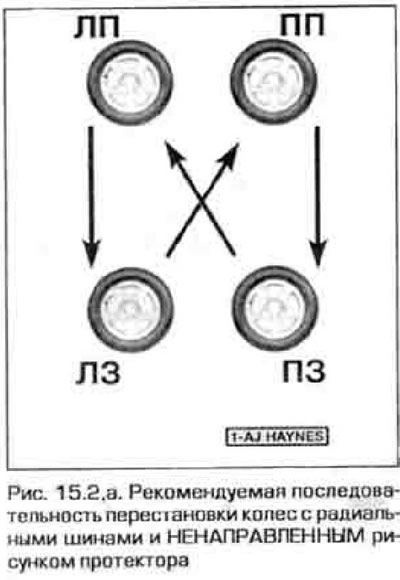
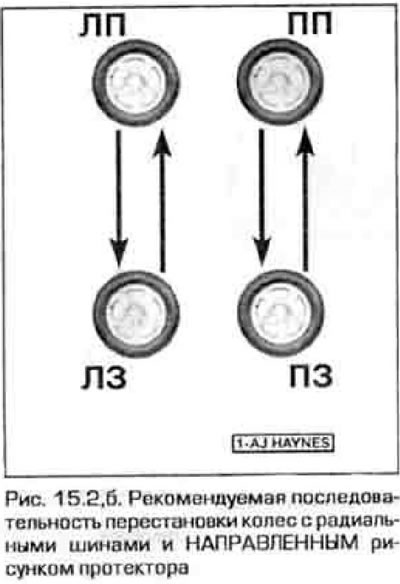
2. Wheels equipped with radial tires should be changed in a certain sequence (fig 15.2, a, b). Most models are factory fitted with non-directional tires, but some models may have directional tires that require a different rotation sequence. To find out what type of tires your vehicle has, look at the sidewall of the tire. Tires with directional tread have arrows indicating the direction of rotation. The set of wheels equipped with tires with directional tread consists of two left and two right wheels. Left and right wheels cannot be moved to the other side.
 |  |
3. Raise the car as indicated in the paragraph. Jacking up the car at the beginning of the book. If you want to check the brake system at the same time, do not apply the handbrake. Instead, put chocks under the wheels to prevent the car from rolling with the wheel up.
4. It is preferable to lift the entire car at once. This can be done with a hydraulic jack, or you can jack up each wheel in turn and place solid stands under the body reinforcements. In this case, you will need four stands. Make sure. that the vehicle is securely mounted on them.
5. After rearranging the wheels, check the tire pressure and. if necessary, bring it to the required. Check wheel nuts for tightness. Ideally, the nuts should be tightened to the prescribed torque using a torque wrench, and then checked for tightness after a run of 40-50 km.
6. More information about wheels and tires see chapter 10.