

High-voltage wires
1. When installing new spark plugs, it is recommended to check the high-voltage wires.
2. Start by inspecting the wires while the engine is running. In a darkened garage (make sure it is well ventilated) start the engine and inspect each high-voltage wire. Be careful not to touch rotating engine parts. If the high-voltage wire has a break or insulation defect, you will see sparking or a breakdown to ground at the damaged area. If such sparking is observed, replace the corresponding wire. After checking the wires, turn off the engine and let it cool. After this, check the distributor cap and rotor.
3. Now check all the wires one by one. To avoid mixing up the wires in the future, number them,
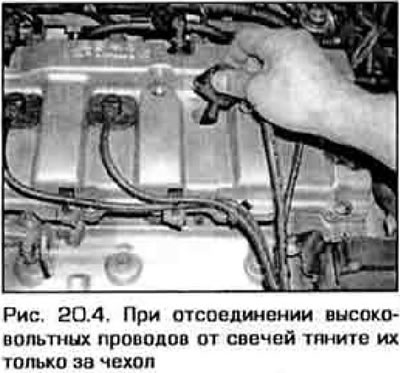
4. Disconnect the spark plug wire tip. To do this, you can use a special device, or pull the tip off the spark plug, grabbing the rubber cover of the tip (figure 20.4). Do not pull on the wire. On a V-engine, access to the rear spark plugs is particularly difficult, and a special tool will still be needed to remove the high-voltage wires.
5. Inspect the wire boots for corrosion, which appears as a white, loose powder. Minor corrosion can be removed with a wire brush, but if the corrosion is significant, the wire will need to be replaced.
6. Place the wire tip onto the spark plug. It should fit snugly onto the spark plug contact. If the contact is not tight, remove the wire and press the metal tabs of the tip inside the case.
7. Wipe the wire with a clean cloth along its entire length. Inspect the wire for burns, cracks, or other damage. Do not bend the wire at a sharp angle, as this may break the inner conductor.
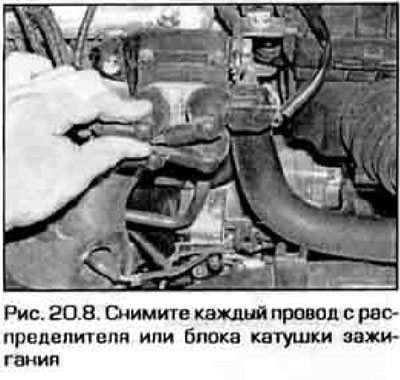
8. Disconnect the wire from the distributor or from the ignition coil unit (on models without a distributor) (figure 20.8). Pull only the cover, not the wire. Check for corrosion and secure contact. Reconnect the wire.
[For details, see the website: Mazbook]
9. Check the remaining high-voltage wires in the same way. After completing all checks, the wires should have reliable contact with the spark plugs and the distributor (or ignition coil block).
10. If the wires require replacement, purchase a wire kit designed for your engine model. Replace the wires one at a time to avoid mixing up the firing order.
Distributor cap and rotor
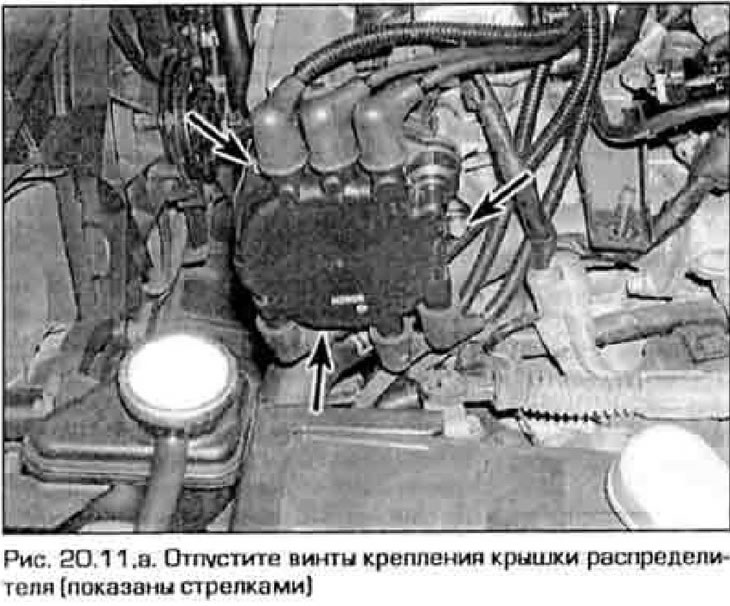
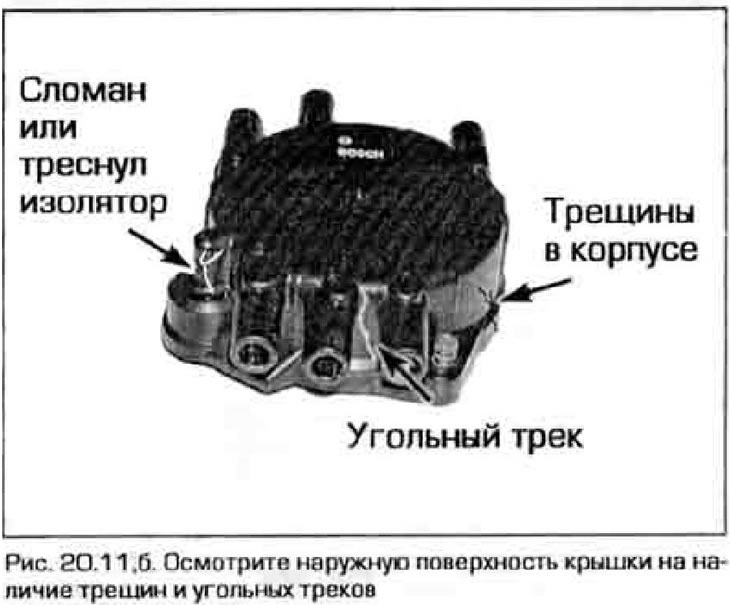
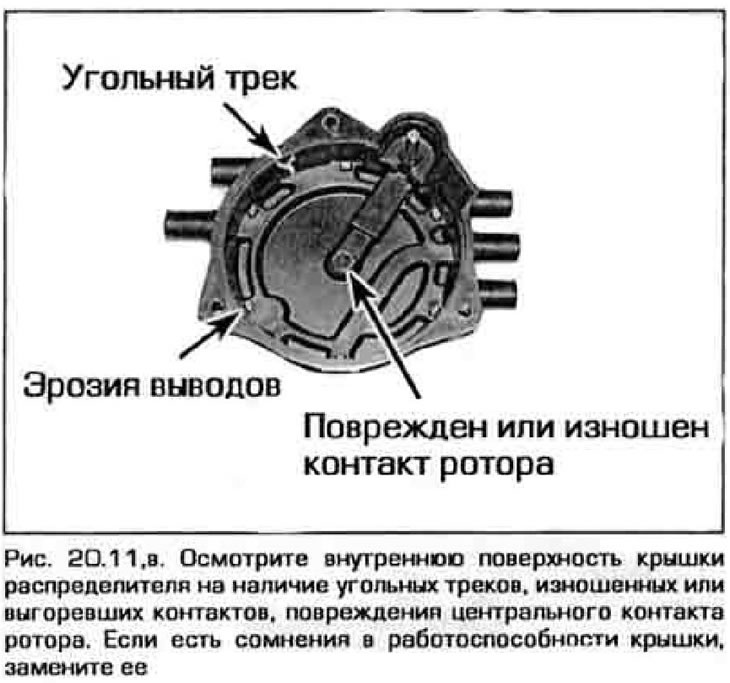
11. Remove the distributor cap by loosening the screws that secure it (fig. 20.11,a). Inspect the cap for cracks, carbon tracks, worn, burnt or loose contacts (figure 20.11, b, c).
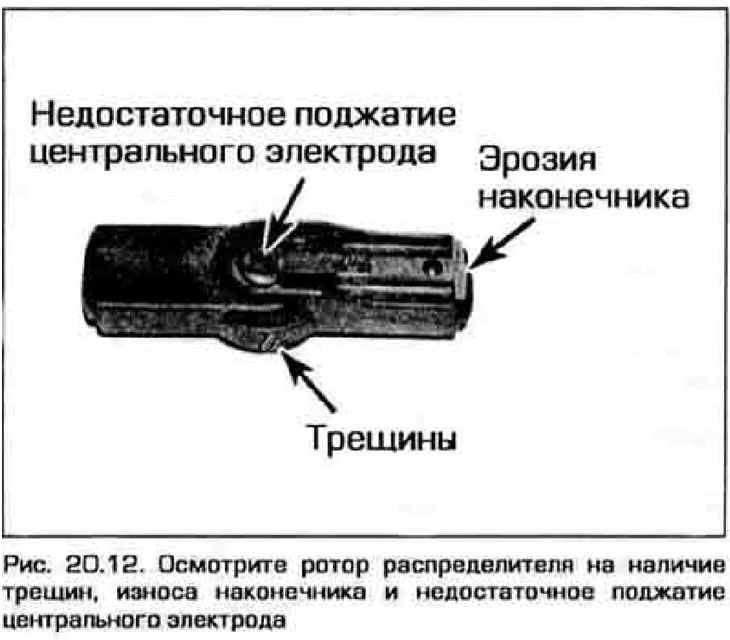
12. Remove the distributor rotor from the shaft and inspect it for cracks and carbon tracks (figure 20.12). If there is damage, replace the rotor.
13. It is common practice to replace the distributor cap and rotor at the same time as replacing the high-voltage wires, but if you want to continue using the old distributor cap, check the resistance between the high-voltage wires and the cap. If the resistance is greater than the maximum permissible value specified in the Technical Data for this chapter, the cover and wires must be replaced.
14. When replacing the distributor cap, disconnect the high-voltage wires from the old cap one by one and immediately connect them to the new cap to avoid disrupting the firing order.
Note: If an accidental error occurs and the wires are mixed up, use the steps in the following to restore their correct connection Technical data firing order of the cylinders. On most models, the terminal of the #1 spark plug wire on the distributor cap is marked.
Ignition coil unit (models without distributor)
15. Wipe the coil unit with a damp cloth and then with a dry cloth.
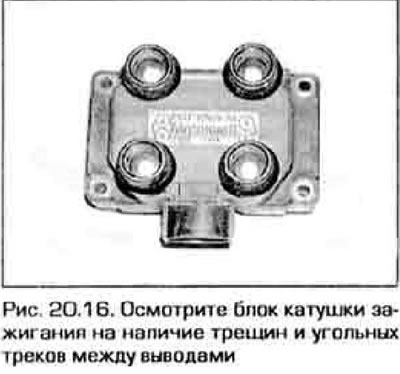
16. Inspect the block for cracks, damage and carbon tracks (figure 20.16). Carbon tracks can usually be erased. If the unit is damaged, replace it as directed in chapter 5.