


Caution! Because there is high voltage in the ignition system. please exercise special care when working with it. This applies not only to the booster, coil, distributor and spark plugs, but also to the spark plug caps, tachometer and other equipment.
Distributor ignition systems
1. If ignition failures occur, do not rush to blame the distributor for everything. First, please perform the following checks:
- a) Check the reliability of the connection of the battery cables to the battery terminals.
- b) Check the battery condition (see paragraph 3). If the battery does not pass all of the above tests, replace it.
- c) Check the external wiring and connections of the distributor and ignition coil.
- d) Inspect the wires coming out of the fuse box in the engine compartment and the fuses themselves. If there is a blown fuse or broken wire, find out and fix the cause.
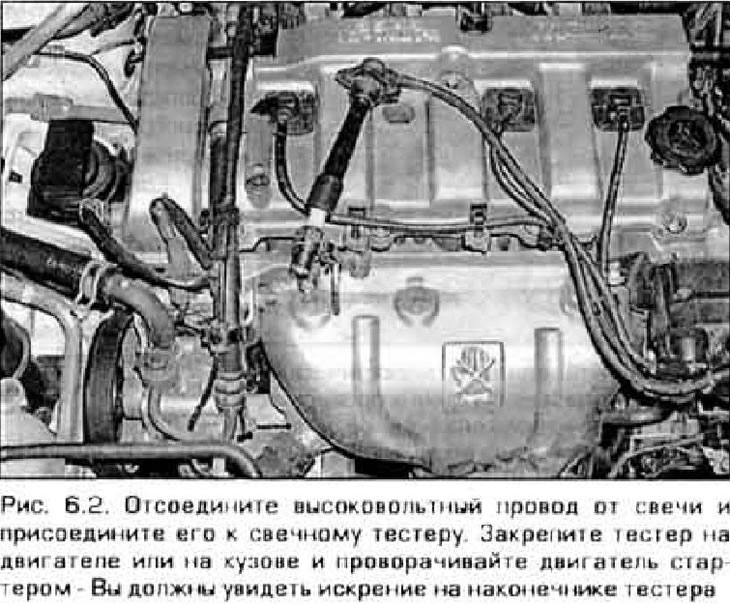
2. Check if high voltage is supplied to the spark plugs. To do this, disconnect the high-voltage wire from the spark plug and connect it to a spark plug tester (figure 6.2). Attach the tester to the engine or body ground. Crank the engine with the starter and observe the tester tip. If the system is working properly, the tester will produce a clearly visible spark.
3. If there is a spark, then there is sufficient voltage in the ignition system for spark formation. Repeat this check for the remaining spark plug wires (this check ensures that the distributor cap and rotor are in good working order). However, the spark plugs themselves may be faulty. Turn them out and check them as described in Chapter 1.
4. If there is no spark or it is erratic, remove the distributor cap and check the cap and rotor (see chapter 1). If the cover and rotor are wet, remove the moisture, install the cover and repeat the previous check.
5. If there is still no spark, check the condition of the central and side contacts of the distributor cap. Replace the cover if necessary.
6. If there is still no spark, disconnect the central wire of the ignition coil from the distributor, connect the wire to a spark plug tester and check the ignition system for spark in the same way. as for spark plug wires.
7. If a spark now appears, the distributor cap, rotor, or high-voltage wires may be faulty.
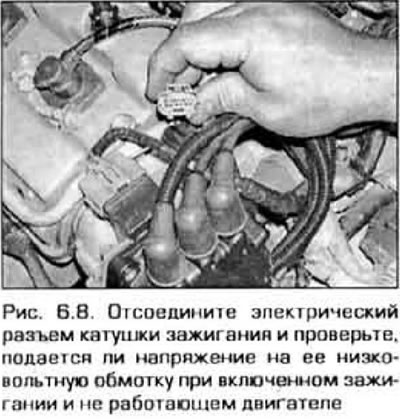
8. If no spark appears, check the connection of the wires to the low-voltage winding of the ignition coil. Check if voltage is supplied to the low-voltage winding from the ignition switch (figure 6.8). If necessary, use the electrical circuit diagrams in chapter 12. If a circuit fault is found, correct it and retest.
9. If voltage is supplied to the low-voltage winding, but there is still no spark, measure the resistance of the low-voltage and high-voltage windings of the ignition coil (see paragraph 7). If a break in the winding is detected, replace the coil.
10. If the coil is in good condition, check the operation of the ignition control unit (see paragraph 8).
11. If you are unable to restore the ignition system to working order on your own, contact a service station or a vehicle electrical specialist.
Distributorless ignition systems
12. Check all spark plugs for spark as described above in paragraph. 2.
13. If there is no spark on any of the spark plugs, measure the resistance of the primary and secondary windings of the coil pack (see paragraph 7). Also check the voltage supply circuit to the coil pack (see wiring diagrams. at the end chapter 12).
14. If there is no spark at all on one or more spark plugs, or a weak spark is observed, check the resistance of the high-voltage wires and compare the obtained result with Technical data. If necessary, replace the wire(s).