
MazBook.ru
English Русский
Български
Беларускі
Український
Српски
Hrvatski
Română
Polski
Slovenský
Magyar
• Bookmark • Sitemap • Contacts •   
Cars Opel Cars Ford Cars Volkswagen Cars Audi Cars Kia Cars Renault Cars Peugeot


Familia Capella Mazda3 Mazda6 CX-? Others Articles
Capella 3 (1982-1992, petrol) Capella 3 and 4 (1982-1992) Capella 4 (1987-1992) Capella 5 (1991-1997) Capella 6 (1997-2005, petrol)

Cooling system maintenance (fluid draining, flushing and filling) (Mazda Capella GF)

  • Home
  • Mazda Capella
  • Capella GF (1997-2005)
  • General information
  • Maintenance
  • Cooling system maintenance (fluid draining, flushing and filling)
0
Contents: Draining the liquid ⇓ Flushing ⇓ Filling ⇓
Every 50,000 km or every two years.

Caution! Avoid contact with skin or painted surfaces of the vehicle. Wash off the soaked antifreeze with plenty of clean water. Antifreeze is highly toxic - do not allow it to enter your body. Do not leave antifreeze unattended in an open container or in puddles on the floor - children and pets may be attracted to its sweet smell and may want to try it.


1. The cooling system should be periodically emptied, flushed and filled with fresh fluid to prevent corrosion of the internal parts of the system.

2. At the same time as replacing the fluid, it is necessary to check all the hoses of the cooling system and the radiator cap valves. If faulty elements are found, they must be replaced (see paragraph 13).

3. Antifreeze is toxic and chemically active, so be careful with it - do not spill it on the painted surfaces of the car and do not allow it to come into contact with your skin. If this happens, flush out the antifreeze with plenty of water. Do not pour antifreeze onto the ground or down the drain - check with your local authorities for proper disposal of used fluid.

Draining the liquid


4. If the vehicle has recently been driven, allow the engine to cool down. Apply the parking brake.

5. After the engine has cooled down, unscrew the radiator cap (on 4-cylinder models - Figure 24.5) or the filler cap (on V-shaped models). Also remove the expansion tank cap.
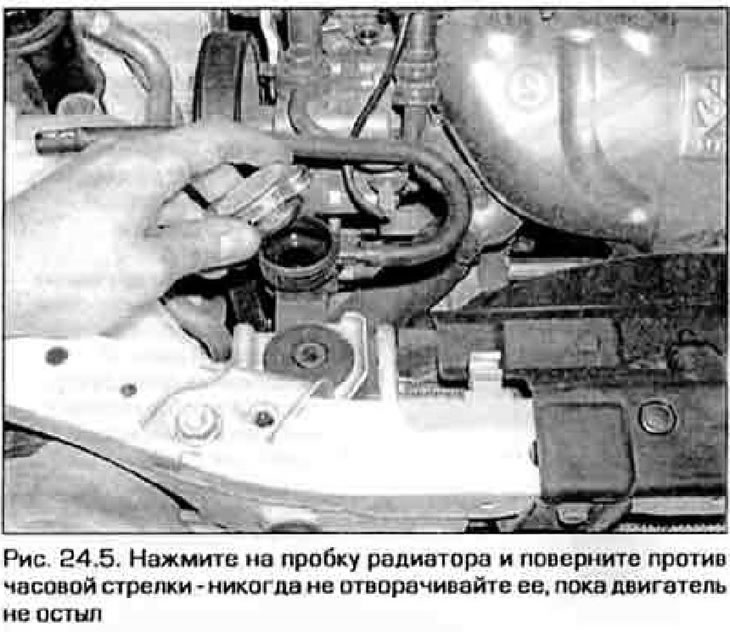
5. After the engine has cooled down, unscrew the radiator cap (on 4-cylinder models - Figure 24.5)…


6. Unscrew the drain plug on the bottom of the radiator (figure 24.6) and drain the liquid. If the plug is rusted and won't come off, or if the radiator doesn't have a plug at all, disconnect the lower hose from the radiator and drain the fluid from the pipe.
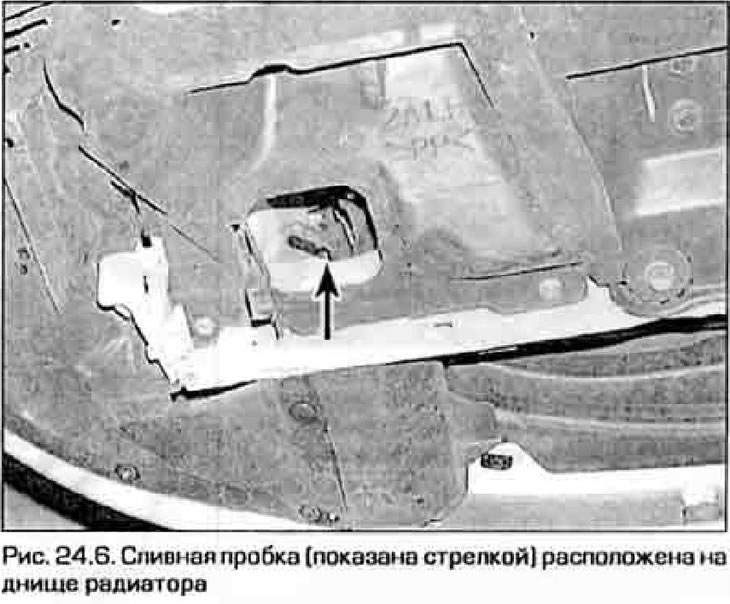


6. Unscrew the drain plug on the bottom of the radiator (figure 24.6) and drain the liquid. If the…


7. After the fluid stops flowing from the radiator drain hole, disconnect the lower hose and drain the remaining fluid from the cylinder block.

8. While the fluid is still draining from the block, disconnect the hose from the expansion tank and remove the tank (if necessary, see chapter 3). Wash the tank outside and inside so that the fluid level marks are clearly visible.

9. While the fluid is flowing, check the condition of the radiator and heater hoses, as well as their clamps.

10. Replace faulty hoses and clamps.

Flushing


11. When all the liquid has drained, remove the thermostat housing from the engine (see chapter 3), remove the thermostat itself from it and put the housing back in place,

The article is copied from the resource: mazbook.ru

12. Connect the lower hose to the radiator and screw in the drain plug. Set the heater tap to the extreme "hot" position to also flush the heater radiator.

13. Disconnect the upper hose from the radiator. Insert a garden hose into the top radiator hose and turn on the water. Flush the system until clear water flows from the top hose.

14. If the radiator is heavily soiled or clogged, remove the radiator from the vehicle and take it to a service station for cleaning and repair.


15. There are chemical products available for flushing cooling systems. When using them, follow the manufacturer's instructions.

Note: If the coolant is changed frequently, such a thorough flush is usually not necessary.


Filling


16. Before filling the system, install the thermostat, expansion tank and connect all hoses.

17. Turn the heater valve to the fully open position ("hot").

18. Fill the system with the recommended antifreeze/water mixture (see Technical data at the beginning of this chapter). Slowly fill the system through the radiator neck or filler neck until the liquid level reaches the base of the neck. Then add fluid to the expansion tank until the dipstick reads level F. Wait five minutes and check the radiator fluid level. If necessary, add liquid to the base of the neck.

19. Leave the filler cap open and start the engine. Warm up the engine until the thermostat opens (the fluid will begin to circulate through the radiator and the top hose will become hot).

20. Turn off the engine and let it cool down. Drink the liquid to the bottom of the filler neck.

21. Squeeze the upper radiator hose several times to force air out of the system. Check the level again and add fluid if necessary. Screw on the filler cap.

22. Set the temperature and fan speed control knobs to the maximum position.

23. Start the engine, warm it up to operating temperature and check for leaks.

24. If the coolant temperature rises above normal, it means that the air has not been completely removed from the system. Log the engine and let it cool completely. The air will be released from the system automatically. Repeat the system check and ensure that it operates normally when the engine temperature settles just before the red section on the gauge.
This article is available at: russian, bulgarian, belarusian, ukrainian, serbian, croatian, romanian, polish, slovak, hungarian
This text was checked by: German Vorobyov
Share with friends on social networks:

Previous
Capella 6 » Maintenance
Next

Checking and Adjusting Spark Timing (1997 and Earlier Models)
Checking and Adjusting Idle Speed (1997 and Earlier Models)
Checking and replacing the crankcase ventilation valve
Checking and replacing ignition system components
Checking and replacing spark plugs
Brake fluid change — every 50,000 km or every two years
Check suspension and steering — every 50,000 km or every two years
Automatic transmission fluid change — every 50,000 km or every two…
Manual transmission oil change — every 50,000 km or every two years
Exhaust system check — every 50,000 km or every two years
More articles on repairing other Mazda models
Filling the cooling system with liquid Mazda Familia 5 (1985-1989)
Radiator of the cooling system — description Mazda3 BK (2003-2009)
Cooling system — general information Mazda6 GG (2002-2008)
Safety precautions when working with the cooling system Mazda CX-5KE (2012-2017)
Engine and exhaust system maintenance Mazda 121 (3) (1996-2003)
Link in different formats to this article
Comments and feedback from visitors
No comments yet


How much will 25 + 37 ?


Capella 6 (1997-2005, petrol) 
  • General information
  • Introduction to guide
  • User manual
  • Troubleshooting
  • Maintenance
  • Power unit
  • 4-cylinder engines
  • 6-cylinder engines
  • Engine overhaul
  • Cooling and ventilation
  • Power and exhaust systems
  • Engine electrics
  • Control system
  • Transmission
  • Mechanical gearbox
  • Automatic gearbox
  • Clutch and drive shafts
  • Chassis
  • Brake system
  • Car suspension
  • Steering
  • Body
  • Exterior (external elements)
  • Interior (internal elements)
  • Doors, windows and locks
  • Electrical equipment
  • Equipment and devices
  • Electrical circuits
Capella 5 (1991-1997) 
  • General information
  • User manual
  • Maintenance
  • Helpful hints
  • Power unit
  • Petrol engines 1.6 and 1.8
  • Petrol engines 2.0
  • 2.5 petrol engines
  • Overhaul engines 1.6 and 1.8
  • Overhaul engines 2.0 and 2.5
  • Diesel engine 2.0
  • Engine electrics
  • Cooling system
  • Air conditioner
  • Carburetor Nikki 30/34
  • Power system (1.6 and 1.8)
  • Power system (2.0 and 2.5)
  • Control system
  • Transmission
  • Mechanical gearbox
  • Automatic gearbox
  • Clutch and axles
  • Chassis
  • Brake system
  • Suspension and wheels
  • Steering
  • Body
  • Exterior (external elements)
  • Interior (internal elements)
  • Doors and windows
  • Electrical equipment
  • Equipment and devices
  • Electrical circuits
Capella 4 (1987-1992) 
  • General information
  • Introduction to manual
  • Vehicle specifications
  • Power unit
  • Engine repair
  • Lubrication system
  • Cooling system
  • Fuel system (carburetor)
  • Fuel injection (FE)
  • Fuel injection (DOHC)
  • Fuel system (diesel)
  • Ignition system
  • Transmission
  • Clutch
  • Gearbox
  • Drive shafts
  • Chassis
  • Front suspension
  • Rear suspension
  • Steering system
  • Brake system
  • Electrical equipment
  • Equipment and devices
  • Electrical circuits
Capella 3 and 4 (1982-1992) 
  • General information
  • User manual
  • Maintenance
  • Power unit
  • Gasoline engine
  • Engine overhaul (gasoline)
  • Diesel engine
  • Cooling and heating
  • Supply system
  • Ignition system
  • Emission reduction
  • Transmission
  • Clutch
  • Mechanical gearbox
  • Automatic gearbox
  • Drive shafts
  • Chassis
  • Brake system
  • Suspension and wheels
  • Steering
  • Body
  • Exterior (external elements)
  • Interior (internal elements)
  • Electrical equipment
  • Equipment and devices
  • Power devices
  • Electrical circuits
Capella 3 (1982-1992, petrol) 
  • General information
  • User manual
  • Maintenance
  • Troubleshooting
  • Late models
  • Power unit
  • Engine in car
  • Engine overhaul
  • Cooling and heating system
  • Fuel and exhaust system
  • Engine electrical system
  • Emission control system
  • Transmission
  • Mechanical gearbox
  • Automatic gearbox
  • Clutch and drive shafts
  • Chassis
  • Brake system
  • Suspension and wheels
  • Steering
  • Body
  • Exterior (external elements)
  • Interior (internal elements)
  • Electrical equipment
  • Equipment and devices
  • Lighting and lamps
  • Electrical circuits
MazBook.ru © 2018–2026 · Mobile version · Articles and news · Sitemap: EN BG BY UA RS HR RO PL SK HU · Feedback · Site search · Add to bookmarks Familia 5 (BF) · Familia 6 (BG) · Capella 3 (GC) · Capella 3 and 4 (GC) · Capella 4 (GD) · Capella 5 (GE) · Capella 6 (GF) · Mazda3 BK · Mazda6 GG · CX-5KE · Mazda 121 (3) · Mazda BT-50 (1) ·
By continuing to use the site, you agree to the use of cookies 🔐