


Caution! Gasoline is highly flammable, so take all fire safety precautions when working with any component of the fuel system. See warnings at the beginning paragraph 2.
1. Before starting work, relieve pressure in the fuel system (see paragraph 2).
2. Fuel supply and return lines, as well as tank ventilation lines, run from the fuel tank to the engine compartment. The pipes run under the vehicle's underbody and are secured to it with clamps and screws. Periodically, pipelines and their fastenings should be inspected for any kinks or dents.
3. If dirt is found in the fuel filter during inspection, the lines must be disconnected and blown out. Check the fuel pump intake pipe mesh filter for damage (see paragraph 5).
Steel pipelines
4. If replacement of the fuel line or exhaust pipe is necessary, use for this purpose solid or welded pipes of the dimensions specified by the vehicle manufacturer.
5. Do not use copper or aluminum pipes to replace steel ones. These materials cannot withstand normal vibrations. arising in the car.
6. Since fuel lines on fuel-injected vehicles are always under excess pressure, they must be handled with particular care.
7. Some pipelines have threaded nipple connections with sealing rings. When separating them, the following rules should be observed.
- a) Always hold the other half of the connection with an open-end wrench to avoid twisting the pipe.
- b) Inspect all sealing pin connections for cracks, cuts and rubber decomposition. Replace the seal. if it is hardened, worn out, or its condition is questionable.
- c) When replacing piping or fittings, purchase genuine parts whenever possible, or at least use a source you trust.
Flexible hoses
Caution: Purchase only genuine replacement hoses or hoses of equivalent specifications. Not every hose can handle the pressure created by this system.
8. Do not route fuel hoses closer than 0.1 m from mufflers and exhaust pipes, or closer than 0.25 m from the catalytic converter. Secure the pipes so that they do not rub against body parts. To achieve this, there must be a gap of at least 8 mm between the pipeline and the body.
Removal and installation
9. Relieve the pressure in the fuel system (see paragraph 2).
10. Release the pipeline from its fastenings to the body.
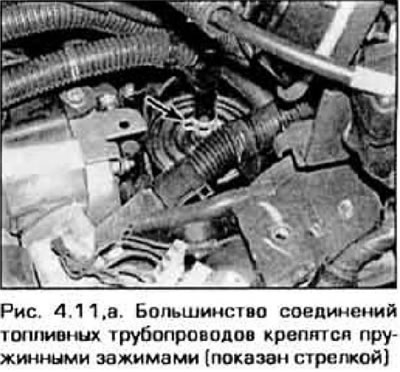
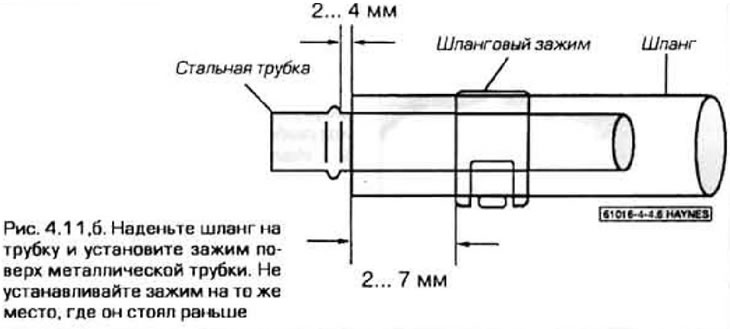
11. In most cases, flexible hoses are connected to steel pipes using spring clamps (figure 4.11,a). To loosen this type of fastening, squeeze the bent ends of the clamp with pliers and slide it along the hose. Do not reuse such a clamp if it is bent or has lost elasticity - it is better to replace it. Insert the metal tube into the hose at least 25mm and place the clamp over the metal tube (figure 4.11,b).
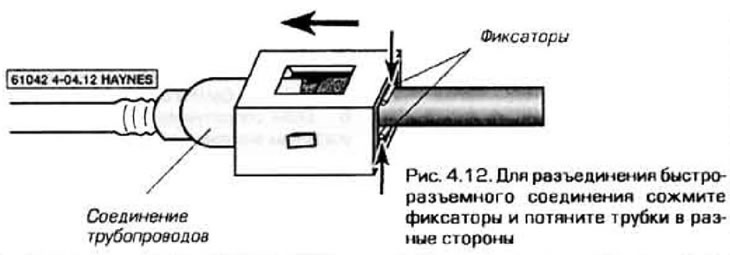
12. Some pipelines are equipped with quick-release couplings (figure 4.12). To disconnect such pipes, squeeze the connector tabs and pull the pipes in different directions.
Caution: Do not remove the connector part from the metal tube unless necessary. After reinstalling it, you will hardly be able to ensure a tight connection.
13. The connection of pipelines is carried out in the reverse order of their separation. Push the quick-release coupling halves together until the latches snap into place.
Repair
14. In case of damage to a pipeline element (hose or steel tube) the faulty part should be replaced with the same original part. Parts of dubious origin may not withstand the high pressure generated by the system.