


Caution! Gasoline is highly flammable, so take all fire safety precautions when working with any component of the fuel system. See the warning at the beginning paragraph 2.
Note: This job is much easier if the tank is empty. Some tanks have a drain hole for this purpose. If there is no such hole, pump the fuel out of the tank using a hand pump provided specifically for this purpose. Do not suck gasoline with your mouth.
1. Unscrew the filler cap of the tank to relieve pressure in it.
2. Relieve the pressure in the fuel system (see paragraph 2).
3. Disconnect the negative cable from the battery.
Warning. If your vehicle's audio system is equipped with anti-theft protection, make sure you have the unlock code before disconnecting the battery.
4. If your car's fuel tank has a drain hole, unscrew the plug and drain the remaining fuel into a suitable container. If there is no such hole, pump out the fuel using a hand pump.
5. Disconnect the connectors on the coca and level sensor (see paragraph 5).
6. Loosen the rear wheel nuts, lift the car and place it on stands.
7. Remove the exhaust system behind the catalytic converter (see paragraph 16). Remove the heat shield installed above the intermediate muffler.
8. Remove the pressure control valve and the fuel tank pressure sensor (see chapter 6).
9. Mark and disconnect the fuel and vent hoses from the tank.
10. Support the tank from below with a trolley jack.
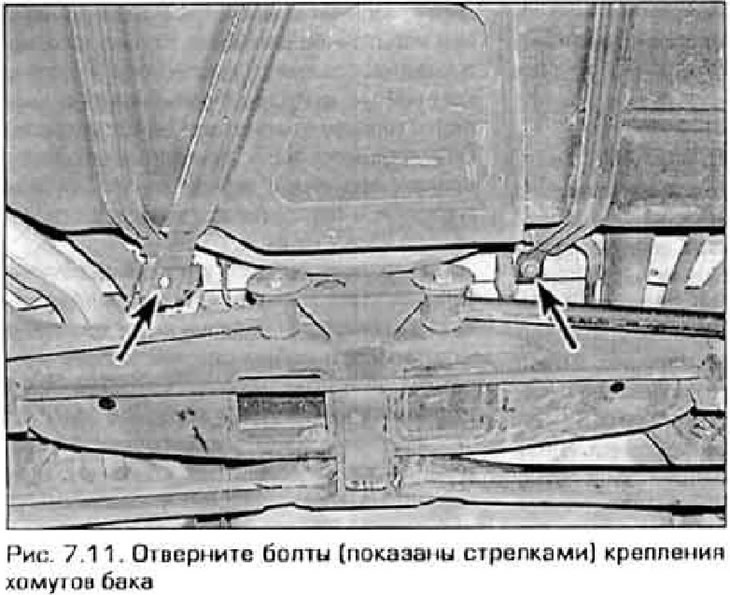
11. Unscrew the tank clamp fasteners and set them aside (figure 7.11).
12. Lower the jack and remove the tank.
13. The tank is installed in reverse order.