


Engine cooling system
All vehicle models described in this manual have a closed, positive-pressure cooling system with two thermostat-controlled coolant circuits (figure 1.1). To ensure fluid circulation, a centrifugal water pump is installed on the cylinder block. Coolant circulates around each cylinder in a direction from the front to the rear of the engine. The fluid circulates through the channels around each valve, around the spark plug holes, and around the exhaust valve bushings.
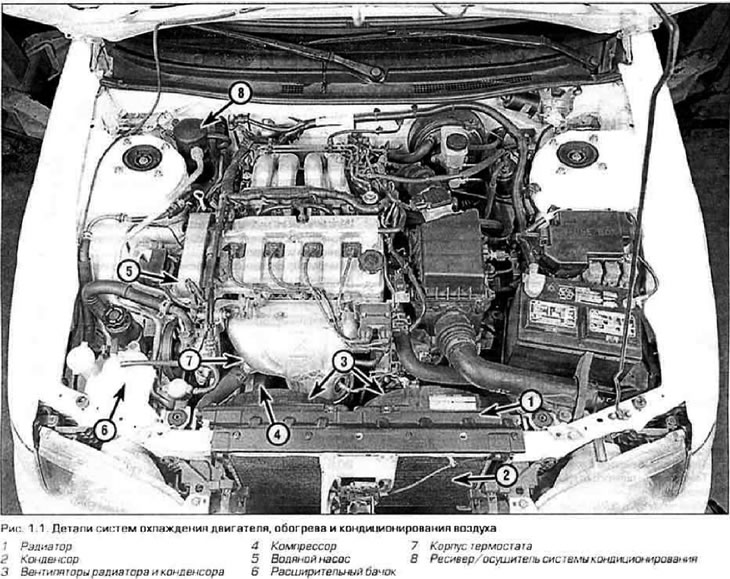
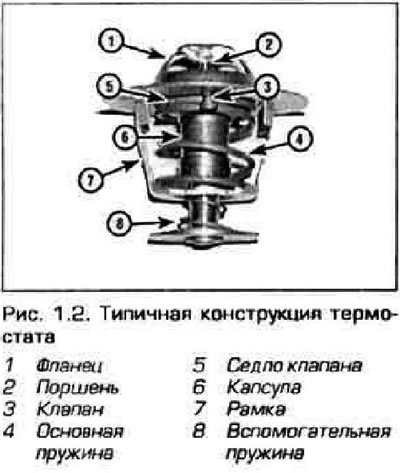
Thermostat with wax filling (figure 1.2). located at the rear of the engine on the transmission mounting side. When the engine warms up, the thermostat is closed and no liquid enters the radiator. When the operating temperature is reached, the thermostat opens and the coolant begins to circulate through the radiator, where it is cooled. The cooling system operates under pressure, which is regulated by a release valve in the radiator cap. Excess pressure in the cooling system increases the boiling point of the liquid and also increases the efficiency of the radiator. If the pressure in the system exceeds the permissible value, the valve in the radiator cap opens slightly, and excess coolant flows into the expansion tank. When the engine cools down, the coolant is automatically drawn back into the radiator.
The expansion tank serves to replenish the cooling system with fresh liquid and to store excess liquid formed during the volumetric expansion of heated coolant.
This type of cooling system is known as a closed system because excess coolant flows into the expansion tank (and back) and is reused.
Heating system
The heating system consists of a fan, a heater core located under the dashboard on the right side, hoses connecting the heater core to the engine cooling system, and heater/air conditioning control knobs located on the dashboard. The engine cooling system coolant circulates through the heater radiator. When the heating system is turned on, the damper opens and the fan turns on. The air flow created by the fan passes through the heater radiator and warm air begins to enter the car's interior.
Air conditioning system
The air conditioning system consists of a condenser located in front of the radiator, an evaporator installed next to the heater core, a compressor mounted on the engine, a filter dryer in which there is a safety valve for excess pressure, and pipelines connecting all of the above-mentioned units.
The heater fan delivers warm air from the vehicle's interior to the evaporator grille. In the evaporator, the air gives up its heat to the refrigerant, causing the air to cool and the liquid refrigerant to boil, turning into low-pressure vapor. The compressor circulates the refrigerant and pumps heated refrigerant from the evaporator through the condenser. In the condenser, the refrigerant cools down and returns to the evaporator.
Until 1994, the air conditioning system was charged with A-12 refrigerant. Since 1994, the system has been charged with the more environmentally friendly R-134a refrigerant. These refrigerants are not compatible, nor are the oils used in the systems. Even after releasing the A-12 refrigerant from the system, its residues still remain in the cavities and hoses of the system, so simply filling the system with R-134a refrigerant can only have a negative effect. Under no circumstances should this be done in a garage without special equipment and experience. In addition, systems designed for different types of refrigerants differ in design and their parts are also not interchangeable.