MazBook.ru
English Русский
Български
Беларускі
Український
Српски
Hrvatski
Română
Polski
Slovenský
Magyar
• Bookmark • Sitemap • Contacts •   
Cars Opel Cars Ford Cars Volkswagen Cars Audi Cars Kia Cars Renault Cars Peugeot


Familia Capella Mazda3 Mazda6 CX-? Others Articles
Capella 3 (1982-1992, petrol) Capella 3 and 4 (1982-1992) Capella 4 (1987-1992) Capella 5 (1991-1997) Capella 6 (1997-2005, petrol)

Launch on the rise (Mazda Capella GC)

  • Home
  • Mazda Capella
  • Capella GC (1982-1992)
  • General information
  • User manual
  • Launch on the rise
0
Contents: Starting the engine ⇓ Shifting to a lower gear. ⇓ Launch on the rise ⇓ Blocking method ⇓
Press the brake pedal with your left foot and move the automatic transmission selector lever to position "P" or "1", depending on the vehicle load and the steepness of the slope, then release the parking brake. Press the gas pedal with your right foot while releasing the brake pedal.

(For vehicles equipped with an electronic automatic transmission)

the "Electronic Automatic Transmission" (EC-AT) uses a sequential selector lever, lock-up switch and drive method. The normal driving mode is carried out with the gear lever in position "D".

Note: To achieve a minor change in speed, press the brake pedal to shift from "N" or "P" for forward or reverse.
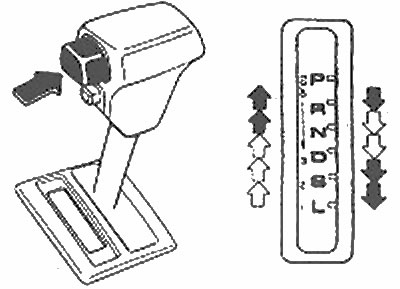

Press the button located on the shifter handle to switch between the «R» and «P» positions and to…
Press the button located on the shifter handle to switch between the "R" and "P" positions and to switch from "D" to "S" and from "S" to "L".
The switch handle can move freely in other positions.


Attention:
  • Do not move the gearshift lever to the "R" and "P" positions until the vehicle has come to a complete stop.
  • At high speeds, use the brakes rather than downshifting to slow down.
  • If you stop on an incline, do not use the engine to hold the vehicle. Use the brake pedal.
  • Do not shift from the "N" or "P" position to the "P" position "1", "2", "D" or "R" at high engine speeds.


Starting the engine


Set the gearshift lever handle to the "P" or "N" position, otherwise the starter will not work.

R (Parking). This position is selected only when the vehicle is completely stopped.

Caution! Do not use the "P" (Park) position instead of the parking brake. Make sure the shift lever handle is set to the "P" position so that it cannot move without pressing the button. Apply the parking brake. Turn off the engine when you leave the vehicle. Do not leave the car with the engine running, it may suddenly start moving.


R (Reverse). To make the car move backwards - after a complete stop.

N (Neutral position). When the car stops (the brake is on)

D (Movement). (Storage switch in the "OFF" position and the automatic transmission shift lever in any position.)

This configuration is used for normal driving conditions, where the 4-speed gearshift intervals are adjusted to achieve fuel economy.

S (Symbol). (Storage switch in the "OFF" position and the automatic transmission shift lever in any position.)

Use this symbol when driving slowly and over short distances, for more power when climbing, or to make braking easier when descending, set the shifter handle so that the transmission is in 3rd gear.

L (Symbol). (Save switch to "OFF" and gearshift lever in any position.)

When the load is heavy, or when climbing or descending a very steep slope, set the shift lever handle to the (L) symbol so that the gearbox is in 2nd gear.

Shifting to a lower gear.


Press the accelerator pedal all the way down to shift from a higher gear to a lower one, you can get power and sudden acceleration to climb steep slopes.


Launch on the rise


Press the brake pedal with your left foot and shift the gearshift lever to the "D" or "L" position, depending on the vehicle load and the steepness of the slope, then release the parking brake. Gently press the gas pedal with your right foot, releasing the brake pedal.

Drive mode selection lever


You can choose the method of movement that is most convenient in certain conditions.

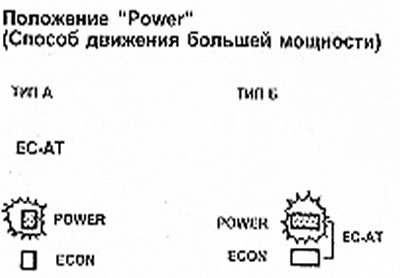
Press the mode selector button to select "Economy" (An economical way to travel) or "Power" (A method of movement with greater power). The control lamp lights up to indicate the selected method.
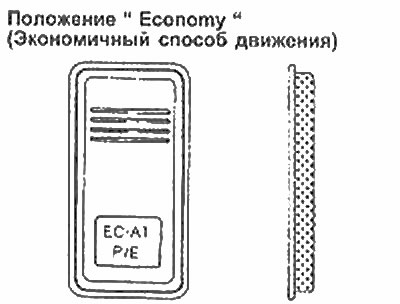
Press the mode selector button to select «Economy» (An economical way to travel) or «Power» (A…


For normal driving, it is recommended to place the transmission selector lever in the "D" (Drive) position, the lockout lever in the "OFF" position, and the drive mode selector lever in the "Economy" position (Economical).
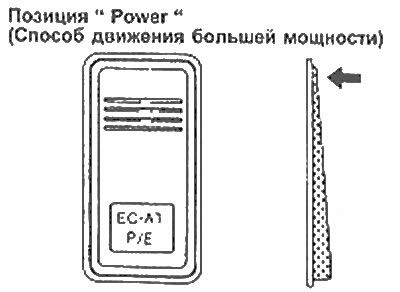
For normal driving, it is recommended to place the transmission selector lever in the «D» (Drive)…


Note: When the engine coolant temperature is low, the vehicle operates in "POWER" mode, even if "ECONO" mode is selected (economical). However, at this point, the "ECONO" indicator light on the instrument panel will still light up.


When the locking method is selected, the POWER and ECONO indicator lamps go out.
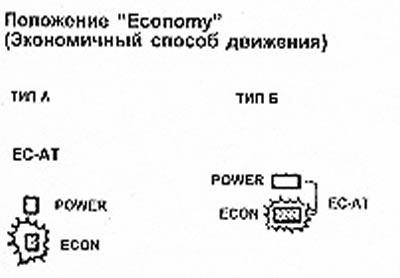
When the locking method is selected, the POWER and ECONO indicator lamps go out.

Locking lever


This system decouples the automatic gear change mechanism and has three stages: Third (3) on "D", Second (2) on "S" and First (1) on "L".

(Information copied from the portal: Mazbook)

Use this system to start on slippery surfaces (snow, mud, etc.), to overcome steep slopes or to use engine braking on descents.
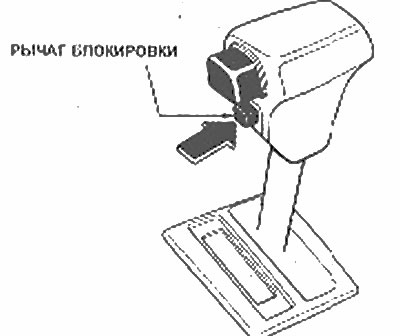
Use this system to start on slippery surfaces (snow, mud, etc.), to overcome steep slopes or to use…


Lock indicator light


When the lockout lever is in the "ON" position.


Caution! If the indicator light flashes, there is damage to the automatic transmission. If this happens, contact your Mazda service center.

Selecting a blocking method


The blocking method is selected by pressing the blocker button. To disable it, click the blocker button again.

Note: The locking method is automatically cancelled when the engine is started.


Blocking method


D (Movement). When the locking mode is selected, the transmission is locked in third (3) gear. When stopped, the automatic transmission downshifts to (2) and then upshifts again to (3) to provide more consistent acceleration.

S (Second). When the locking method is selected, the gearbox is locked in position (2). Do not exceed 115 km/h in position "S".

L (First). When the locking method is selected, the gearbox is locked in position (1). Do not exceed 60 km/h in position "L".
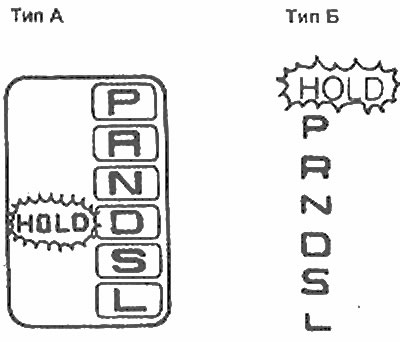
L (First). When the locking method is selected, the gearbox is locked in position (1). Do not…
This article is available at: russian, bulgarian, belarusian, ukrainian, serbian, croatian, romanian, polish, slovak, hungarian
This text was checked by: Evdokia Filimonova
Share with friends on social networks:

Previous
Capella 3 » User manual
Next

Automatic transmission
Manual transmission
Power steering system
Starting the engine (diesel vehicle)
Starting the engine (petrol engine without fuel injection system)
Power steering with 4-wheel drive (4WS)
Ways to use fuel more efficiently.
Speed control and regulation system
Lighting and turn signals. Horn
Windscreen washer and wiper lever
More articles on repairing other Mazda models
Push or tow launch Mazda Familia 6 (1989-1994)
Launch system Mazda CX-5KE (2012-2017)
Link in different formats to this article
Comments and feedback from visitors
No comments yet


How much will 16 + 35 ?


Capella 6 (1997-2005, petrol) 
  • General information
  • Introduction to guide
  • User manual
  • Troubleshooting
  • Maintenance
  • Power unit
  • 4-cylinder engines
  • 6-cylinder engines
  • Engine overhaul
  • Cooling and ventilation
  • Power and exhaust systems
  • Engine electrics
  • Control system
  • Transmission
  • Mechanical gearbox
  • Automatic gearbox
  • Clutch and drive shafts
  • Chassis
  • Brake system
  • Car suspension
  • Steering
  • Body
  • Exterior (external elements)
  • Interior (internal elements)
  • Doors, windows and locks
  • Electrical equipment
  • Equipment and devices
  • Electrical circuits
Capella 5 (1991-1997) 
  • General information
  • User manual
  • Maintenance
  • Helpful hints
  • Power unit
  • Petrol engines 1.6 and 1.8
  • Petrol engines 2.0
  • 2.5 petrol engines
  • Overhaul engines 1.6 and 1.8
  • Overhaul engines 2.0 and 2.5
  • Diesel engine 2.0
  • Engine electrics
  • Cooling system
  • Air conditioner
  • Carburetor Nikki 30/34
  • Power system (1.6 and 1.8)
  • Power system (2.0 and 2.5)
  • Control system
  • Transmission
  • Mechanical gearbox
  • Automatic gearbox
  • Clutch and axles
  • Chassis
  • Brake system
  • Suspension and wheels
  • Steering
  • Body
  • Exterior (external elements)
  • Interior (internal elements)
  • Doors and windows
  • Electrical equipment
  • Equipment and devices
  • Electrical circuits
Capella 4 (1987-1992) 
  • General information
  • Introduction to manual
  • Vehicle specifications
  • Power unit
  • Engine repair
  • Lubrication system
  • Cooling system
  • Fuel system (carburetor)
  • Fuel injection (FE)
  • Fuel injection (DOHC)
  • Fuel system (diesel)
  • Ignition system
  • Transmission
  • Clutch
  • Gearbox
  • Drive shafts
  • Chassis
  • Front suspension
  • Rear suspension
  • Steering system
  • Brake system
  • Electrical equipment
  • Equipment and devices
  • Electrical circuits
Capella 3 and 4 (1982-1992) 
  • General information
  • User manual
  • Maintenance
  • Power unit
  • Gasoline engine
  • Engine overhaul (gasoline)
  • Diesel engine
  • Cooling and heating
  • Supply system
  • Ignition system
  • Emission reduction
  • Transmission
  • Clutch
  • Mechanical gearbox
  • Automatic gearbox
  • Drive shafts
  • Chassis
  • Brake system
  • Suspension and wheels
  • Steering
  • Body
  • Exterior (external elements)
  • Interior (internal elements)
  • Electrical equipment
  • Equipment and devices
  • Power devices
  • Electrical circuits
Capella 3 (1982-1992, petrol) 
  • General information
  • User manual
  • Maintenance
  • Troubleshooting
  • Late models
  • Power unit
  • Engine in car
  • Engine overhaul
  • Cooling and heating system
  • Fuel and exhaust system
  • Engine electrical system
  • Emission control system
  • Transmission
  • Mechanical gearbox
  • Automatic gearbox
  • Clutch and drive shafts
  • Chassis
  • Brake system
  • Suspension and wheels
  • Steering
  • Body
  • Exterior (external elements)
  • Interior (internal elements)
  • Electrical equipment
  • Equipment and devices
  • Lighting and lamps
  • Electrical circuits
MazBook.ru © 2018–2026 · Mobile version · Articles and news · Sitemap: EN BG BY UA RS HR RO PL SK HU · Feedback · Site search · Add to bookmarks Familia 5 (BF) · Familia 6 (BG) · Capella 3 (GC) · Capella 3 and 4 (GC) · Capella 4 (GD) · Capella 5 (GE) · Capella 6 (GF) · Mazda3 BK · Mazda6 GG · CX-5KE · Mazda 121 (3) · Mazda BT-50 (1) ·
By continuing to use the site, you agree to the use of cookies 🔐