


2. There are several types of drive belts. Removed belts must be replaced only with identical ones.
3. The number of belts used on a particular model depends on the components it is equipped with. Belts are used to drive the generator, power steering pump and air conditioning compressor. Depending on the arrangement of the pulleys, the belt can drive one or more components.
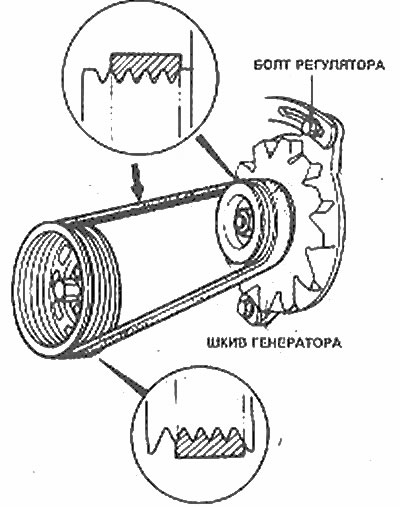
4. Various belt installation profiles are shown in the illustrations.
5. Open the hood (the engine is turned off) and find the drive belts. Move along the belt, feeling it with your fingers to check the belts for cracks and delamination. Use a flashlight if necessary. Also check for frayed and worn (shiny) areas. Both sides of the belt should be inspected, meaning you'll have to flip the belt over to inspect the back.
6. The tension of each belt can be checked by pressing on the belt in the middle of one of its runs (at the points indicated by arrows in the illustrations). Press firmly on the belt with your thumb and use a ruler to determine how far it deviates. Compare the obtained value with the data given in the Specifications (photo).
Installing a belt that drives only the generator. The tension check point is marked with an arrow (Chapter 6)
7. If the belt tension needs to be adjusted, move the component it drives in the desired direction.
Installing the belt driving the generator and power steering pump. The tension check point is marked with an arrow (Chapter 6)
(The original article is posted on: Mazbook)
8. Each component has an adjusting bolt and a pivot bolt. Both bolts must be slightly loosened to allow the component to be moved. The power steering belt and air conditioning compressor tension are adjusted by turning the idler pulley adjusting bolt (photo). Before adjusting, loosen the idler pulley locknut and tighten it again when the adjustment is complete.
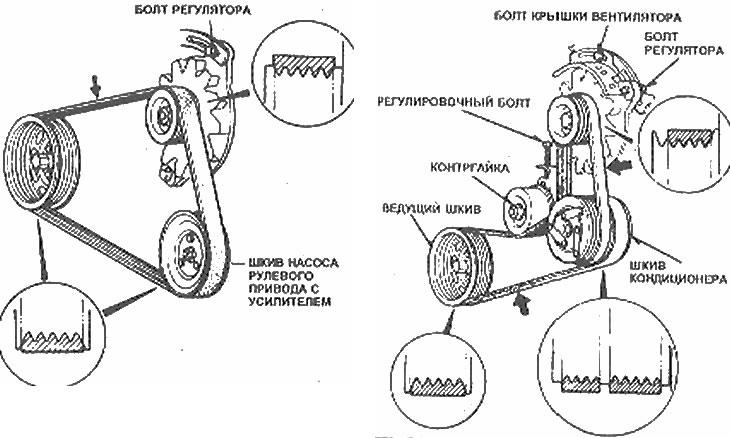
Installing the belt on models with air conditioning. Tension check points are marked with arrows (Chapter 6)
9. After loosening the two bolts, move the component away from the engine to tighten the belt or towards the engine to loosen it. While holding the belt driven component, check the belt tension. If it is correct, lightly tighten the two bolts and recheck the tension. If the tension is correct, tighten the bolts completely.
10. It is often necessary to use a special tool to move the component when adjusting the belt tension. Work carefully to avoid damaging the components.
11. To replace the drive belt, loosen the old belt as described so that it can be removed from the pulleys. (If two belts are installed, remove the belt farthest from the engine first, even if it does not need to be replaced.)
12. Install the new belt(s) and adjust the tension as described above. Please note that the new belt tolerance is different from the old one - see Specifications.
13. Recheck the tension of the new belt after several hundred kilometers.