


Note: For detailed photographs of brake system components, see. v Section 9.
1. The brakes should be inspected whenever the wheels are removed or whenever they are suspected of being faulty.
Signs of a faulty brake system include:
- vehicle veers to the side when braking;
- squealing brakes;
- excessive brake pedal free play;
- pedal pulsation;
- fluid leak, usually visible on the inside of the wheel.
Disc brakes
2. To inspect the front disc brake, you only need to remove the wheel.
3. Raise the vehicle and support it securely on axle stands. Remove the wheels.
4. Now the disc brake calipers, which contain the pads, are visible. Each caliper has an outer and inner pad. Both pads must be inspected.
5. Check the brake pad lining thickness through the inspection hole in the caliper body (photo). If the linings are worn down to 1 mm or thinner, the pads must be replaced. Remember that the overlay is attached to a metal base, the thickness of which is not included in this measurement.
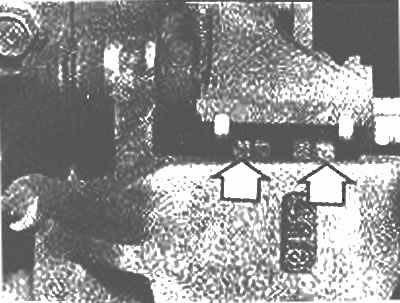
Assess the thickness of the brake pad linings (arrows) through the inspection hole in the caliper body
6. If it is difficult to measure the exact thickness of the lining and the condition of the pad is in doubt, remove the pads and inspect them.
7. Before installing the wheels, check the brake hoses and their connections for leaks and damage (cracks, splitting, etc.). Replace hoses or connections as necessary (see Section 9).
8. Inspect the brake disc for scratches and burns. If these damages are found, remove the hub/disc assembly and perform the necessary service procedures (Section 9).
Drum brakes
9. Remove the brake drum assembly/hubs (Chapter 27). If this fails, make sure the parking brake is released. See also paragraph 4 of Chapter 6 of Section 9.
10. Carefully remove all dirt and dust deposits from the brake components.
Warning: Do not blow dust away with compressed air. Try not to inhale the dust, as it contains asbestos, which is hazardous to your health.
11. Measure the thickness of the rear brake pad linings (photo). If the distance between the rivet heads and the pad surface is 1 mm or less, replace the pads. If the pads look worn but you cannot determine their exact thickness, compare them with new ones. The brake pads also need to be replaced, they are cracked and their linings are worn out (have a shiny surface) or contaminated with brake fluid.
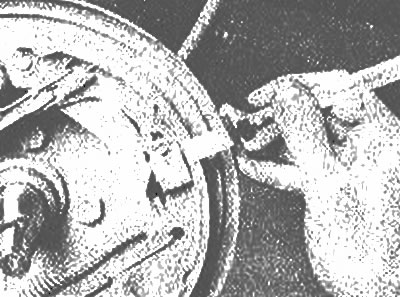
Remove the brake drum and measure the brake shoe lining thickness
12. Check the condition of all brake assembly springs.
13. Check brake components for signs of fluid leaks. Using your fingers, carefully remove the rubber caps from the wheel cylinder located at the top ends of the brake pads. Any leakage indicates that the wheel brake cylinders should be overhauled immediately (Section 9). Also check the hoses and connections for signs of leaks.
14. Wipe the inside of the drum with a clean cloth soaked in denatured alcohol. Be careful not to inhale hazardous asbestos dust.
15 Inspect the inside of the drum for cracks, deep scratches, and discolored spots. If the detected defects cannot be removed with fine sandpaper, the drum must be re-sharpened, for which purpose please contact a specialist. Also check the condition of the wheel bearing seal and replace it if necessary (Chapter 27).
16 If inspection shows that all parts are in good condition, install the hub/brake drum (see Chapter 27). Install the wheel and lower the car to the ground.
Parking brake
17 Tighten the parking brake lever to approximately 10 kg and check that the lever moves the number of clicks specified in the Specifications. If this is not the case, adjust the parking brake (Section 9).
18 The easiest way to check the operation of the parking brake is to park the vehicle on a steep hill with the parking brake applied and the transmission in neutral. If the parking brake cannot hold the vehicle, it needs to be adjusted (see Section 9).
Brake booster
19. Press the brake pedal several times (the engine is turned off), to relieve residual vacuum in the brake booster unit.
20. Firmly press the brake pedal all the way down and, holding it in this position, start the engine. If the brake booster unit is working properly, the brake pedal will noticeably move downwards at the moment of starting.
21. If the brake booster unit does not work, check the vacuum hose and one-way valve before replacing the brake booster unit itself (Section 9).