


Front brake hose
2. To disconnect the flexible hose and the brake system pipe, loosen the pipe nut with a special wrench, then remove the clamp. When connecting them, install the bracket, then tighten the nut.
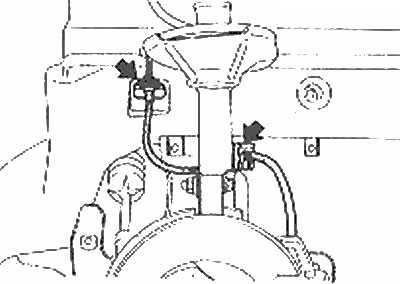
Location of the front brake hose mounting bracket
3. When installing, make sure that the threads of all bolts are clean.
4. After completing the installation of the brake hose, make sure that the hose is not kinked. Also, check to see if the hose is coming into contact with any front suspension components. To do this, turn the wheels to the far left and then to the far right position. If the hose touches the suspension in any position, remove the hose and adjust its installation as necessary.
5. Finally, bleed the brake system (Chapter 15).
Rear brake hose
6. Using a special wrench, disconnect both ends of the hose, being careful not to bend the bracket or steel tubes.
7. Use pliers to remove all clamps and separate the hose ends from the brackets.
8. Press the hose retaining clip and remove the hose.
9. Without twisting the hose, install the hose ends into the brackets.
10. Install the brackets that secure the tips to the bracket.
11. Using a special wrench, attach the ends of the steel tubes to the ends of the hoses. Be careful not to bend the bracket or steel tube.
12. Make sure that the bracket does not loosen during the installation of the hose. Tighten the bracket if necessary.
13. Fill the master cylinder reservoir and bleed the system (see Chapter 15).
Steel brake lines
14. When replacing steel lines, use only double-wall steel tubing or at least the type of tubing approved by the manufacturer. If copper alloy tubing is used, carefully install the additional mounting brackets following the manufacturer's instructions.
15. Automotive stores sell ready-made brake lines of various lengths.
16. If there is no ready-made tube of the appropriate length, purchase a tube of the recommended material and tips to make the required tube. Determine the required length by measuring the old brake pipe and adding 13 mm to the resulting value for flaring the ends.
17. Insert the tips into the new tube and flare the ends using a special tool.
18. Using a special tool, bend the tube to give it a shape identical to the old tube.
19. Flaring of the ends of the tube and giving it the required shape can be entrusted to any service station that has the appropriate equipment.
20. When installing the brake pipe, ensure that there is at least 20 mm of clearance between the pipe and surrounding components.
21. Finally, bleed the brake system (Chapter 15).