


1. Remove the caliper (Chapter 3) and brake pads (Chapter 2). The caliper piston can be removed in two ways. Step 4 below describes how to remove the piston from a caliper that has been removed from the vehicle. If the brake hose is still attached to the caliper and the pads are removed, the piston can be pushed out using hydraulic pressure. Cover the support with a plate or a cloth folded in several layers. Do not place your fingers under the piston. Have an assistant press the brake pedal very slowly to push the piston out. Be prepared for brake fluid to leak (photo).
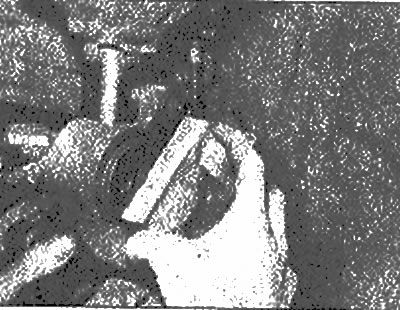
When removing the pistons using hydraulic pressure, use a die to protect the caliper. Do not expose your fingers to the impact of the piston
2. Clean the outer surface of the caliper with brake fluid, denatured alcohol or a special cleaner (never use gasoline or kerosene). Place the caliper on a clean workbench.
3. Remove the caliper bleeder screw.
4. If the piston has not yet been removed, cover the caliper with a plate or rag and push the piston out of the caliper using compressed air. It is enough to simply remove the edge of the piston from the hole. If the piston flies out, even if it hits a rag, it can be damaged.
Warning: Do not try to catch the piston with your fingers, this may cause injury.
5. Remove the retainer and dust seal from the caliper channel.
6. Using a suitable wooden or plastic tool, pry the piston seal out of the groove in the caliper bore. Metal instruments can damage the canal walls.
7. Remove the dust boots, pins and bushings from the caliper lugs.
(The article is reprinted from the portal: www.MAZbook.ru)
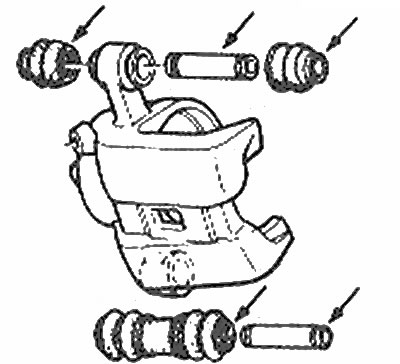
Caliper boot, bushing and pins (arrows indicate areas requiring lubrication)
8. Clean the remaining parts with brake fluid. Let the liquid drain, then shake off any remaining liquid with vigorous movements.
9. Carefully inspect the piston and caliper bore for scratches, burrs, and corrosion. If these defects are found, replace the parts. If the defects are minor, the caliper channel can be sanded with fine abrasive paper. Inspect mounting bolts, pins and bushings for corrosion and damage. Replace components if necessary.
10. When assembling, lubricate the caliper bore and seal with clean brake fluid. Apply the red grease supplied with the seal kit to the piston seal.
11. Insert the seal into the groove of the caliper channel (photo).
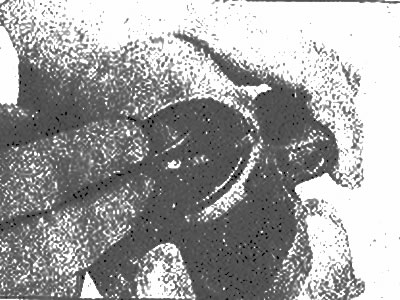
11 Insert the piston seal into the groove of the caliper bore
12. Install the dust seal on the piston. Apply a small amount of orange grease to the dust seal (comes with a set of seals), then install the piston and dust seal into the caliper bore. Install the dust seal retainer.
13. Install the bleed nipple.
14. Lubricate the dust boots, bushings and stamps with orange grease and install the caliper.
15. Apply a small amount of grease to the sound-absorbing pads of the brake pads. For disc brakes (Mazda 8175 49 248) or a special sound-absorbing composition. Avoid contact of lubricant with rubbing surfaces. Install the brake pads.
16. Install the caliper and bleed the brakes (Chapter 15).