


2. Remove the wheel.
3. Remove the caliper assembly (see Chapter 3).
Note: There is no need to disconnect the brake hose. After removing the caliper mounting bolts, secure the caliper to the body with a piece of rope. Do not allow the caliper to hang on the brake hose, this may cause damage to the hose.
4. Inspect the surface of the brake disc. The presence of shallow scratches or grooves is perfectly acceptable, but if there are deep grooves or severe erosion, the disc must be replaced or reground. Vibration felt when braking can be caused by either worn brake discs or worn wheel bearings.
Information copied from the portal [Mazbook]
5. Install the micrometer on the caliper mounting bracket, rotate the brake disc and measure its runout. Check the runout on both the inner and outer surfaces. If the runout exceeds the maximum value specified in the Specifications and the wheel bearings are known to be in good condition, remove the brake disc from the vehicle and have it reground by a dealer.
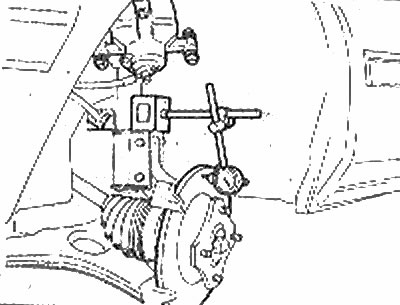
Measure the brake disc runout
6. Using a micrometer, measure the thickness of the brake disc. If it is less than the one specified in Specifications at a minimum, replace the disk. Measure the thickness of the disc at several points. If the difference between these measurements exceeds 0.0127 mm, vibration will be felt when braking. In this case, if the thickness of the disc allows, the disc can be re-sharpened.
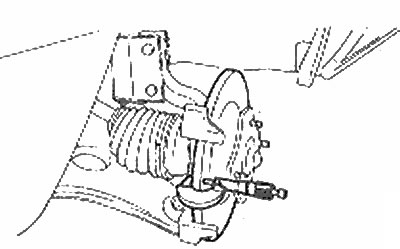
Measure the thickness of the brake disc
7. To remove the disc from the hub, special tools are required. Remove the disc assembly with the hub (Section 10) and contact your dealer to have the blade reground or replaced.