


Contents: Inspection ⇓ Bearing lubrication ⇓
Inspection
1. Jack up the vehicle and support it securely on axle stands. Spin the rear wheels and make sure they rotate quietly, freely, and without wobbling. Now grab the wheel at its top and bottom points. Try moving the wheel back and forth. If the wheel moves more than 0.13 mm, the bearings should be checked and adjusted or, if necessary, replaced.
2. Unlike the front wheel bearings, servicing the rear wheel bearings on these models does not require disassembling the hub unit.
Bearing lubrication
3. Raise and securely support the rear of the vehicle on axle stands.
4. Remove the wheels and apply the parking brake.
5. Use a flat chisel and hammer to remove the grease cap by tapping around its periphery.
6. Bend back the locking rim and remove the hub nut. The manufacturer recommends using a new nut during installation.
7. Pull the hub assembly out slightly, then push it back into its original position. This should push the outer bearing and washer out enough. so that they can be removed (photo). If the hub-drum assembly cannot be moved, see paragraph 4 of Chapter 6 of Section 9.
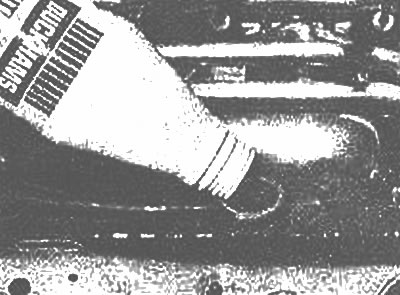
Pull the hub out to push and remove the washer... |
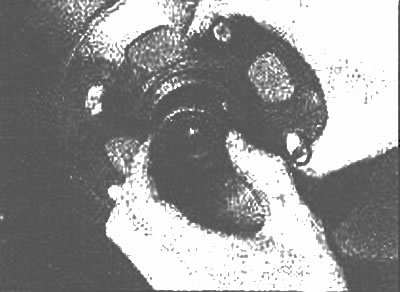
... and the outer bearing |
8. Remove the hub, place it on a suitable work surface and remove the inner bearing seal using a screwdriver (photo).
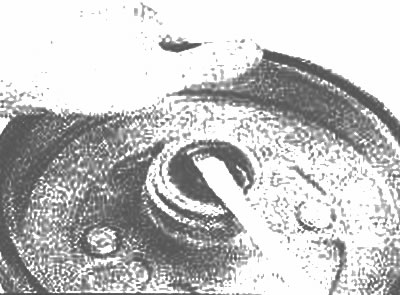
Remove the bearing seal from the hub
9. Use solvent to remove all traces of old grease from the bearings, hub and axle. Allow the components to dry.
10. Carefully inspect the bearings for cracks, scratches and uneven surface wear. If the bearing rings are defective, see Section 10. Bearings and rings form matched sets, so replacing the rings requires replacing the bearings. Likewise, replacing bearings requires that new rings be installed in the hub.
11. Lubricate the bearings thoroughly with specified high temperature wheel bearing grease.
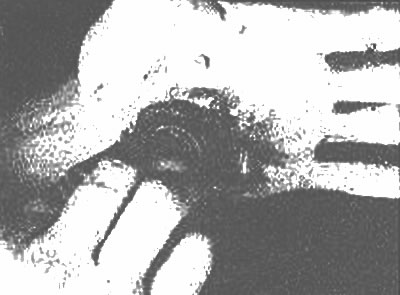
Lubrication of bearing with high temperature grease. Make sure the rollers are lubricated on all sides
12. Apply a thin coat of grease to the axle at the outer bearing seat, inner bearing seat, flange and seal seat.
13. Apply a small amount of grease to the race of each bearing inside the hub.
14. Install the greased inner bearing into the hub and coat its edge with additional grease.
15. Install the new seal onto the inner bearing with the open end facing the bearing.
16. Lightly lubricate the seal, carefully place the hub assembly on the axle and push the thoroughly lubricated outer bearing and washer into place (photo).
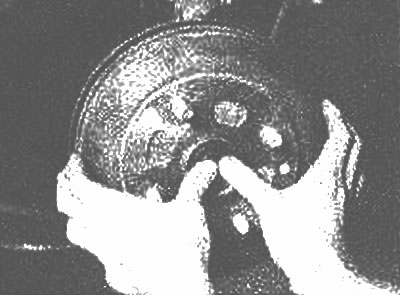
Place the hub on the axle, holding the outer bearing and washer with your thumbs
17. Install the new hub nut and adjust the bearing preload using the following procedure:
- a) Tighten the hub nut to the specified tightening torque Specifications (photo).
- b) Rotate the hub two to three turns to seat the bearings, then loosen the hub nut one turn (make sure the hub rotates freely).
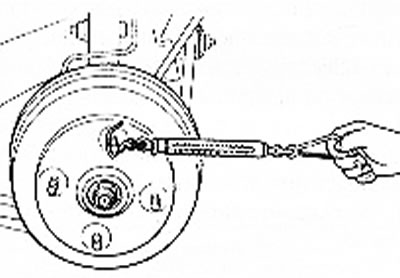
- c) Mount a dynamometer on the top stud of the wheel and measure the torque at which the hub begins to turn (this is the compaction resistance).
- d) Tighten the hub nut until resistance (the force at which the hub begins to turn) was approximately 3.9-9.8 N greater than the compaction resistance measured in the previous point.
- e) Use a hammer and punch or other suitable blunt instrument to drive the locking collar of the nut into the groove of the axle (photo).
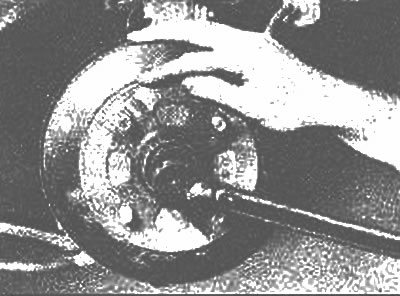
Tighten the hub nut with a torque wrench |
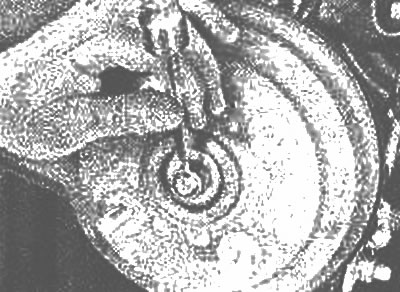
Use a hammer and a small punch to tap the locking ring of the nut into the groove of the axle |
18. Fill the cap with grease and install it by tapping its periphery with a hammer and punch.
19. Install the wheels and lower the car to the ground. Tighten the wheel nuts.
20. Press the brake pedal several times to adjust the position of the brake pads, then check the travel of the parking brake lever and adjust it if necessary (Section 9, Chapter 10).