


2. Disconnect the negative cable from the battery.
3. Loosen the distributor cap mounting screws. The screws are held in the lid by clamps. Remove the cover (photo).
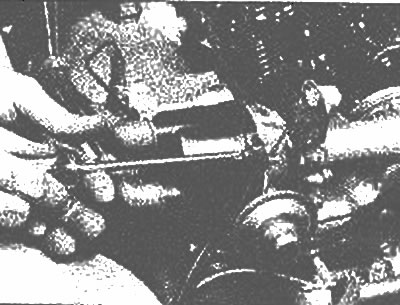
Loosen the distributor cap screws
4. Inspect the lid for cracks and other damage. Carefully inspect the contacts on the inside of the cover for excessive corrosion (photo). Minor scratches are perfectly acceptable. Deposits on the contacts can be removed with a fine file.
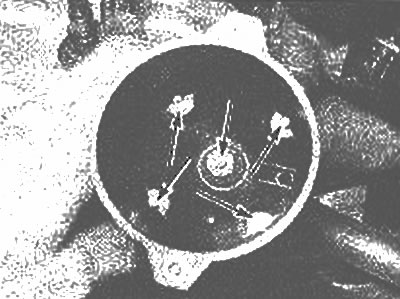
Inspect the distributor cap contacts (arrows) for corrosion and damage
5. If upon inspection it turns out that the cover is damaged, it must be replaced. Inspect the runner.
6. The runner, installed under the cover on the distributor shaft, is secured with two screws. Loosen the screws, remove the runner and inspect it for cracks or other damage.
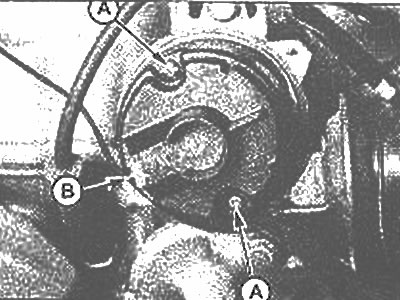
Screws (A) and contact (B) of the distributor rotor
7. Inspect the metal contact on top of the rotor for burnout and pitting (photo).
8. If the contact is in poor condition, the runner must be replaced.
9. Inspect the centrifugal timing advance assembly for damage and signs of corrosion. Check if the springs are broken. Pull the weights back to ensure they move easily and that the spring tension returns them (photo). Apply a thin layer of silicone grease to the assembly's contact surfaces.
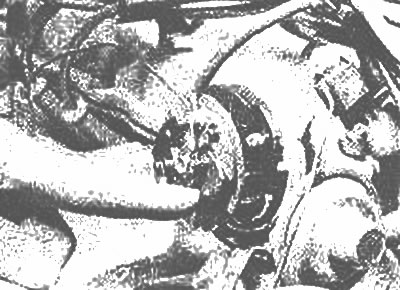
Pull back the centrifugal governor weights to ensure the springs are returning them to their original position
10. If the runner and cover are in good condition, install them.
11. If the cover needs to be replaced, do not install the new cover at this stage, set it aside without disconnecting the wires.
12. If the check described in step 1 showed that the spark plug wires are good, perform the following test.
13. Inspect the wires one by one to avoid mixing them up.
14. Disconnect the wire from the spark plug. Use a special tool or grab the rubber tip, twist it slightly from side to side and remove the wire. Do not touch the wire itself, only the rubber tip (photo).
Pull on the spark plug wire tip, not the wire itself
15. Inspect the inner surface of the tip for signs of corrosion (white solid powder). Some models use a white silicone grease, do not confuse this with traces of corrosion. Clean the tip of corrosion using a screwdriver or knife.
16. Reinstall the wire onto the end of the spark plug - the tip should fit snugly onto the spark plug. If this is not the case, remove the wire and use pliers to gently bend the metal connector inside the wire tip until the tip no longer dangles from the spark plug.
17. Using a clean cloth, clean the entire length of the wire from any dirt and grease that has accumulated. Inspect the wire insulation for burns, cracks, and other damage. Bend the wire in several places to ensure that the wire does not lose its flexibility.
18. Check the end of the wire at the distributor cap in the same way. Inspect the wires one by one to avoid mixing them up.
19. If you have a multimeter, measure the resistance of each wire. It should be 16 kOhm.
20. If the wires are in good condition, make sure they are securely attached. If the cover and runner are also in good condition, the test is complete. Connect the battery cable.
21. If the procedures in steps 14 - 19 indicate that the wires, cover, or distributor rotor need to be replaced, make the necessary replacements.
22. If new wires are installed, replace them one at a time to avoid causing a panic.
23. Install the cover on the distributor, then connect the battery cable.
The original article is on MAZBOOK.ru