


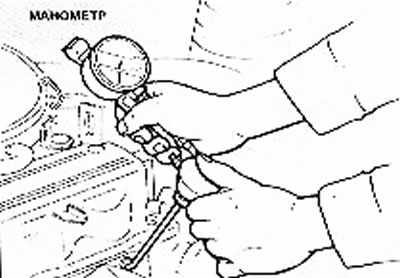
Checking engine compression
1. A compression test will tell you what condition the engine is in. Low compression indicates leaks caused by worn piston rings, faulty valves and valve seats, or a blown head gasket.
2. Warm up the engine to normal operating temperature, turn it off and wait 10 minutes to allow the catalytic converter temperature to drop. On models without a catalytic converter, there is no need to wait 10 minutes.
3. First, clean the area around the spark plugs to prevent dirt from getting into the cylinders when checking the compression. Remove the spark plugs.
4. Disconnect the primary winding wire from the distributor. Lock the throttle and choke valves so they are open.
5. Insert a pressure gauge into the spark plug hole of cylinder No. 1, crank the engine at least four times through the compression strokes and monitor the pressure gauge readings. Compression should increase quickly. Low compression on the first stroke that does not increase during subsequent strokes indicates worn valves, a blown head gasket, or cracks in the head. Record the highest reading on the pressure gauge and compare it with the data given in Specifications.
6. Repeat the procedure on the remaining cylinders. The lowest compression value should not be less than 70% of the highest. No reading should be less than 7.9 bar.
7. Pour in a couple of teaspoons of motor oil (best with a syringe) into each cylinder through the spark plug hole and repeat the test.
8. If after this the compression has increased significantly, the piston rings are worn out. If the compression has not increased, there is a leak in the valves or through the cylinder head gasket. Valve leaks can be caused by burnt valve seats or by warped or cracked valves.
9. If two adjacent cylinders have equally low compression, the cylinder head gasket between them is most likely blown. The presence of coolant in the combustion chambers or crankcase confirms this version.
10. If the compression is higher than normal, the combustion chamber walls are probably covered with carbon deposits. Remove the cylinder head and remove carbon deposits.
11. If the compression is below normal or there are large differences between cylinders, contact a specialist to perform a special leak test.