


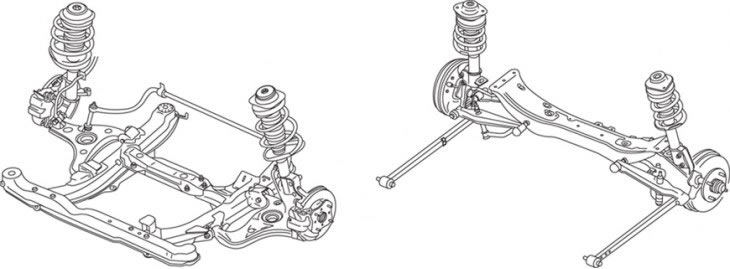
Figure 11.2. Front and rear suspension
Front and rear suspension are independent (figure 11.2). The design uses a combination of a spring and a shock absorber, which is mounted directly to the steering knuckle. The lower control arm of the front suspension is attached to the steering knuckle. The anti-roll bar is attached to the lower arms; it is a suitably bent rod made of spring steel. It works as follows: if, when turning a corner, the wheel located on the inside radius of the turn moves away from the car, the stabilizer twists. This resulting elastic force now supports the shock absorber strut, which is located on the outer radius of the turn, which, together with the springs, increases the rigidity of this strut. The result of the stabilizer's operation is a significant reduction in the vehicle's roll when cornering. If the car tilts at the same time, for example when braking, the stabilizer does not work.
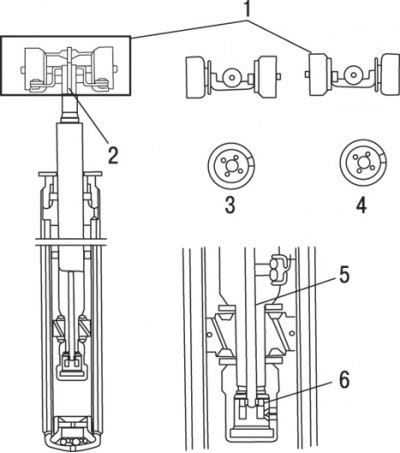
Figure 11.3. Three-stage damping system using a rack rail to vary the damping action: 1 – actuator; 2 – rod; 3 – normal mode; 4 – sports mode; 5 – rod; 6 – valve
Some models are also equipped with a three-stage damping system, which adjusts the damping of the shock absorbers manually or automatically (figure 11.3). This system is implemented by means of actuators mounted at the top of the struts, which rotate the rack by approximately 60° to change the damping action. These models use gas-charged shock absorbers, while models with a non-adjustable damping system use conventional sealed hydraulic shock absorbers.
(Data provided by the website www.MazBook.ru)
It is strictly prohibited to carry out welding and straightening work on the front suspension elements. Be sure to replace self-locking nuts, as well as bolts with signs of corrosion.