


Reliable ignition operation throughout the entire engine operating range is a significant factor in the efficiency of the catalytic converter.
Ignition of a small cloud of finely dispersed fuel-air mixture by a spark is sufficient to initiate the entire ignition process.
The main components of the ignition system include the battery, distributor, ignition coils and switch, spark plugs, low and high voltage wires.
This ignition system uses a contactless magnetic system, the elements of which are located inside the ignition distributor and include the distributor rotor, sensor winding, mechanical centrifugal ignition timing regulator, vacuum ignition timing regulator and switch. The latter is an electronic unit, so maintenance of the contact group, as in a mechanical breaker, is not required.
In an electronic ignition system, the ignition voltage is more than 30 kV. Under unfavorable circumstances (high humidity in the engine compartment) voltage peaks can break down the insulation and cause shock when touched. To avoid injury and damage to the ignition system, the following requirements must be met when working with it:
- do not touch or disconnect the ignition wire with your hand while the engine is running or the engine crankshaft is cranked with the starter;
- disconnecting the ignition system wires and connecting and disconnecting any measuring instruments is only possible with the ignition off;
- it is not possible to install an ignition coil designed for a system with a breaker;
- when heated above 80°C (when painting a car) do not start the engine immediately after warming up;
- wash the engine only when the engine is not running;
- when carrying out electric welding work, it is necessary to disconnect the battery;
- persons with a pacemaker are prohibited from working on the ignition system.
Checking the ignition system
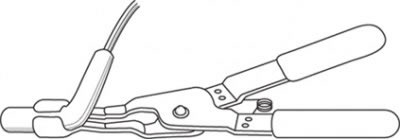
Figure 7.1. Using special pliers to hold the high-voltage wire when checking for sparking
If the starter turns the crankshaft, but the engine does not start, disconnect the wire from the spark plug, bring it to a bare section of the car's ground at a distance of about 6 mm and ask an assistant to turn the starter. When checking for spark, hold the high-voltage wire with special pliers (figure 7.1).
If no spark is observed, check for spark in the next cylinder in exactly the same way. The appearance of a spark and its subsequent disappearance is a criterion for the absence of spark formation.
If a stable spark is observed, check the spark plugs and/or fuel supply.
If the spark is weak or absent, disconnect the ignition coil wire from the distributor, bring it approximately 6 mm to the exposed ground area of the vehicle and check for spark formation in the same way as described.
If there is no spark, check the ignition coil.
If there is a spark, check the condition of the distributor cap and/or distributor rotor.
Further testing of the ignition system must be carried out at a service center or workshop.
[Based on website data: mazbook.ru]