


2. Remove the cap from connecting rod #1. Remove the old bearing shells and wipe the bearing surfaces on the connecting rod and cap with a clean, thick (lint-free) cloth. They should remain spotlessly clean.
3. Clean the back of the new upper bearing shell, then install it into the connecting rod. Make sure that the protrusion on the bearing fits into the recess on the connecting rod. Do not use a hammer when installing the liner. Place the insert back in place carefully to avoid damaging its surface. Do not lubricate the bearing shell at this stage.
4. Clean the back of the other bearing and install it into the connecting rod cap. Again, make sure the tab on the insert fits into the recess in the cover and do not lubricate the insert. It is critical that the bearing and connecting rod mating surfaces are completely clean and free of grease.
5. Install the piston rings so that their gaps are located as shown in the illustrations, then place a piece of plastic or rubber hose on each connecting rod cap bolt.
6. Lubricate the piston and rings with clean engine oil and install a piston ring puller on the piston so that the piston skirt protrudes approximately 6 mm from the puller to allow the piston to be inserted into the cylinder (photo). Compress the rings as much as possible.
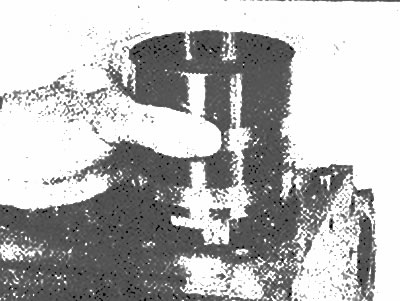
When installing pistons, make sure the piston skirt protrudes slightly from the piston ring puller so that the piston can be inserted into the cylinder |
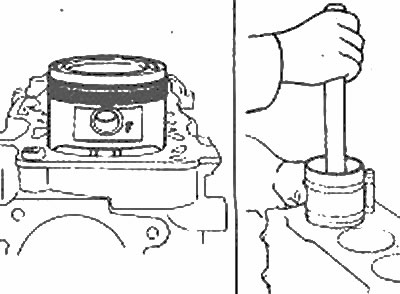
Install the pistons so that the "F" mark faces the front end of the engine |
7. Turn the crankshaft so that the journal of connecting rod No. 1 moves away from the cylinder to the maximum distance (bottom dead center), and lubricate the cylinder walls with engine oil.
8. Gently place the piston/connecting rod assembly into the No. 1 cylinder bore with the notch or arrow on the piston facing the front of the engine. The lower edge of the piston ring puller should rest against the cylinder block. Tap the top edge of the piston ring puller to ensure it is fully seated on the block. (If there are no notches or arrows on the piston crown, make sure the "F" mark next to the piston pin alignment hole is facing the front of the engine before installing the piston ring puller.)
9. Gently tap the top of the piston with the end of a wooden hammer handle (photo), and install the end of the connecting rod onto the crankshaft journal. Piston rings may pop out of the piston ring puller before entering the cylinder bore. To avoid this, press the piston ring puller against the cylinder block. Work slowly and if you feel resistance from the piston, stop immediately. Find out what is preventing the installation and eliminate the cause. Never force the piston into the cylinder, otherwise you will break the ring and/or piston.
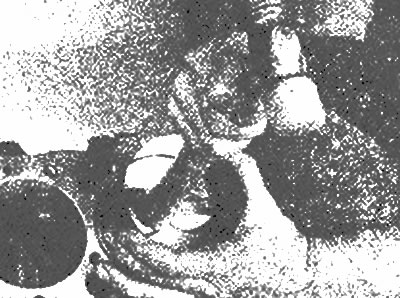
Gently push the piston into the cylinder bore by pressing on it with the end of the wooden handle of the hammer
(The full text is on the website: «mazbook.ru»)
10. Once the piston/connecting rod assembly is installed, check the connecting rod bearing running clearance before finally installing the connecting rod cap.
11. Cut a piece of Plascigage material (tool for measuring clearances in plain bearings) of a suitable size, so that it is slightly shorter than the width of the connecting rod bearing, and place it on the journal of connecting rod No. 1, parallel to the axis of the journal (photo). It should not intersect the oil hole in the journal.
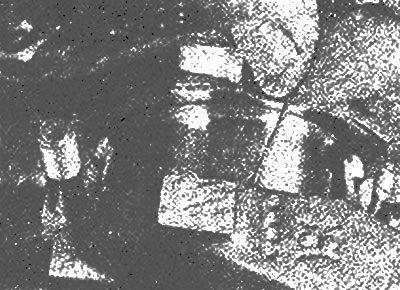
Place a piece of Plastigago material across the crank pin
12. Clean the bearing seat in the connecting rod cap, remove the protective pieces of tubing from the connecting rod bolts and install the cap. Make sure the mark on the cap is on the same side as the mark on the connecting rod. Install the nuts and tighten them in three stages to the torque specified in the Specifications. Do not turn the crankshaft during this action.
13. Remove the rod cover very carefully, being careful not to dislodge the Plastigage. Compare the Plastigage width with the scale on the tool packaging to calculate the working clearance (photo). Compare this measurement with the data in the Specifications. If the gap is not correct, recheck that the correct size bearings are installed. Also, recheck the crankshaft journal diameter and ensure that no dirt or oil has entered the bearing shells when measuring the clearance between the connecting rod or cap.
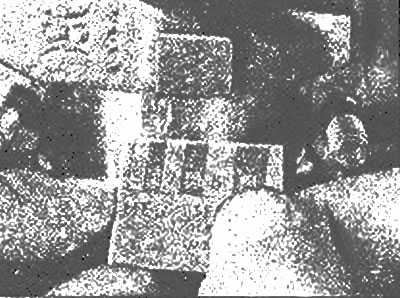
Compare the width of the Plastigago material to the scale to determine the working clearance
14. Carefully clean all traces of Plastigage from the crankpin and/or bearing surface. Be very careful not to scratch the insert, use your fingernail or a wooden block. Make sure the bearing surfaces are perfectly clean, then apply an even coat of clean, high-quality molybdenum grease or special engine assembly oil to both surfaces. Push the piston into the cylinder to gain access to the bearing shell surface in the connecting rod. Don't forget to first place the protective pieces of hose on the rod bolts (photo).
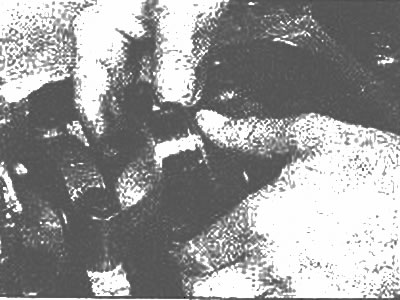
Use rubber boots to prevent the connecting rod cap bolts from scratching the cylinder walls and crankshaft journal, and install the connecting rod onto the journal
15. Reinstall the connecting rod onto the journal, remove the protection from the connecting rod cap bolts, install the cap and tighten the nuts in three stages to the tightening torque specified in the Specifications.
16. Repeat the procedure on the remaining piston/connecting rod assemblies. Ensure cleanliness. Make sure you don't mix up the pistons (installed each of them in the corresponding cylinder) and that the notch-arrow or "F" mark on the piston points toward the front of the engine (photo). Be sure to generously lubricate the piston before installing the piston ring puller. Also, when finally installing the connecting rod caps, do not forget to lubricate the bearing surfaces.
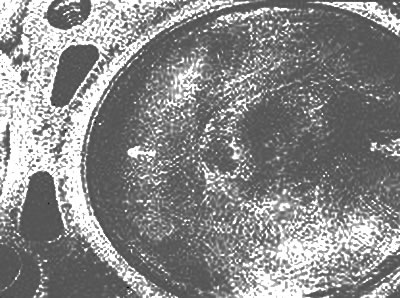
The arrow on the piston head should point towards the front of the engine |
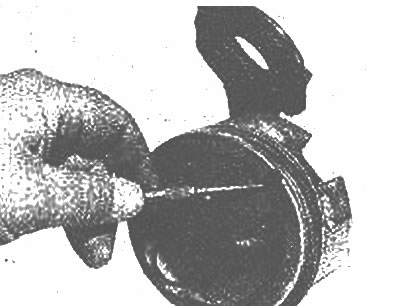
Some pistons have a notch instead of an arrow |
17. After installing all pistons/connecting rods, turn the crankshaft by hand several times to ensure that it rotates freely.
18. Finally, check the play of the connecting rod head (see Chapter 11). Compare the obtained value with the data given in Specifications.