


- a) Check the reliability of the fastening of the wire clamps to the battery terminals.
- b) Check the battery condition (see paragraph 3). If the battery is faulty, replace it.
- c) Check the battery wires and replace any faulty ones.
- d) Check the condition of the wires and their connections going to the starter.
- d) Check that the starter mounting bolts are tightened well.
- e) Check the fuses in the box under the hood. If blown fuses are found. find out and eliminate the cause. Check the ignition switch for proper operation (see chapter 12).
- g) Make sure the mode selector is in the PARK or NEUTRAL position (automatic transmission) or that you didn't forget to press the clutch pedal (manual transmission). Check the correct operation of the transmission mode switch (automatic transmission) or the serviceability of the clutch starting circuit (manual transmission). Detailed testing and adjustment of the automatic transmission mode switch is described in Chapter 7. To check the clutch release lever, refer to the electrical circuit diagrams at the end of Chapter 12.
- c) Check the operation of the starting circuit interrupt relay. The relay is located in the fuse box and the relay is under the hood. Testing the interrupt relay is described in Chapter 12.
2. If the starter does not show any signs of life when you turn the key to the START position, check if battery voltage is being supplied to the starter relay. To do this, ask an assistant to turn the ignition key to the start position, and measure the voltage at terminal S. The voltage supplied to the terminal should be approximately equal to the battery voltage. If there is no voltage. check all circuits, fuses and relays associated with the starting system (to troubleshoot, refer to the electrical diagrams at the end of Chapter 12). If there is voltage but the starter does not work, remove it from the engine and check it on a workbench (see point 4).
3. If the starter turns, but too slowly, measure the voltage at the motor terminals while it is running and the current from the battery to the motor. This check must be performed on the engine. Crank the starter for no more than 10 seconds. The voltage should not drop below 9 V during this time. If the voltage drops further, replace the starter. But before changing the starter, make sure that the battery is in good condition and charged, that its technical data corresponds to your car, that the contacts of its wires are securely tightened and not oxidized. If the temperature is very low, the engine block may need to be warmed up to start.
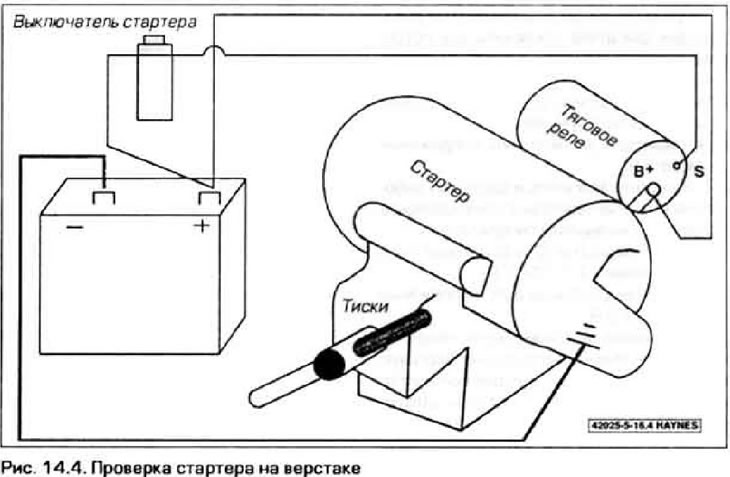
4. If the starter has power but does not work, remove the starter and test it on a work bench. Most likely. the traction relay is faulty. In some rare cases, the engine may have seized up - check this option by rotating the crankshaft by the bolt of its pulley. Secure the starter in a vice and connect the battery to it as shown in the figure 14.4. Engage the starter for no more than 10 seconds. The traction relay armature should extend the lever with the pinion and overrunning clutch, and the pinion should begin to rotate. If the gear extends but does not rotate, the motor is faulty. If the relay clicks, but the lever with the gear does not extend, then either the relay or the motor is faulty. If the pinion extends and rotates, the starter is working properly.
Article is available on the website (MAZbook.ru)