MazBook.ru
English Русский
Български
Беларускі
Український
Српски
Hrvatski
Română
Polski
Slovenský
Magyar
• Bookmark • Sitemap • Contacts •   
Cars Opel Cars Ford Cars Volkswagen Cars Audi Cars Kia Cars Renault Cars Peugeot


Familia Capella Mazda3 Mazda6 CX-? Others Articles
Capella 3 (1982-1992, petrol) Capella 3 and 4 (1982-1992) Capella 4 (1987-1992) Capella 5 (1991-1997) Capella 6 (1997-2005, petrol)

Piston rings — installation (Mazda Capella GF)

  • Home
  • Mazda Capella
  • Capella GF (1997-2005)
  • Power unit
  • Engine overhaul
  • Piston rings — installation
0
1. Before installing new rings, it is necessary to check the gaps in their locks. It is assumed that the gaps of the rings in the grooves have been pre-checked (see paragraph 18).

2. Place the track sets next to the pistons and ensure that the pistons and rings associated with each cylinder are kept in the set until the end of assembly.

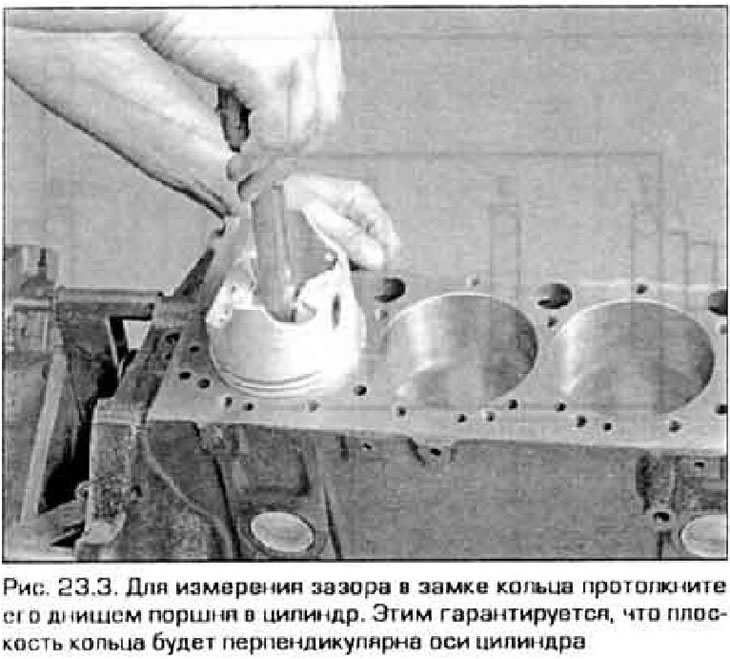
3. Insert the top ring into cylinder No. 1 and push it into the cylinder with the piston bottom until the ring is at BDC (figure 23.3).
3. Insert the top ring into cylinder No. 1 and push it into the cylinder with the piston bottom…


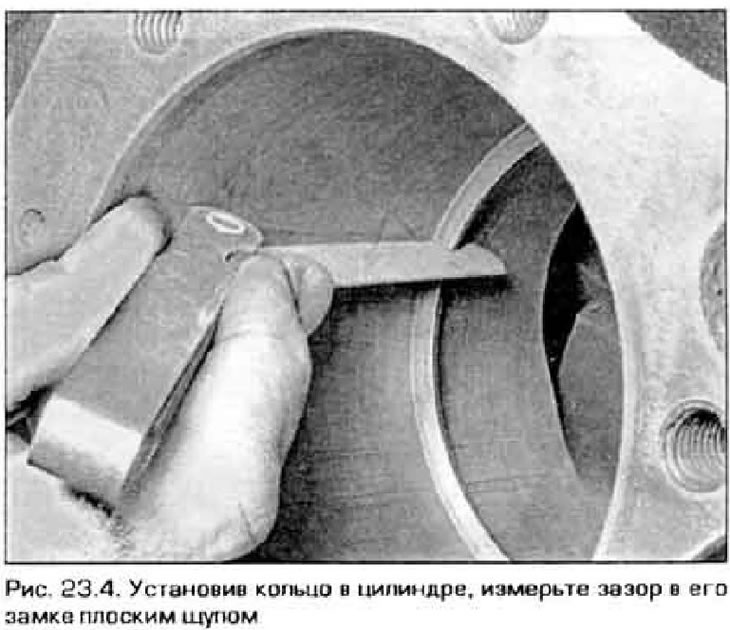
4. Measure the gap in the ring lock. by selecting a feeler gauge of the required thickness, which enters the gap with some friction (see Figure 23.4). Compare the obtained result with Technical data at the beginning of the chapter. If the gap is smaller or larger than the permissible value, measure it again to be sure.
4. Measure the gap in the ring lock. by selecting a feeler gauge of the required thickness, which…


5. If the gap is too small, it can be filed down. However, the ability to correct the gap in this way depends on the material the ring is made of and what it is coated with. Please read the instructions included with your ring set carefully.


6. A large gap is not as dangerous as a small one, unless, of course, it exceeds the maximum permissible value. To be sure, double-check the gap to ensure that you have purchased the correct size rings. If you still think it is necessary to correct the gap with a file, then clamp the file in a vice (and not a ring) in a vertical position, lubricate the top of the vice jaws, place the ring lock on the file and slide the rings back and forth across the file, pressing the ring against the vice. After filing the ring a little, check the gap again and, if necessary, file it further. Once the gap is within tolerance, use a file to remove any burrs that formed during filing.

7. Repeat this procedure for all rings of the first cylinder, and then for the remaining cylinders. During and after checking, do not mix up the rings - they must be subsequently inserted into the cylinder in which they were checked.

8. After checking and adjusting the clearances, the rings can be inserted into the piston grooves.

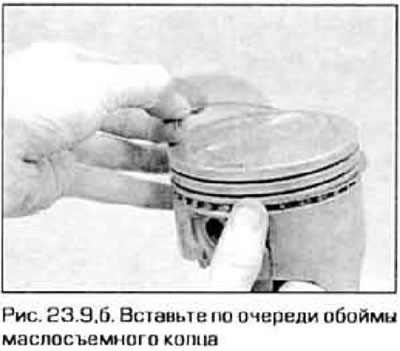
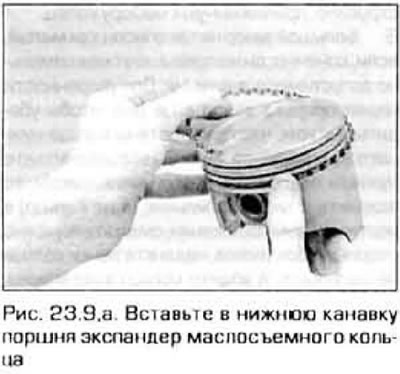
9. The lower one is installed first (oil scraper) ring. It consists of three parts. Insert the expander into the lower groove of the piston (figure 23.9,a). If the expander has a locking tab, it should fit into the hole in the piston groove. Then insert the lower ring collar. Do not use a ring installer for this purpose - the race can easily be damaged in the process. Instead, insert one end of the ring into the gap between the expander and the groove wall and press it against the piston. Run your finger along the ring around the piston, fitting the ring into the groove (fig. 23.9,b). Insert the top ring collar in the same way.


9. The lower one is installed first (oil scraper) ring. It consists of three parts. Insert the…

10. After installing all three ring parts, make sure that the races rotate freely in the groove.

11. Next, install the second (middle) ring. It usually has a marking that should face up.

Note: Follow the instructions printed on the ring set packaging - rings from different manufacturers may require different approaches. Do not confuse the middle and top rings - they have different cross-sections.


12. To install the second ring, it is better to use a device. Make sure the ring is facing up and insert it into the middle groove (figure 23.12). Do not spread the ring more than necessary to allow it to pass through the piston.
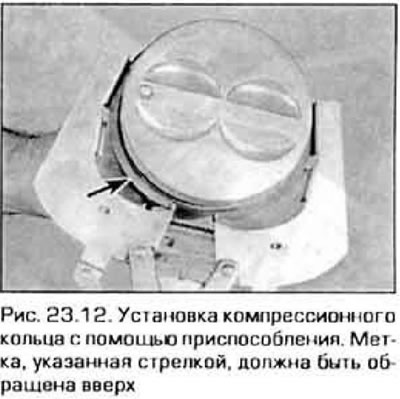
12. To install the second ring, it is better to use a device. Make sure the ring is facing up and…


13. Install the top ring in the same way. Remember that the markings must face up. Don't mix up the rings.

14. Install the rings on the remaining pistons in the same manner.
This article is available at: russian, bulgarian, belarusian, ukrainian, serbian, croatian, romanian, polish, slovak, hungarian
This text was checked by: German Vorobyov
Share with friends on social networks:

Previous
Capella 6 » Engine overhaul
Next

Engine repair — assembly procedure
Camshafts and tappets — inspection
Main and connecting rod bearings — inspection and selection of liners
Crankshaft — inspection
Pistons and connecting rods — inspection
Installing the crankshaft and checking the clearances in the main…
Installing the rear cuff
Installing the connecting rod and piston group and checking the…
First start and engine running-in after repair
More articles on repairing other Mazda models
Piston rings and piston pin — description Mazda3 BK (2003-2009)
Piston rings and piston pin Mazda6 GG (2002-2008)
Checking the piston rings of the cylinder block Mazda CX-5KE (2012-2017)
Disassembling the piston-connecting rod unit of the cylinder block Mazda BT-50 (1) (2006-2011)
Link in different formats to this article
Comments and feedback from visitors
No comments yet


How much will 42 + 29 ?


Capella 6 (1997-2005, petrol) 
  • General information
  • Introduction to guide
  • User manual
  • Troubleshooting
  • Maintenance
  • Power unit
  • 4-cylinder engines
  • 6-cylinder engines
  • Engine overhaul
  • Cooling and ventilation
  • Power and exhaust systems
  • Engine electrics
  • Control system
  • Transmission
  • Mechanical gearbox
  • Automatic gearbox
  • Clutch and drive shafts
  • Chassis
  • Brake system
  • Car suspension
  • Steering
  • Body
  • Exterior (external elements)
  • Interior (internal elements)
  • Doors, windows and locks
  • Electrical equipment
  • Equipment and devices
  • Electrical circuits
Capella 5 (1991-1997) 
  • General information
  • User manual
  • Maintenance
  • Helpful hints
  • Power unit
  • Petrol engines 1.6 and 1.8
  • Petrol engines 2.0
  • 2.5 petrol engines
  • Overhaul engines 1.6 and 1.8
  • Overhaul engines 2.0 and 2.5
  • Diesel engine 2.0
  • Engine electrics
  • Cooling system
  • Air conditioner
  • Carburetor Nikki 30/34
  • Power system (1.6 and 1.8)
  • Power system (2.0 and 2.5)
  • Control system
  • Transmission
  • Mechanical gearbox
  • Automatic gearbox
  • Clutch and axles
  • Chassis
  • Brake system
  • Suspension and wheels
  • Steering
  • Body
  • Exterior (external elements)
  • Interior (internal elements)
  • Doors and windows
  • Electrical equipment
  • Equipment and devices
  • Electrical circuits
Capella 4 (1987-1992) 
  • General information
  • Introduction to manual
  • Vehicle specifications
  • Power unit
  • Engine repair
  • Lubrication system
  • Cooling system
  • Fuel system (carburetor)
  • Fuel injection (FE)
  • Fuel injection (DOHC)
  • Fuel system (diesel)
  • Ignition system
  • Transmission
  • Clutch
  • Gearbox
  • Drive shafts
  • Chassis
  • Front suspension
  • Rear suspension
  • Steering system
  • Brake system
  • Electrical equipment
  • Equipment and devices
  • Electrical circuits
Capella 3 and 4 (1982-1992) 
  • General information
  • User manual
  • Maintenance
  • Power unit
  • Gasoline engine
  • Engine overhaul (gasoline)
  • Diesel engine
  • Cooling and heating
  • Supply system
  • Ignition system
  • Emission reduction
  • Transmission
  • Clutch
  • Mechanical gearbox
  • Automatic gearbox
  • Drive shafts
  • Chassis
  • Brake system
  • Suspension and wheels
  • Steering
  • Body
  • Exterior (external elements)
  • Interior (internal elements)
  • Electrical equipment
  • Equipment and devices
  • Power devices
  • Electrical circuits
Capella 3 (1982-1992, petrol) 
  • General information
  • User manual
  • Maintenance
  • Troubleshooting
  • Late models
  • Power unit
  • Engine in car
  • Engine overhaul
  • Cooling and heating system
  • Fuel and exhaust system
  • Engine electrical system
  • Emission control system
  • Transmission
  • Mechanical gearbox
  • Automatic gearbox
  • Clutch and drive shafts
  • Chassis
  • Brake system
  • Suspension and wheels
  • Steering
  • Body
  • Exterior (external elements)
  • Interior (internal elements)
  • Electrical equipment
  • Equipment and devices
  • Lighting and lamps
  • Electrical circuits
MazBook.ru © 2018–2026 · Mobile version · Articles and news · Sitemap: EN BG BY UA RS HR RO PL SK HU · Feedback · Site search · Add to bookmarks Familia 5 (BF) · Familia 6 (BG) · Capella 3 (GC) · Capella 3 and 4 (GC) · Capella 4 (GD) · Capella 5 (GE) · Capella 6 (GF) · Mazda3 BK · Mazda6 GG · CX-5KE · Mazda 121 (3) · Mazda BT-50 (1) ·
By continuing to use the site, you agree to the use of cookies 🔐