


Note: Before removing the connecting rod and piston assemblies, remove the cylinder head, oil pan, oil pick-up pipe and oil separator as described in Chapter 2A or 2B.
1. On a 4-cylinder engine (only), remove the booster block by unscrewing its mounting bolts in the opposite order to that shown above (see Fig. 13.23 Chapter 2A).
2. Run your finger inside the top end of the cylinder mirror to feel it. there was no ledge formed on it due to wear by piston rings (approximately 6 mm from the end of the cylinder). If a ledge is formed, the protruding edge of the cylinder must be removed with a special tool (figure 13.2). Follow the tool manufacturer's instructions. If the protrusion is not removed, the piston may be damaged during removal.
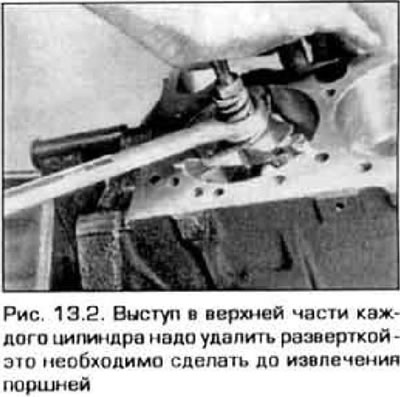
3. After removing the protrusions in the cylinders, turn the engine over with the crankshaft facing up.
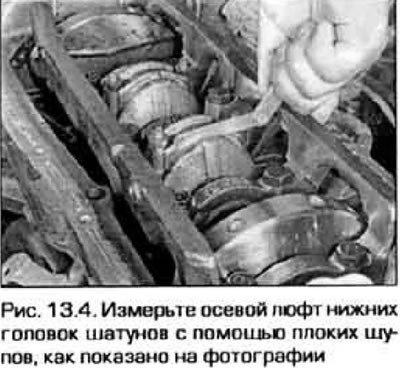
4. Before disassembling the lower connecting rod head, check its axial play. Move the head until it stops against the crankshaft cheek and measure the gap between the head and the second cheek with a set of feeler gauges (figure 13.4). If the axial play exceeds the value specified in Technical data, the connecting rod needs to be replaced. When installing a new connecting rod or replacing the crankshaft, the connecting rod axial clearance may be below its minimum limit. In this case, the connecting rod can be further processed (please consult a service station about this issue). Check the remaining connecting rods in the same way.
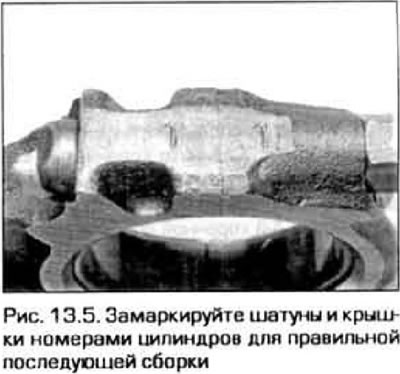
5. Check that there are pi marks on the connecting rods and caps. If such marks cannot be found, number them according to the cylinder numbers yourself using a center punch or digital stamps (figure 13.5).
6. Gradually loosen the connecting rod cap nuts 1/2 turn at a time until they can be removed by hand. Remove the first connecting rod cap together with the bearing - do not let the bearing fall out of the cap.
7. Remove the bearing shell and push the connecting rod with the piston out of the block through the top of the engine. To do this, press the wooden handle of the hammer onto the bearing surface of the connecting rod. If resistance is felt when pushing out, check again whether the protruding flange at the top of the cylinder has been completely removed.
8. Remove the remaining pistons in the same manner.
Note: If necessary, rotate the crankshaft so that the connecting rod of the piston being removed is located approximately along the cylinder axis; do not attempt to remove the piston if the connecting rod is located at a large angle to the cylinder generatrix.
9. After removing the pistons, reassemble the lower heads of the connecting rods with the liners so that all the connecting rod bearing parts are in their original places. Tighten the head covers with nuts by hand. Keeping the liners in place until the engine is assembled will prevent accidental damage to the bearing surfaces of the connecting rod heads.
10. Do not disconnect the pistons from the connecting rods (for more details see. paragraph 18).