


Note. At the service station, remanufactured cylinder heads may be on sale. Consider that a special tool is needed to repair the head, the store may not have the necessary spare parts, it may be more economical to purchase a finished head.
1. Removal of camshafts and tappets is described in chapters 2A and 2B. For complete disassembly of the head, it remains only to remove the valves and related parts.
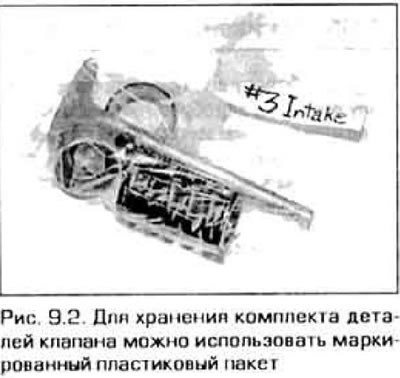
2. Before removing valves, consider labeling and storing them with related parts as follows. so that during installation they all take their original places (pic. 9.2).
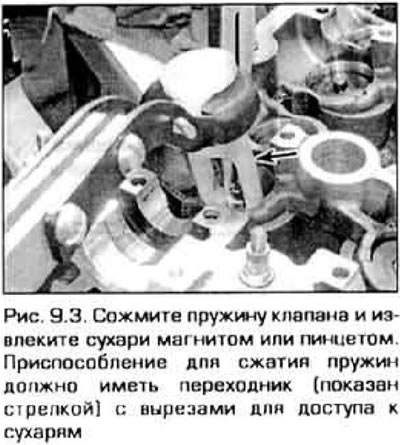
3. Compress the spring of the first valve with a puller and remove the crackers (pic. 9.3). Carefully release the spring and remove the spring from the top and bottom (if provided) plates. Be careful: When using the puller, do not damage the tappet bores.
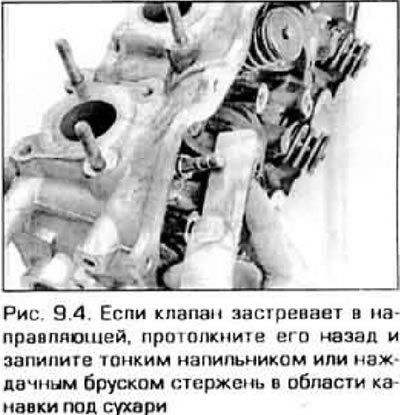
4. Pull the valve out of the head, then remove the valve stem seal from the valve guide. If the valve is stuck in the guide, push it back and file with a thin file or emery bar the rod in the cracker groove area (pic. 9.4).
5. Repeat these steps for the rest of the valves. Don't forget to put all the valves with their related parts in separate bags.
6. After removing the riveted, you can rinse and inspect the head. However, if you intend to completely repair the engine, postpone this operation until the unit is completely disassembled.