


Note: If the engine has been subjected to severe overheating, the cylinder head may be warped (see chapter 12).
Cleaning
2. Scrape off any remaining old gasket and sealant from the surfaces mating with the block and manifolds. Be careful not to scratch the surfaces. There is a special solvent available for removing gasket residues, which softens the material and makes the operation much easier
3. Remove deposits from all cooling system passages.
4. Clean all holes with a wire brush to remove deposits and rust.
5. Tap all threaded holes with a cooieeiciByiOLuero size tap to clear the threads of dirt and rust. If possible, blow out the holes with compressed air.
Caution! Protect your eyes when working with compressed air.
6. Clean the connector pins with a metal sandpaper.
7. Rinse the head with solvent and dry it thoroughly. Compressed air will speed up the drying process and increase the likelihood that the head passages will be free of any debris.
Note: There are commercially available chemicals to remove carbon deposits from the combustion chamber and valves. These are very caustic substances and should be used with caution. Follow the manufacturer's recommendations strictly.
8. Wash the tappets with solvent and dry them. Compressed air will speed up the drying process and remove any remaining oil from the holes. When flushing, do not mix up the tappets - store them together with the corresponding valves. Hydraulic tappets should be stored upside down in a container of oil.
9. Wash and dry the valve springs, plates and crackers. Work with each set of parts in turn to avoid mixing them up later.
10. Scrape off any carbon deposits from the valve heads, then clean the heads and stems with a wire brush attached to a drill.
Article is available on the website (Mazbook.ru)
Inspection
Note Before deciding whether machining of the head is necessary, perform all the check operations listed below. The procedure for checking the hydraulic tappets is described in paragraph 27.
Cylinder head
11. Inspect the head very carefully for cracks, obvious signs of coolant leaks and other damage. If there is a third one, consult with the service station about the possibility of repair and, if repair is not possible, replace the head with a new one.
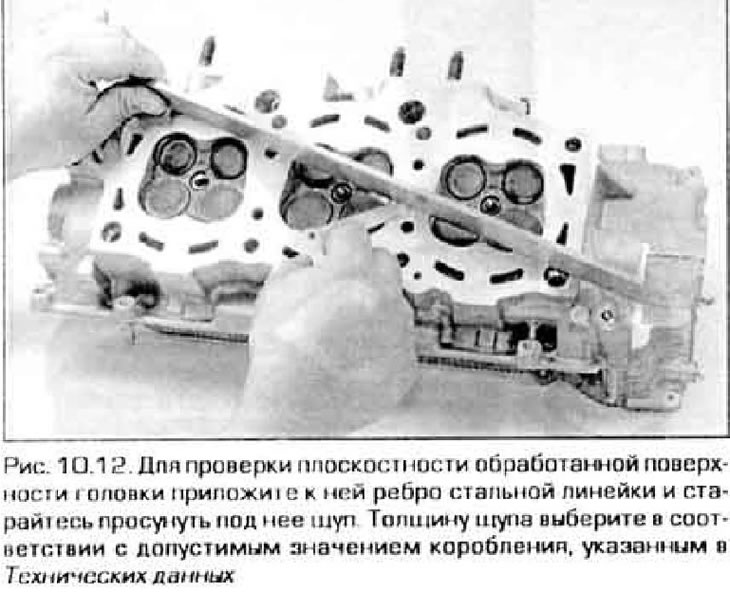
12. Using a steel ruler placed on its edges and a set of flat feeler gauges, check the mating surfaces of the head for warpage (figure 10.12). If the warpage exceeds the permissible level, the head can be corrected by machining in a workshop.
13. Inspect the valve seats in all combustion chambers. If they have pitting, burns or cracks. give the head to specialists for repair - it is not recommended to do this work yourself.
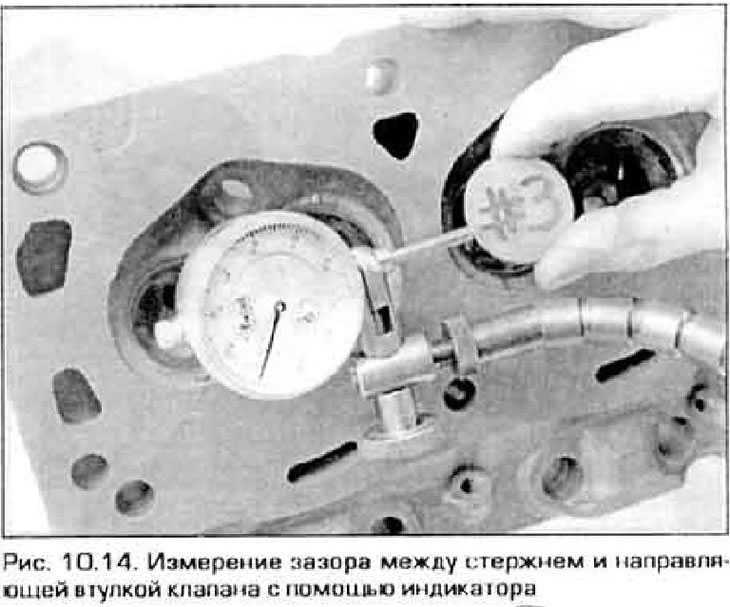
14. Check the clearance between the valve stems and valve guides. For this purpose, you can use a bore gauge and a micrometer or a dial indicator (figure 10.14). When checking with a dial indicator, the valve should be in the guide bushing, and its valve seat should be approximately 15 mm away from the valve stem. Move the entire stem between the walls of the guide bushing (wiggling the rod will give the wrong result) and read the indicator reading. If the gap exceeds the permissible value specified in Technical data the guide bushing should be replaced.
Valves
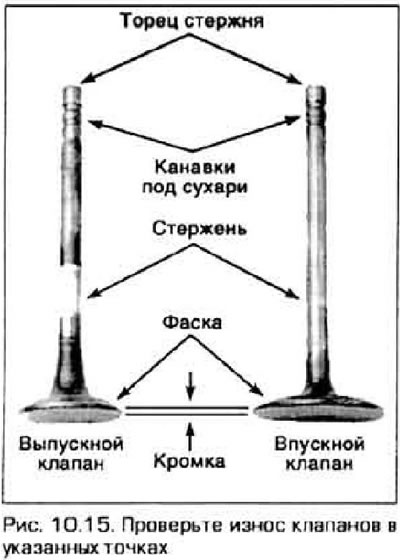
15. Carefully inspect the valve plates for excessive wear and deformation. shells, cracks and burns (figure 10.15). Inspect the valve stem for scoring and wear, and the stem neck for cracks. Rotate the clans to detect signs of curvature. Check for excessive wear on the end of the rod. If any of these signs are detected, the valve must be mechanically treated or replaced.
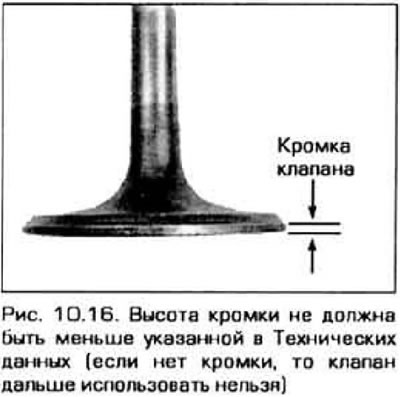
16. Measure the valve disc edge height (figure 10.16). If the edge height has become less than the permissible value (see Technical Data), the valve needs to be replaced.
Valve Mechanism Parts
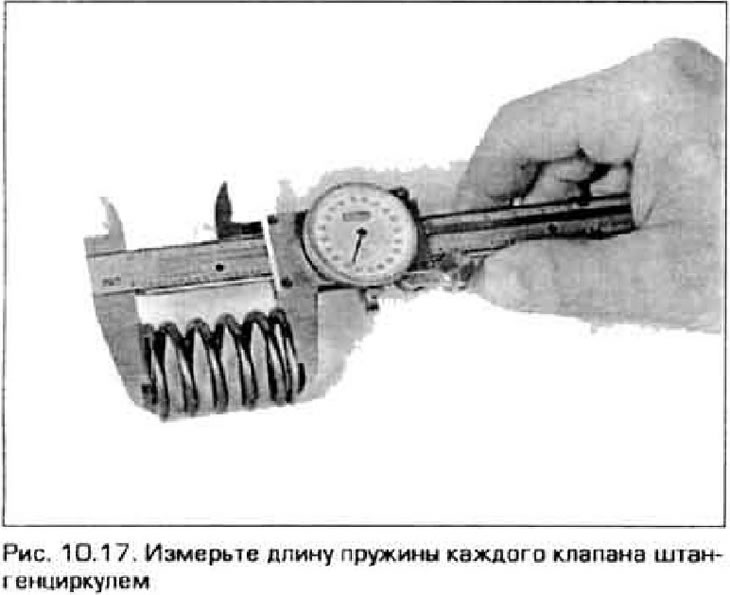
17. Inspect the ends of the springs for pitting and wear. Measure the height of the springs in a free state (figure 10.17) and compare the results with Technical data. All springs shorter than the specified length must be replaced. It is also advisable to remove the characteristics of the springs, i.e. the dependence of the displacement on the load. Usually, a home workshop does not have the equipment to perform such a check, so they should be taken to a service station.
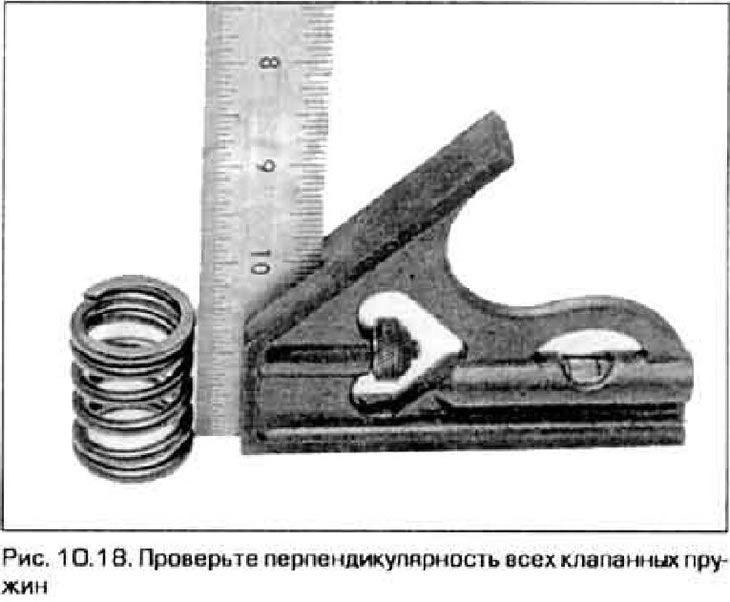
18. Place the spring on a flat surface and check that it is perpendicular (figure 10.18). If any of the springs are bent or out of square, replace the entire set of springs.
19. Inspect the spring plates and crackers for obvious wear and cracks. All suspicious parts should be replaced with new ones, since their failure during engine operation can cause very serious malfunctions.
20. All worn or damaged valve group parts must be replaced.
21. If all valve components are in poor condition, which is common for an engine requiring a major overhaul, replace the entire valve group and install new valves as recommended paragraph 11.