


Note: The engine must be warmed up to normal operating temperature before checking. and the battery must be fully charged.
2. Clean the spark plug sockets before removing them, using compressed air and a brush if necessary. In a pinch, you can use a bicycle pump. The purpose of this operation is to prevent dirt from entering the cylinders.
3. Remove the spark plugs from all cylinders (see chapter 1).
4. Fix the throttle valve in the fully open position.
5. Disconnect the high-voltage center wire from the distributor cap and ground it to the cylinder block with a "jumper clip" (on models without a distributor, disconnect the electrical connector from the ignition coil pack). De-energize the fuel system pump by removing the corresponding fuse.
6. Insert the compression tester into the spark plug hole (figure 3.6).
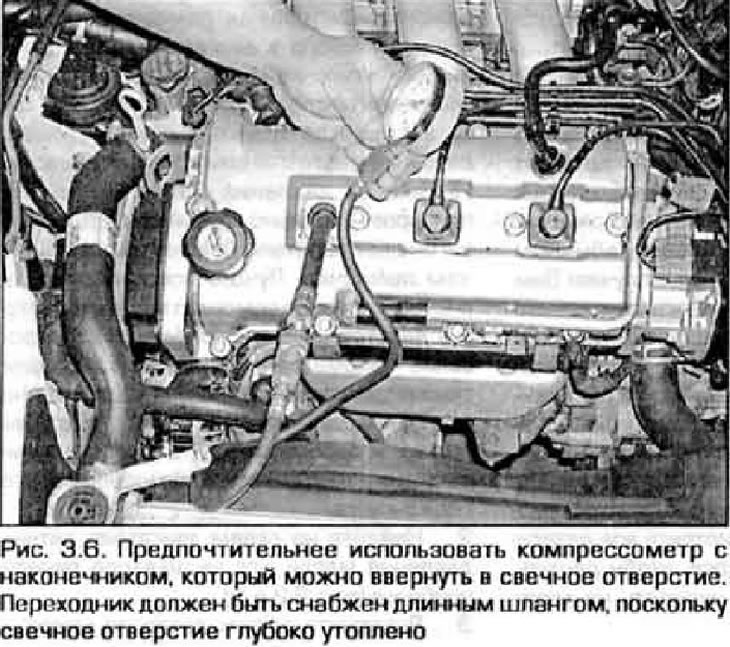
7. Turn on the starter and crank the engine for at least seven compression strokes, observing the readings on the compression gauge. If the engine is in good working order, the reading should increase quickly. A slow increase in pressure indicates wear on the piston rings. Low pressure in the first stroke, which does not increase in subsequent strokes, indicates leaky valves. or a breakdown of the cylinder head gasket. The cause could also be carbon deposits on the valves or a crack in the cylinder head. Record the highest pressure reading in the cylinder.
8. Repeat the check for the remaining cylinders. Compare the obtained results with the values given in "Technical data" this chapter.
9. Pour some engine oil through the spark plug hole (about a foot spoon) into each cylinder and repeat the test.
10. If the compression increases after adding oil, it means that the piston rings are definitely worn out. If the pressure has not changed significantly, then the valves or gasket are leaking. Valve leaks can be caused by burnout, cracking or warping of the valves and their seats.
11. If two adjacent cylinders have equally low compression, this almost certainly means that the gasket between them has failed. This can be confirmed by the appearance of coolant in the combustion chamber or in the engine crankcase.
12. If the pressure in one of the cylinders is slightly lower than in the others, and the engine does not idle quite smoothly, a possible cause could be a hot exhaust cam.
13. If the pressure is unusually high, it is possible that the combustion chamber is covered with a thick layer of carbon. In this case, you need to remove the cylinder head and clean it.
14. If the pressure drops or varies greatly from cylinder to cylinder, contact a service station to have the engine checked using diagnostic equipment. This inspection will allow you to accurately determine the location of the leak and the severity of the problem.