MazBook.ru
English Русский
Български
Беларускі
Український
Српски
Hrvatski
Română
Polski
Slovenský
Magyar
• Bookmark • Sitemap • Contacts •   
Cars Opel Cars Ford Cars Volkswagen Cars Audi Cars Kia Cars Renault Cars Peugeot


Familia Capella Mazda3 Mazda6 CX-? Others Articles
Capella 3 (1982-1992, petrol) Capella 3 and 4 (1982-1992) Capella 4 (1987-1992) Capella 5 (1991-1997) Capella 6 (1997-2005, petrol)

Pistons and connecting rods — inspection (Mazda Capella GF)

  • Home
  • Mazda Capella
  • Capella GF (1997-2005)
  • Power unit
  • Engine overhaul
  • Pistons and connecting rods — inspection
0
1. Before inspection, clean and wash the pistons and connecting rods and remove the old rings from the pistons.

Note: Always replace piston rings whenever the engine is overhauled.


2. To remove piston tracks, you can use a tool specially designed for this purpose. When removing the rings, be careful not to scratch the piston.

3. Scrape off any carbon deposits from the piston crown. To complete this operation, you can use a hand-held wire brush or fine sandpaper. Do not, under any circumstances, use a brush inserted into a drill on this chain. The piston is made of a soft material and such a brush can significantly damage it.

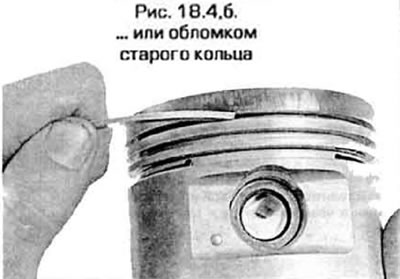
4. Clean the grooves under the ring with a special tool (figure 18.4,a) or a fragment of an old ring (figure 18.4,b). Be careful to remove only carbon deposits from the grooves, not piston metal.
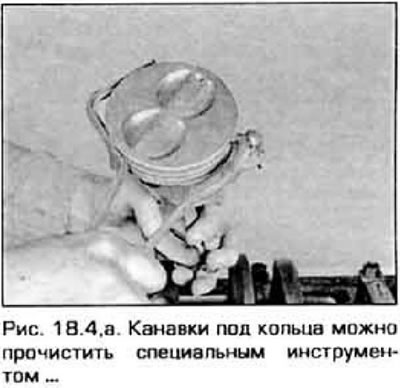
4. Clean the grooves under the ring with a special tool (figure 18.4,a) or a fragment of an old…

5. After removing the carbon deposits, wash the pistons and connecting rods with solvent and dry them, if possible, with compressed air. Don't forget to clean the oil holes in the piston grooves and in the connecting rods.


6. If traces of uniform, slight wear are observed on the more heavily loaded tank surface of the piston, and the compression ring in the upper groove has a slight play, this condition of the piston is considered normal and there is no need to replace the piston (if the cylinder has not been bored). However, the piston rings should be replaced in any case.

7. Carefully inspect each piston for cracks in the skirt, bosses and between the grooves.

8. Inspect the piston walls for scuffs and deep scratches, and the bottom for burns and scorch marks. If there are scuffs on the piston skirt, this may be the result of engine overheating due to a faulty cooling system or a violation of the composition of the working mixture. Check the cooling and lubrication systems. Burnout of the piston crown is usually a result of incorrect ignition timing. Bottom burns usually occur during detonation. If defects of this kind are discovered during inspection, the causes that caused them must be eliminated, otherwise they will recur. The causes may be intake manifold leaks, incorrect mixture composition, incorrect ignition timing, or malfunctions in the exhaust gas recirculation system.

9. Piston corrosion, manifested as fine pitting, may be the result of coolant leaks into the combustion chamber or crankcase. In this case, the cause must also be eliminated. otherwise the defect will appear again.

10. Measure the gaps between the rings and the groove walls. To do this, insert the ring into the groove from the side and use a flat feeler gauge (figure 18.10). Check the clearance in three or four places in the groove. Don't mix up the rings - they have different thicknesses. If the gap exceeds the permissible level specified in Technical data, the piston should be replaced.
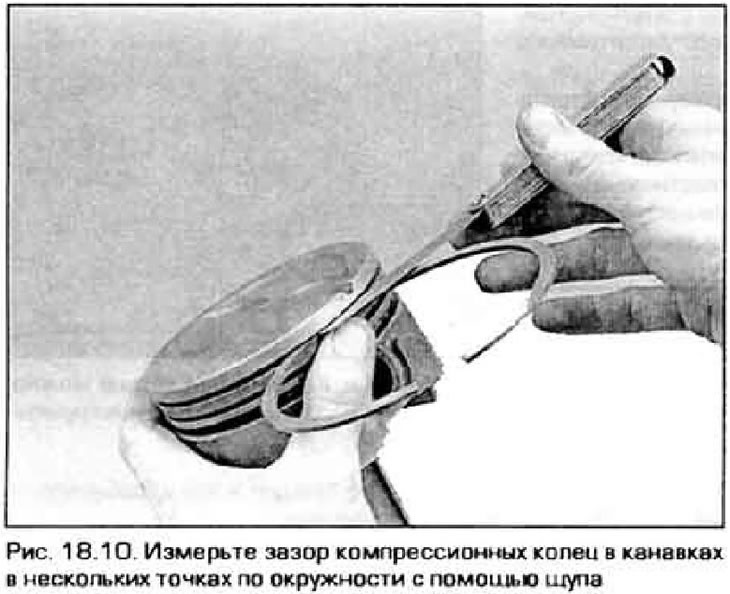


10. Measure the gaps between the rings and the groove walls. To do this, insert the ring into the…


11. Check the clearances between the pistons and cylinders. To do this, measure the inner diameters of the cylinders (see paragraph 16) and the outer diameters of the pistons. Measure the piston diameter on the skirt in a direction perpendicular to the axis of the piston pin (figure 18.11). Calculate the clearance as the difference between the diameters of the cylinder and piston. If the clearance exceeds the permissible value, it is necessary to ream the cylinders and use pistons of the next repair size.
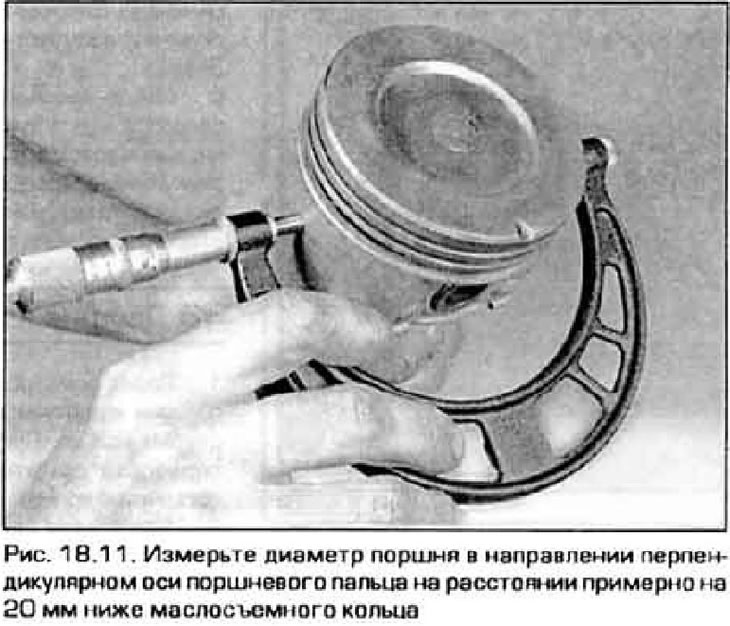
11. Check the clearances between the pistons and cylinders. To do this, measure the inner diameters…


12. Check the clearance in the connection between the upper connecting rod head and the pin. trying to swing the connecting rod relative to the pin. Noticeable play indicates increased wear that should be eliminated.


13. If for some reason it is necessary to separate the connecting rods from the pistons, it is better to do this at a service station or workshop. There you can also check whether there are any deviations in the shape of the connecting rods.

14. Measure the length of the connecting rod lower head bolts from the bottom surface of the head to the end of the thread. On 4-cylinder engines, the bolt length should not exceed 46 mm, and on V-engines, 48 mm. If the bolt length exceeds these values, it means the bolts have stretched during operation and should be replaced. If even one bolt is found to be defective, replace the entire bolt set.

15. Inspect the connecting rods for cracks and other defects. Temporarily remove the lower head covers, remove the old bearings, wipe the bearing surfaces with a clean cloth and inspect them for dents, cracks or burrs. After inspection, reinsert the old liners, install the covers and tighten the mounting nuts by hand.
This article is available at: russian, bulgarian, belarusian, ukrainian, serbian, croatian, romanian, polish, slovak, hungarian
This text was checked by: German Vorobyov
Share with friends on social networks:

Previous
Capella 6 » Engine overhaul
Next

Cylinder honing
Cylinder block — inspection
Cylinder block — cleaning
Crankshaft — removal
Pistons and connecting rods — removal
Crankshaft — inspection
Main and connecting rod bearings — inspection and selection of liners
Camshafts and tappets — inspection
Engine repair — assembly procedure
Piston rings — installation
More articles on repairing other Mazda models
Disconnecting and connecting cable plugs Mazda Familia 6 (1989-1994)
Connecting rod and connecting rod bearing — description Mazda3 BK (2003-2009)
Connecting rod and connecting rod bearing Mazda6 GG (2002-2008)
Checking the connecting rods of the cylinder block Mazda CX-5KE (2012-2017)
Connecting rods and pistons Mazda BT-50 (1) (2006-2011)
Link in different formats to this article
Comments and feedback from visitors
No comments yet


How much will 23 + 21 ?


Capella 6 (1997-2005, petrol) 
  • General information
  • Introduction to guide
  • User manual
  • Troubleshooting
  • Maintenance
  • Power unit
  • 4-cylinder engines
  • 6-cylinder engines
  • Engine overhaul
  • Cooling and ventilation
  • Power and exhaust systems
  • Engine electrics
  • Control system
  • Transmission
  • Mechanical gearbox
  • Automatic gearbox
  • Clutch and drive shafts
  • Chassis
  • Brake system
  • Car suspension
  • Steering
  • Body
  • Exterior (external elements)
  • Interior (internal elements)
  • Doors, windows and locks
  • Electrical equipment
  • Equipment and devices
  • Electrical circuits
Capella 5 (1991-1997) 
  • General information
  • User manual
  • Maintenance
  • Helpful hints
  • Power unit
  • Petrol engines 1.6 and 1.8
  • Petrol engines 2.0
  • 2.5 petrol engines
  • Overhaul engines 1.6 and 1.8
  • Overhaul engines 2.0 and 2.5
  • Diesel engine 2.0
  • Engine electrics
  • Cooling system
  • Air conditioner
  • Carburetor Nikki 30/34
  • Power system (1.6 and 1.8)
  • Power system (2.0 and 2.5)
  • Control system
  • Transmission
  • Mechanical gearbox
  • Automatic gearbox
  • Clutch and axles
  • Chassis
  • Brake system
  • Suspension and wheels
  • Steering
  • Body
  • Exterior (external elements)
  • Interior (internal elements)
  • Doors and windows
  • Electrical equipment
  • Equipment and devices
  • Electrical circuits
Capella 4 (1987-1992) 
  • General information
  • Introduction to manual
  • Vehicle specifications
  • Power unit
  • Engine repair
  • Lubrication system
  • Cooling system
  • Fuel system (carburetor)
  • Fuel injection (FE)
  • Fuel injection (DOHC)
  • Fuel system (diesel)
  • Ignition system
  • Transmission
  • Clutch
  • Gearbox
  • Drive shafts
  • Chassis
  • Front suspension
  • Rear suspension
  • Steering system
  • Brake system
  • Electrical equipment
  • Equipment and devices
  • Electrical circuits
Capella 3 and 4 (1982-1992) 
  • General information
  • User manual
  • Maintenance
  • Power unit
  • Gasoline engine
  • Engine overhaul (gasoline)
  • Diesel engine
  • Cooling and heating
  • Supply system
  • Ignition system
  • Emission reduction
  • Transmission
  • Clutch
  • Mechanical gearbox
  • Automatic gearbox
  • Drive shafts
  • Chassis
  • Brake system
  • Suspension and wheels
  • Steering
  • Body
  • Exterior (external elements)
  • Interior (internal elements)
  • Electrical equipment
  • Equipment and devices
  • Power devices
  • Electrical circuits
Capella 3 (1982-1992, petrol) 
  • General information
  • User manual
  • Maintenance
  • Troubleshooting
  • Late models
  • Power unit
  • Engine in car
  • Engine overhaul
  • Cooling and heating system
  • Fuel and exhaust system
  • Engine electrical system
  • Emission control system
  • Transmission
  • Mechanical gearbox
  • Automatic gearbox
  • Clutch and drive shafts
  • Chassis
  • Brake system
  • Suspension and wheels
  • Steering
  • Body
  • Exterior (external elements)
  • Interior (internal elements)
  • Electrical equipment
  • Equipment and devices
  • Lighting and lamps
  • Electrical circuits
MazBook.ru © 2018–2026 · Mobile version · Articles and news · Sitemap: EN BG BY UA RS HR RO PL SK HU · Feedback · Site search · Add to bookmarks Familia 5 (BF) · Familia 6 (BG) · Capella 3 (GC) · Capella 3 and 4 (GC) · Capella 4 (GD) · Capella 5 (GE) · Capella 6 (GF) · Mazda3 BK · Mazda6 GG · CX-5KE · Mazda 121 (3) · Mazda BT-50 (1) ·
By continuing to use the site, you agree to the use of cookies 🔐