


2. Install the block with the main bearings facing up.
3. Loosen the bolts and remove the main bearing caps or lower crankcase (v6 engines): Lay out the lids in the order they will be installed.
4. If the old liners are still in place, remove them. Wipe the surfaces under the inserts in the block and in the covers with a clean, lint-free cloth. Surfaces must be sterile clean!
Checking clearances in main bearings
5. Wipe the outer surfaces of the new bearings and place the bearings with the oil holes in the block bed. Place the second halves of the kits into the covers of the corresponding supports or into the lower crankcase (v6 engines). Then make sure that the protrusion of each insert fits into the slot intended for it. In addition, the oil holes in the block supports and in the liners must match.
Caution! Do not force the insert into place if it does not fit. Do not rub or scratch the surfaces of the liners. Do not use any lubricant at this stage.
6. On all engines, thrust bearings are installed in support No. 4, counting from the toothed belt
7. Wipe the inner surfaces of the bearings in the block and the crankshaft journals with a clean, lint-free cloth. Check the crankshaft oil holes for dirt and clean them if necessary, as dirt will immediately get onto the surfaces of the new bearings.
8. Carefully lower the crankshaft into the supports.
9. Before final installation of the shaft, it is necessary to check the clearances in the main bearings.
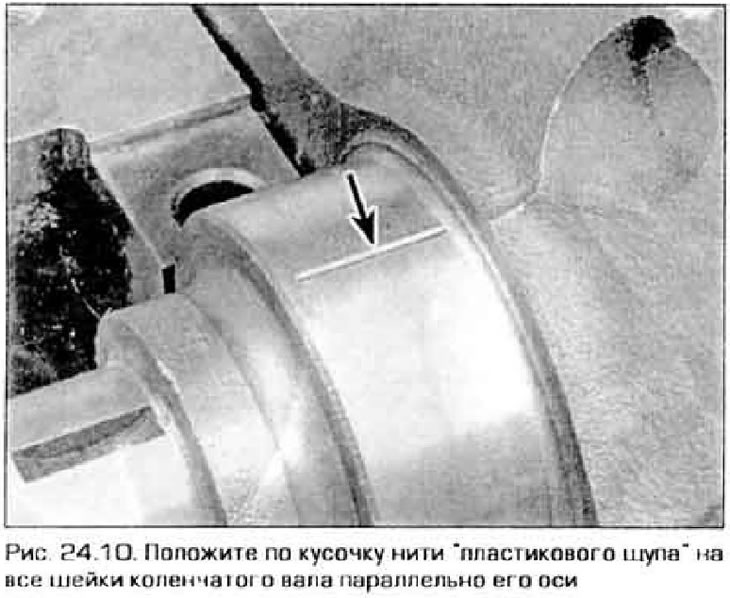
10. Cut off several pieces of "plastic feeler gauge" (they should be slightly shorter than the width of the liners) and place them one by one on each main journal along the shaft axis (figure 24.10).
11. Wipe the surfaces of the bearing cap liners and install the caps in their places with the arrow pointing forward. On a V6 model, place the lower crankcase on the crankshaft. Do not move the "plastic feeler gauges." Lubricate the threads and undersides of the cover bolt heads and reinsert the bolts.
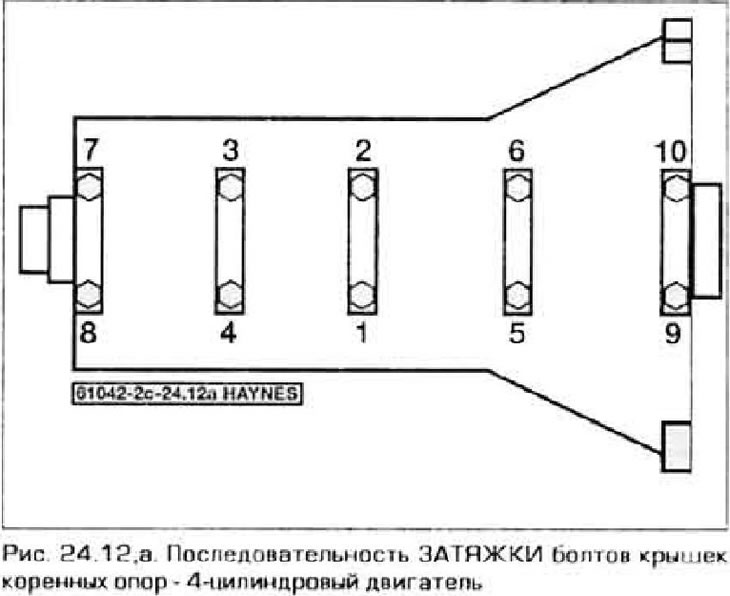
12. Tighten the bolts in the sequence shown in the figure 24.12, and in three stages until the tightening force specified in Technical data this chapter. Rotate the crankshaft during this operation!
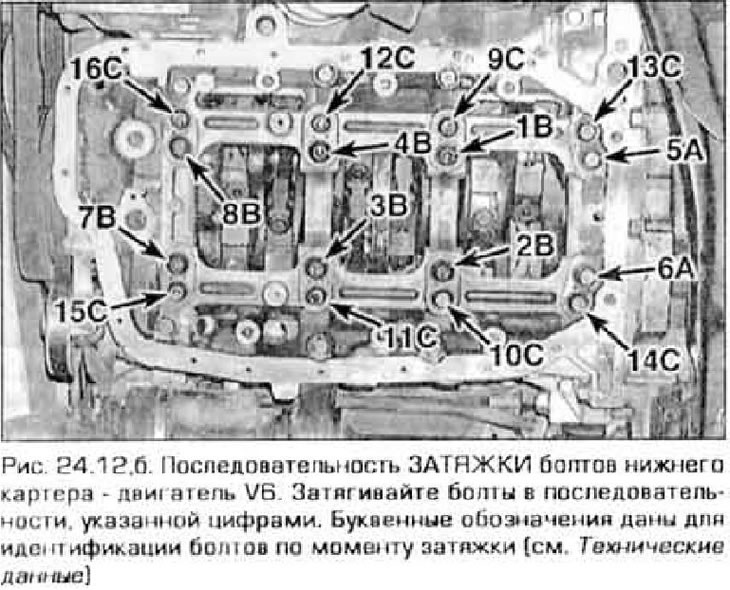
Note: On V6 engines, the lower crankcase mounting bolts have markings on the heads. Bolts "A" (figure 24.12,b) are marked "4", "B" bolts are marked "1", and "C" bolts have no markings. After tightening the 16 bolts holding the crankshaft, tighten the bolts around the perimeter of the crankcase from its center to the edges.
13. Loosen the bolts and carefully remove the covers or lower crankcase. Place the lids against the corresponding supports. Do not move the plastic or rotate the crankshaft. If any cover does not come off by hand, gently tap it from the side with a soft-faced hammer.
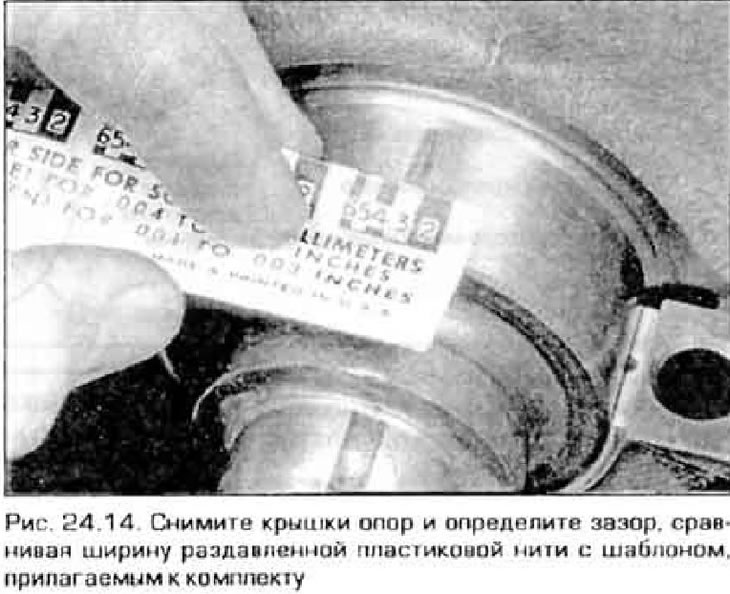
14. Compare the width of the flattened plastic rod with the template and read the gap value from it (figure 24.14). Compare the obtained values with Technical data.
15. If the clearance does not match the recommended one, it may mean that the bearings are of the wrong size (in this case they need to be changed). Before deciding to replace the bearings, make sure that no dirt or oil has entered between the bearings and the bores in the block or bearing caps during measurement. If the "plastic feeler gauge" is noticeably wider on one side than the other, this means that the shaft journal is tapered (see paragraph 19).
16. Carefully remove any remaining plastic from the necks or liners. Do not scratch the bearing surfaces.
Final installation of the crankshaft
17. Carefully remove the crankshaft from the supports. Wipe the bearing surfaces in the block and lubricate them with a thin layer of molybdenum grease or special engine assembly grease. Also lubricate the working surfaces of the thrust bearings (Don't forget to install them).
18. Lubricate the crankshaft journals under the seals with clean engine oil.
19. Wipe the shaft journals again and place it in the supports. Wipe and lubricate the bearing surfaces in the covers or in the lower crankcase.
20. Upper thrust bearings (from the block side) can be installed in the working position. turning them relative to the installed crankshaft (fig. 24.20, a, b). Insert the liners into the fourth support, arranging them with the oil grooves facing away from the support. The upper liners must be installed in the support caps (or into the lower crankcase) also with the grooves OUTWARDS and align the mounting protrusions with the corresponding cutouts in the covers.
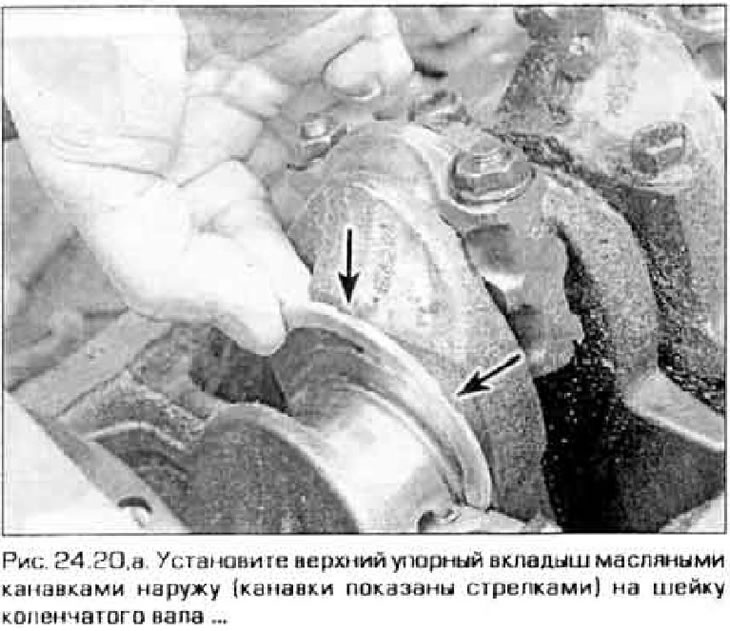
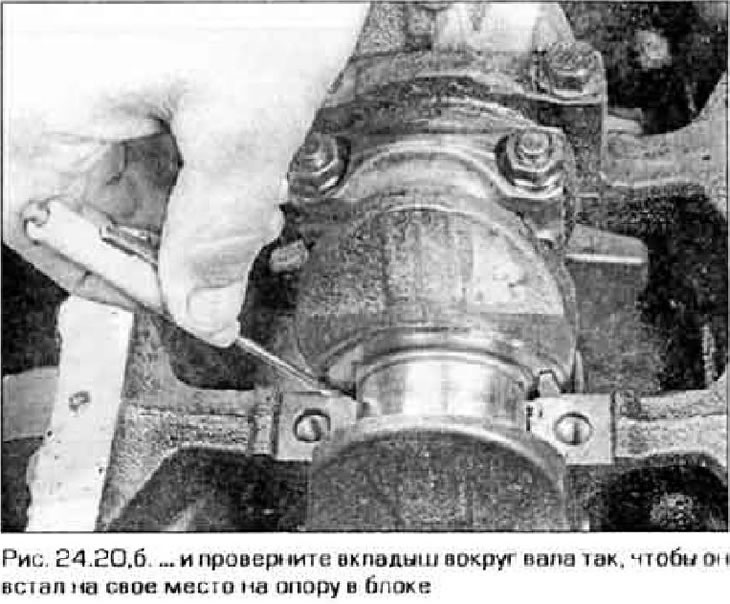
21. On a 4-cylinder engine, install the main bearing caps in their original positions with the arrow pointing forward. Lubricate the threads and bases of the bolt heads and insert them into place. Tighten the bolts in the recommended sequence (see Figure 24.12,a) in several steps, as indicated in Technical data.
22. On a V6 engine, apply a bead of RTV sealant to the surface of the lower crankcase that mated with the upper block. Install the lower crankcase in place. Lubricate the threads and bases of the heads of the crankcase-to-block bolts, screw them in and tighten them in the sequence shown in the figure 24.12,b (see also paragraph 12). The crankcase must be installed no later than 5 minutes after applying the sealant.
23. On a model with a manual transmission, insert the pilot bearing into the crankshaft end (see chapter 8).
24. Turn the shaft several times by hand to make sure it is not pinched.
25. Check the axial play of the shaft using a dial indicator or feeler gauges (see paragraph 14).
26. Install the new rear cuff and screw its housing to the block (see paragraph 25).